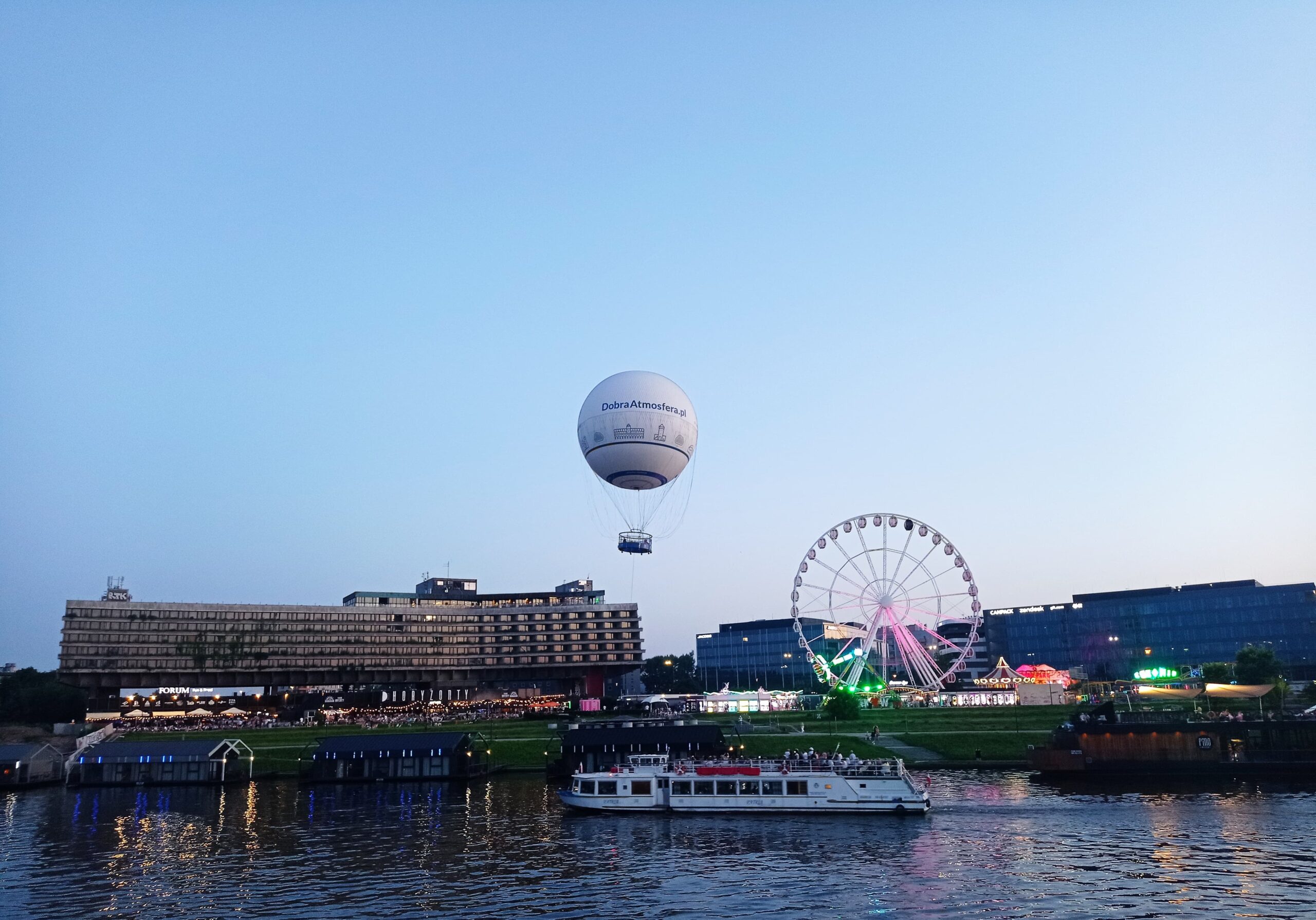
There is a moment when Kraków looks completely different.
It happens when the city begins to fall away beneath you.
The streets become narrow lines. The people moving through the squares become tiny figures. Cars disappear into the distance, and the familiar buildings of the Old Town begin to look almost like a model set carefully beneath the morning sky. Wawel Castle rises from the city like a miniature fortress, the towers of St Mary’s Basilica mark the centre of the historic landscape, and the Vistula bends through Kraków like a silver ribbon.
Then you realise that you are no longer looking at Kraków from the street.
You are above it.
A hot air balloon ride is one of the more unusual ways to experience the city, and for travellers who have already explored Kraków on foot, by bicycle or from the deck of a river boat, it offers something completely different. There is no traffic, no crowded pavement and no glass window between you and the landscape. The basket rises quietly, carried by the wind, giving you time to take in the city from a perspective that most visitors never see.
And that silence is perhaps the most surprising part.
Kraków Looks Smaller From Above
From ground level, Kraków can feel like a large and complicated city. The Old Town leads into Kazimierz, Kazimierz gives way to Podgórze, and beyond the historic centre the urban landscape continues through neighbourhoods that most visitors never have time to explore.
From a hot air balloon, the relationship between these places becomes much easier to understand.
The Vistula provides a natural line through the landscape. Wawel sits prominently beside the river, while the dense roofs of the historic centre stretch away from it. Beyond the Old Town, modern neighbourhoods gradually replace the historic architecture, creating a patchwork of old and new Kraków.
It is the sort of view that makes you pause.
You may have walked past Wawel Castle several times during your trip. You may have photographed it from the river or stood beneath its walls. But seeing the entire hill, the river and the surrounding city together changes your understanding of the place.
The castle is no longer simply an attraction.
It becomes part of Kraków’s landscape.
The Experience Begins Before You Leave the Ground
A balloon flight does not begin with a dramatic countdown.
There is no roar of engines and no sudden acceleration.
Instead, there is preparation.
The enormous envelope of the balloon is gradually inflated, spreading across the ground before slowly taking shape. The burners roar intermittently overhead, filling the balloon with hot air and giving the aircraft its lift.
For many passengers, this is already one of the most memorable parts of the experience.
A hot air balloon is surprisingly enormous when you stand beside it.
What initially looks like a colourful piece of fabric lying across a field or launch area gradually becomes a towering structure above you. The basket waits beneath it, and suddenly the reality of what you are about to do becomes clear.
You are going to fly.
But not in the way you normally think of flying.
There is no airport.
No runway.
No engine pulling you forward.
Just heated air, a basket and the wind.
The Take-Off Is Almost Effortless
When the balloon finally leaves the ground, the sensation can be surprisingly gentle.
There is no steep climb.
No dramatic jolt.
The basket simply begins to rise.
For a few seconds, the ground is still close enough to recognise individual details. Then the rooftops become smaller. Trees form patterns. Roads begin to connect into larger shapes.
The city gradually opens.
Because the balloon moves relatively slowly, there is time to look.
That is one of the greatest advantages of this kind of flight.
From an aeroplane, landscapes disappear beneath you in seconds. From a balloon, the scenery changes at a pace that allows you to study it.
You can look towards the Old Town.
Then turn towards the river.
Then back towards the countryside beyond the city.
There is no rush.
Look for Wawel
If the conditions are right, one of the first things you will want to find is Wawel.
From above, the royal castle has a completely different presence.
The buildings appear compact within the larger landscape, but the hill itself becomes particularly clear. You can see how the royal complex occupies its elevated position beside the Vistula and how the surrounding city developed around it.
Wawel has dominated Kraków’s skyline for centuries.
Kings lived there.
Important ceremonies took place there.
The cathedral became the burial place of Polish monarchs and national figures.
From street level, all of this history can feel monumental.
From the air, you can see the geography that helped make Wawel so important.
The hill stands above the river, offering both visibility and protection, while the city stretches around it.
It is one of those moments when geography and history suddenly make sense together.
The Vistula Becomes the Main Character
From above, the Vistula may be even more impressive than the city’s architecture.
The river curves through Kraków, separating neighbourhoods while connecting them at the same time. Along its banks, parks and walking paths create long green corridors, while bridges link the two sides of the city.
From the ground, you notice individual sections.
From the balloon, you see the whole.
The river becomes a map.
It also helps explain why Kraków developed where it did. Cities are rarely placed randomly, and rivers have shaped settlement, trade, defence and transportation for centuries.
As you float above the landscape, the Vistula provides a reminder that Kraków existed long before its modern roads and buildings.
The river was here first.
A Different View of the Old Town
The historic centre is perhaps the part of Kraków most familiar to visitors.
Rynek Główny.
St Mary’s Basilica.
The Cloth Hall.
The narrow streets.
The towers.
But from above, these famous landmarks lose some of their individual importance and become part of a much larger composition.
The Old Town’s compact layout becomes visible.
You can see how the streets radiate around the Main Market Square and how the green belt of Planty surrounds the historic centre.
Planty is particularly beautiful from above.
What appears from street level to be a collection of separate parks and tree-lined paths becomes a continuous green ring around the Old Town.
The medieval city was once surrounded by defensive walls.
Today, much of that boundary has become one of Kraków’s most pleasant public spaces.
From the sky, the shape is unmistakable.
You May See More Than Kraków
One of the pleasures of a balloon flight is that you do not always know exactly what will appear in the distance.
Visibility and weather determine how far you can see, but on a clear day the landscape extends well beyond Kraków.
The hills and countryside surrounding the city begin to reveal themselves, and depending on conditions, distant mountain ranges may become visible.
This is when Kraków starts to feel less like an isolated destination and more like part of the larger landscape of southern Poland.
The city sits within Małopolska, a region of forests, farmland, hills, villages and mountain landscapes. From the ground, it is easy to focus entirely on the urban environment.
From above, the countryside returns to the picture.
Sunrise Can Make the Experience Even More Special
If your flight takes place early in the morning, the experience can become particularly atmospheric.
The light is softer.
The streets are quieter.
The city has not yet reached its daytime rhythm.
Morning mist can sometimes linger over the river or surrounding landscape, depending on the weather, while the first sunlight catches the roofs and towers of the Old Town.
There is something almost dreamlike about watching a city wake up from a balloon.
Below you, Kraków begins another ordinary day.
People walk to work.
Cars appear on the roads.
Cafés prepare to open.
But from your position high above the city, everything seems calm.
It is one of those travel experiences that does not need much explanation.
You simply look.
Is a Hot Air Balloon Ride Safe?
For anyone considering a balloon flight, safety is naturally one of the first questions.
Hot air ballooning is an aviation activity and should always be undertaken with a properly licensed and experienced operator using appropriate equipment and procedures. Flights are highly dependent on weather, particularly wind conditions, and pilots may postpone or cancel a flight when conditions are unsuitable.
That can be frustrating if you have planned the experience around a particular day.
But it is also part of ballooning.
The weather decides.
Unlike a sightseeing bus, a balloon cannot simply follow a fixed route regardless of conditions. The flight depends on the atmosphere, and the pilot needs suitable conditions to operate safely.
For that reason, it is wise to keep some flexibility in your itinerary if a balloon ride is one of the experiences you particularly want to enjoy.
What Should You Wear?
The temptation might be to dress as though you are going on a normal sightseeing flight.
Think instead about the conditions on the ground.
Comfortable clothing and sensible shoes are important because the experience may involve walking around the launch and landing areas. You should also be prepared for the possibility of standing in the basket for much of the flight.
The temperature in the basket is not necessarily dramatically colder than on the ground because the balloon’s burner produces heat above the passengers. Nevertheless, early-morning flights can begin in cool conditions, so layers are a sensible choice.
And leave the high heels for another evening.
This is an adventure, not a red-carpet arrival.
The Landing Is Part of the Adventure
Eventually, the city begins to rise towards you again.
The balloon descends gradually, and the landscape that looked distant suddenly becomes detailed once more. Trees become individual trees. Roads become roads. Buildings regain their familiar proportions.
The landing can be exciting.
Unlike a commercial aircraft, a balloon does not simply stop at a fixed runway. The pilot chooses a suitable landing area based on the conditions and controls the descent carefully.
Sometimes the basket touches the ground gently.
Sometimes there may be a little movement as it settles.
Either way, passengers often find themselves laughing once it is over.
There is something satisfying about returning to earth after seeing the city from above.
You have not simply looked at Kraków.
For a short time, you have floated above it.
The Best Part May Be What Happens Afterwards
One of the nicest things about a balloon flight is what happens when you return to the city.
Suddenly, familiar places look different.
You walk past Wawel and remember how small it looked from above.
You cross the Vistula and understand its curves.
You walk through Planty and realise that the trees beneath your feet form part of a much larger ring around the Old Town.
You stand in the Main Market Square and look upwards.
The city has not changed.
You have.
That is what good travel experiences do.
They give you a new way of seeing somewhere you thought you already understood.
Is a Hot Air Balloon Ride in Kraków Worth It?
For travellers who want something beyond Kraków’s traditional sightseeing circuit, a hot air balloon ride can be an unforgettable addition to the trip.
It is not the cheapest way to see the city, and it is certainly not necessary for enjoying Kraków. You can explore the Old Town on foot, see Wawel from the river and admire the skyline from countless viewpoints without ever leaving the ground.
But the balloon offers something none of those experiences can provide.
Perspective.
From the basket, Kraków stops being a collection of attractions and becomes a landscape.
The castle, churches, river, streets, parks and neighbourhoods all belong to one city, and from above you can finally see how they fit together.
There are many ways to discover Kraków.
You can follow its royal history through Wawel.
You can explore its Jewish heritage in Kazimierz.
You can eat your way through its restaurants and markets.
Or you can rise quietly into the sky and watch the whole city unfold beneath you.
For a place as beautiful and layered as Kraków, sometimes the best way to understand it is to step away from the streets for a while.
And look down.
Leave a Reply