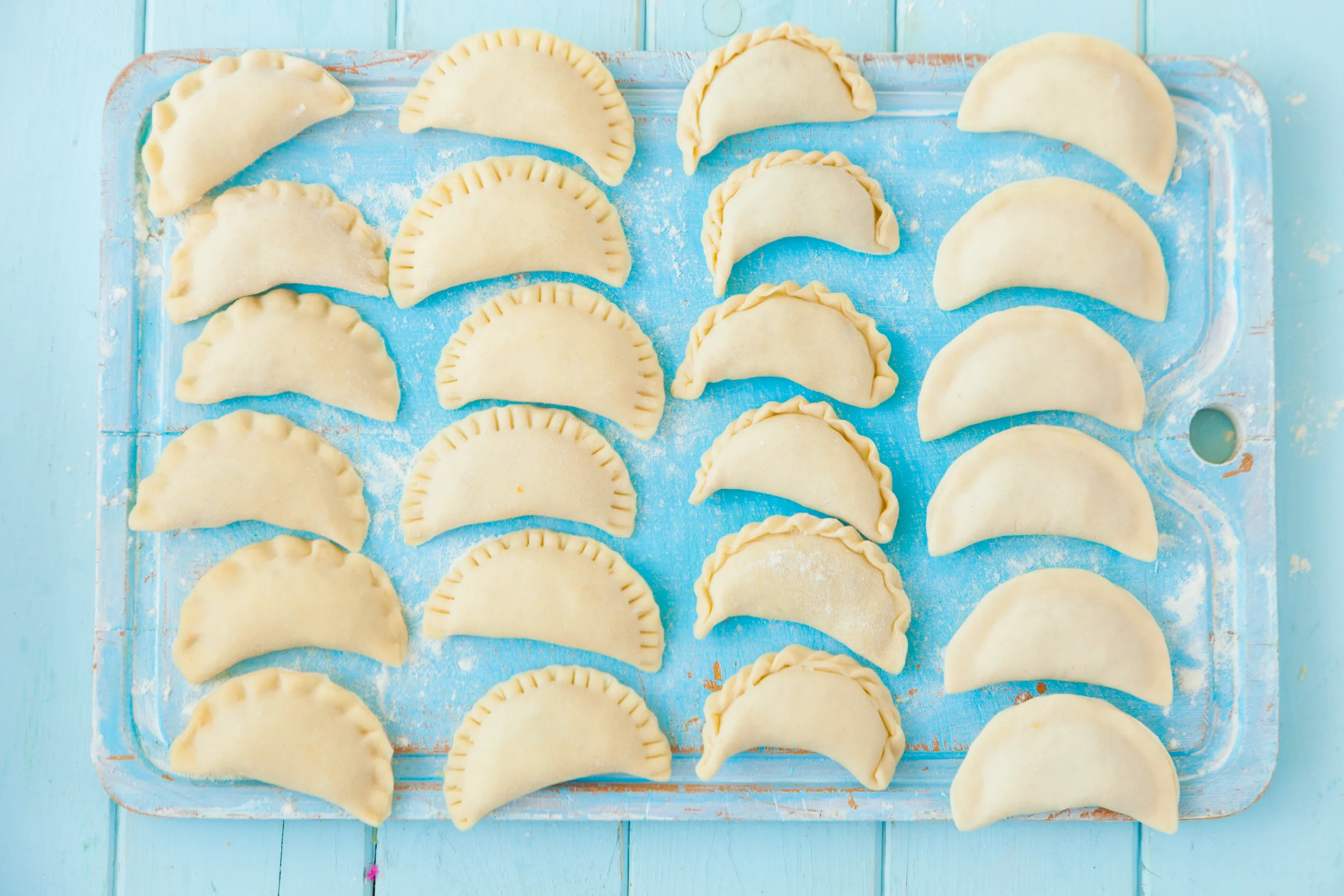
No everyday dish represents Polish cuisine better than pierogi. These Polish dumplings can be made at home, served in a bar mleczny (milk bar), or even found on the menu of a Michelin-starred restaurant, they are simply one of the most famous dishes you have to try when you visit Poland.
Pierogi come with a variety of savory and sweet fillings, including potato and cheese (shown below), sauerkraut, cabbage, seasoned meats, and even fruits and berries.
Here, I share the techniques and step-by-step instructions to authentically make these dumplings, as well as the finished result.
Roll up your sleeves and join us at at a local restaurant in the city center, right next to the Old Town, for a hands-on pierogi adventure! Learn to make dough from scratch and fill your pierogi with two tasty fillings.
Our local pierogi expert will guide you every step of the way, sharing family secrets passed down through generations, and making sure you master the technique without going hungry – because we’ll eat the pierogi we make together! To make the process even more fun, there’ll be wine or beer to sip while you roll and fill your pierogi.
Pierogi-making is a cherished family tradition and an essential part of Polish culture – there’s truly no better way to spend time in Poland. Whether you’re a kitchen novice or a budding chef, you’ll leave confident in your skills, full of tasty pierogi, and with stories to take home.We can’t wait to welcome you!
Few foods are as closely associated with Poland as pierogi. Ask someone who has never visited the country to name a Polish dish, and there is a good chance these small, folded dumplings will be among the first answers. They have become one of Poland’s best-known culinary exports, appearing on restaurant menus around the world, but their true character is best understood at home, where pierogi are still closely connected with family, celebration and the simple pleasure of preparing food together.
In Poland, pierogi are much more than something to order in a restaurant.
They belong to the rhythm of everyday cooking and to some of the country’s most important family traditions. They can be filled with potatoes and cheese, sauerkraut and mushrooms, meat or seasonal fruit. They can be served as a savoury lunch, a comforting dinner or a sweet dish. Some are boiled and served with melted butter, others are fried afterwards until their edges become golden and crisp. At Christmas, during family gatherings and on ordinary weekends, pierogi can bring several generations together around the same kitchen table.
And although they may look complicated when you first see a plate piled high with perfectly shaped dumplings, making them at home is much less intimidating than it appears.
The secret is not some mysterious Polish technique.
It is patience.
The story behind Poland’s favourite dumpling
Pierogi have a long and complicated history, and their exact origins are the subject of discussion among food historians. Similar filled dumplings exist in many parts of Europe and Asia, and the Polish tradition developed through centuries of cultural exchange. What is certain is that pierogi became deeply rooted in Polish cuisine and eventually developed into one of the country’s defining dishes.
That history is reflected in the enormous variety of fillings found across Poland.
There is no single pierogi recipe that represents the entire country.
In some homes, the classic filling is a mixture of potatoes, farmer’s cheese and fried onion. These are the famous pierogi ruskie, despite their name, which refers historically to Ruthenian regions rather than modern Russia. In other kitchens, sauerkraut and mushrooms are favourites, particularly during the Christmas season. Meat-filled versions are popular as well, while summer brings sweet pierogi filled with strawberries, blueberries, cherries or other seasonal fruit.
The dough, however, is the common thread.
It is simple, inexpensive and remarkably forgiving.
What you need
For approximately 35–40 pierogi, you will need:
For the dough:
- 500 g plain flour
- 250–300 ml warm water
- 1 egg
- 1 tablespoon vegetable oil or melted butter
- ½ teaspoon salt
For a classic potato-and-cheese filling:
- 500 g potatoes
- 250 g farmer’s cheese or well-drained cottage cheese
- 1 medium onion
- 1–2 tablespoons butter or oil
- Salt and freshly ground black pepper
You can adjust the filling according to taste. Some people prefer more cheese, others more potato, while fried onion can be made more generous for a deeper flavour.
The important thing is to keep the filling relatively dry. A wet filling can make the dough difficult to seal and may cause the pierogi to open during cooking.
Making the dough
Start by placing the flour in a large bowl and adding the salt. Make a well in the centre and add the egg, followed by the oil or melted butter.
Begin adding the warm water gradually while mixing. Do not pour all of it in at once because the amount of water required can vary depending on the flour. Stir until the mixture begins to form a dough, then transfer it to a lightly floured surface.
Now comes the part that cannot really be rushed.
Knead the dough for several minutes until it becomes smooth and elastic. At first it may feel slightly rough, but as you continue working it, the texture should become soft and supple. If it feels excessively sticky, add a little more flour. If it seems dry and difficult to knead, add a small amount of water.
The finished dough should feel soft without sticking heavily to your hands.
Cover it with a clean cloth or place it in a bowl covered with a plate or plastic wrap and allow it to rest for about 20–30 minutes.
This resting period is important.
The dough needs time to relax. If you roll it immediately, it may spring back and become difficult to work with. After resting, it should be noticeably easier to roll thinly.
Preparing the filling
While the dough rests, prepare the filling.
Peel the potatoes and cut them into evenly sized pieces. Place them in salted water and cook until completely tender. Drain them well and allow the steam to escape for a few minutes.
Meanwhile, finely chop the onion.
Heat the butter or oil in a frying pan and cook the onion slowly until it becomes soft and golden. Do not rush this stage. Properly caramelised onion gives the filling much of its characteristic flavour.
Mash the potatoes while they are still warm, then combine them with the farmer’s cheese and fried onion. Season generously with salt and black pepper.
The filling should be creamy but firm enough to hold its shape.
Taste it.
This is one of the advantages of making pierogi at home: the filling can be adjusted before it ever reaches the dough. If it needs more salt, add it. If you want more pepper or onion, this is the moment.
Allow the filling to cool before assembling the dumplings.
Rolling the dough
Divide the rested dough into two or three portions, keeping the pieces you are not using covered so they do not dry out.
Roll one portion on a lightly floured surface until it is thin — roughly 2 mm is a good guide. It should be thin enough that the finished pierogi are delicate, but not so thin that the filling can break through.
Using a round cutter or an upside-down glass, cut circles from the dough.
Place the circles on the work surface and keep any unused dough covered.
Now comes the moment when pierogi begin to look like pierogi.
Filling and folding
Place a small spoonful of filling in the centre of each dough circle. Resist the temptation to overfill them. A generous amount may look appealing, but too much filling makes the edges difficult to seal.
Dip your finger in a little water and run it around the edge of the dough.
Fold the circle in half over the filling.
Press the edges together firmly with your fingers, making sure there is no filling trapped in the seam. You should end up with a small crescent-shaped dumpling.
This is where Polish kitchens often become workshops.
Once the basic technique is mastered, people develop their own ways of sealing and decorating the edges. Some use their fingers to create a simple pattern; others make neat pleats along the seam. The appearance does not need to be perfect. In fact, slightly irregular homemade pierogi often look more inviting than identical restaurant dumplings.
The important thing is that they are properly sealed.
Place the finished pierogi on a lightly floured tray and continue until all the dough and filling have been used.
Cooking the pierogi
Bring a large pot of salted water to a gentle boil.
Do not overcrowd the pot. Depending on its size, cook the pierogi in batches.
Carefully place them into the water and stir gently once or twice so that they do not stick to the bottom.
At first, the dumplings will sink.
Then, gradually, they will rise towards the surface.
Once they float, allow them to cook for another two to three minutes, depending on the thickness of the dough. Remove them with a slotted spoon and drain well.
At this stage, you already have traditional boiled pierogi.
But there is another step that many Polish cooks consider essential.
The golden finish
Heat a frying pan and add a little butter.
Place the cooked pierogi into the pan and fry them gently until the outside becomes golden brown. The edges should develop a light crispness while the inside remains soft and comforting.
Add the remaining fried onions if you have some.
This combination — tender dough, creamy filling, sweet onion and a lightly crisp exterior — is one of the simplest expressions of Polish comfort food.
Serve the pierogi hot.
A spoonful of sour cream on the side is traditional in many households, while fresh herbs can add brightness. Some people prefer them simply with melted butter and onion.
There is no need to overcomplicate them.
Pierogi change with the seasons
One of the reasons pierogi have survived so strongly in Polish cuisine is their versatility.
In summer, sweet pierogi can become the centre of the meal. Fresh strawberries, blueberries, cherries or other seasonal fruit can be placed inside the dough, sometimes with a little sugar. Once boiled, they can be served with sour cream, yoghurt, butter or a light dusting of sugar.
In autumn and winter, savoury fillings become more common. Mushrooms, cabbage, sauerkraut and meat create richer combinations suited to colder weather.
Christmas brings some of the most important pierogi traditions of all. Many Polish families prepare pierogi filled with sauerkraut and mushrooms as part of the Christmas Eve meal, known as Wigilia. Preparing them can become a family ritual, with several generations working together to roll the dough, prepare the filling and fold hundreds of dumplings.
That is when pierogi become more than food.
They become memory.
A child learns how to seal the edges from a parent or grandparent. Someone rolls the dough. Someone else prepares the filling. Another person places the finished dumplings onto trays. The kitchen becomes crowded, flour appears on the table and conversation continues while the work gets done.
Years later, people may remember those evenings more vividly than the food itself.
The Polish art of making too many
There is one unofficial rule that seems to appear in kitchens across Poland: never make exactly enough pierogi.
Make more.
Always more.
The reason is obvious once the first batch reaches the table. People eat them quickly, then someone reaches for another. A few disappear from the plate while still warm. The leftovers can be refrigerated and fried the next day, when the dough becomes wonderfully crisp.
Pierogi are also excellent for freezing. Arrange uncooked dumplings in a single layer on a floured or parchment-lined tray and freeze them until firm before transferring them to a container or freezer bag. They can then be cooked directly from frozen, although they will need a little more time in the boiling water.
This makes pierogi particularly useful for busy households.
One afternoon of work can provide several meals.
The real secret is the kitchen table
It is easy to understand why pierogi became such an international symbol of Poland. They are visually distinctive, adaptable and comforting. But their importance to Polish culture is not really found in the dumpling itself.
It is found in what happens around it.
Pierogi are food made for sharing.
They are made in large quantities because they are often made for families. They can be prepared ahead of celebrations. They can be filled with whatever is available. They can be sweet or savoury, simple or elaborate, traditional or adapted to modern tastes.
Most importantly, they invite people into the kitchen.
And that is why making pierogi at home can be a more meaningful experience than simply ordering them in a restaurant.
The first batch may not look perfect. Some will be too large, some too small, and one or two may open in the pot. That does not matter. By the second batch, your hands will begin to understand how much filling to use and how firmly to press the edges. By the third, the process becomes almost automatic.
Soon you are no longer thinking about each step.
You are simply making pierogi.
And that is when the recipe becomes something more than instructions on a page.
It becomes a small connection to one of Poland’s oldest and most beloved food traditions — a tradition that has travelled from village kitchens to modern restaurants around the world without losing its essential character.
So if you want to bring a little Polish cooking into your own kitchen, start with flour, potatoes, cheese and onions.
Clear a space on the table.
Invite someone to help.
Make far more than you think you need.
And when the first golden pierogi arrive on the plate, serve them hot, sit down together and enjoy the result.
Because in Poland, pierogi have never been only about what is inside the dough.
They have always been about the people gathered around it.