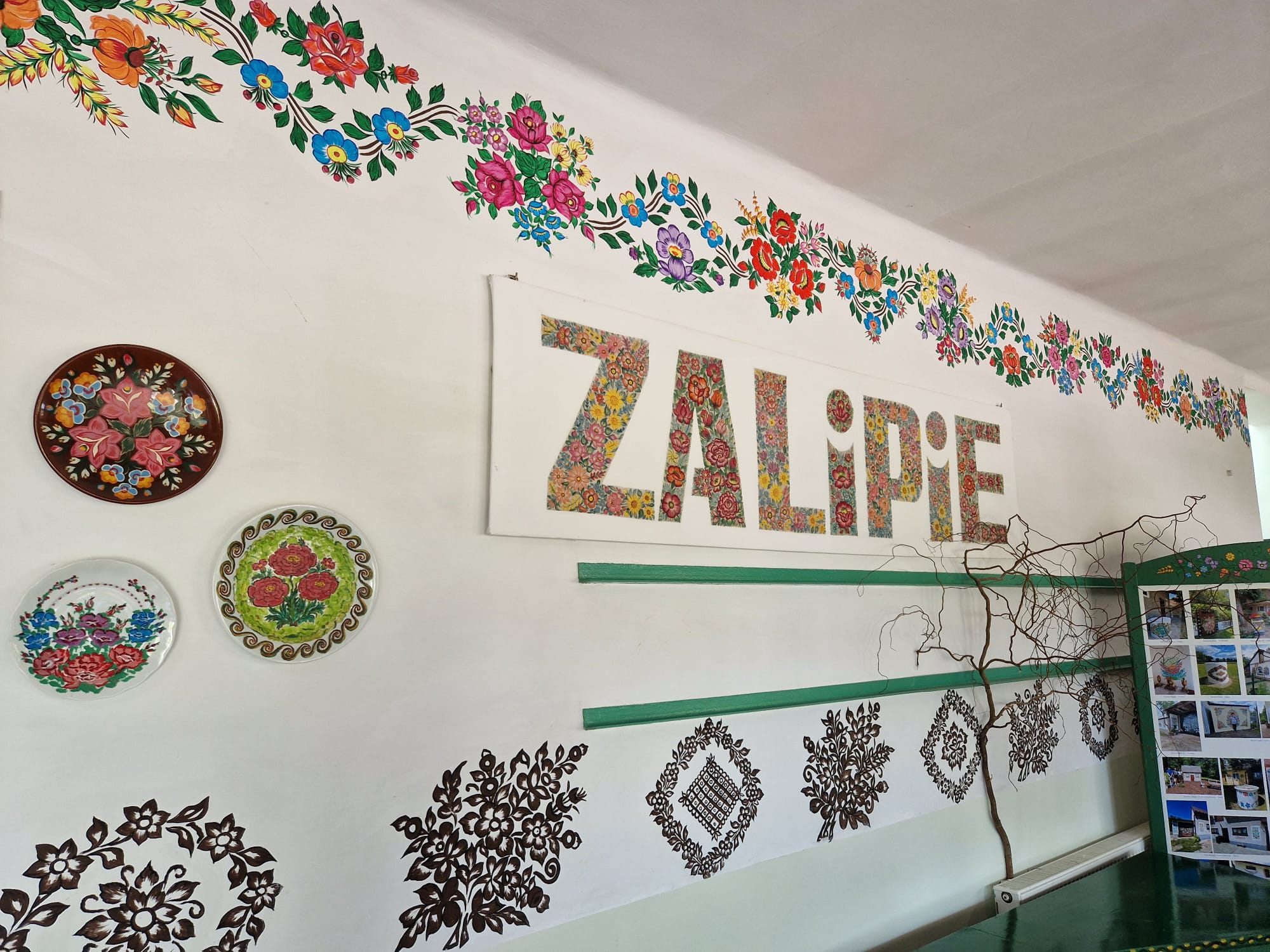
Last week, I visited a tucked-away village that is perfect for a short weekend getaway in Małopolska. Zalipie is one of the most beautiful and colorful villages in Poland.
You will be astonished to find that folk floral paintings are everywhere in the village. Not only are the houses, but also the church, barns, walls, fences, furniture, and even clothing—you name it! These colorful floral patterns have become the identity of Zalipie.
In this article, I’ll tell you the story of the woman behind these beautiful floral patterns who inspired women to preserve this tradition for generations.
This colourful village is famous for the decoration of its houses, with cheerful paintings on the walls and stoves, and crepe-paper flowers, paper-cut designs and hay spiders. A small ancient village in South-Eastern Poland, is definitely one of the country’s top tourist attractions. Not because it has five-stars hotels or massive glass buildings, but on the contrary, due to its small wooden cottages, which are painted in the most vibrant colors.
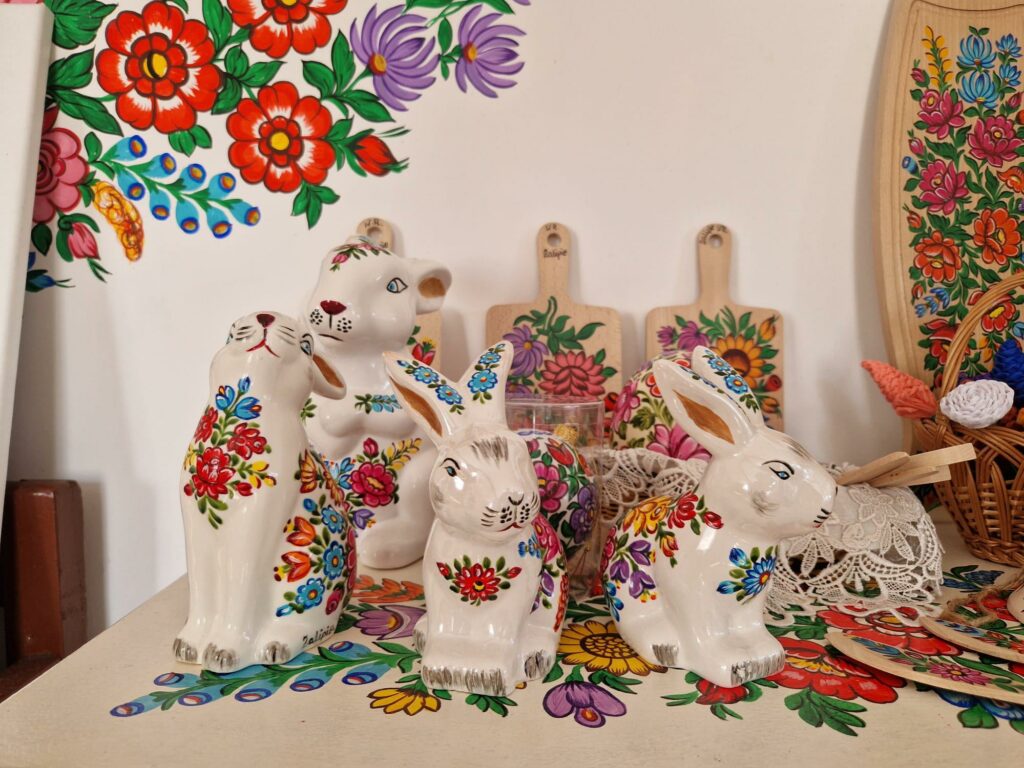
This tradition has existed in the Powiśle Dąbrowskie region since the end of the 19th century. Flowers were also painted on external walls of peasant cottages and farm buildings, on fences, wells and even kennels. In Zalipie, there are now around 20 painted houses. The best known example of this original folk artwork is the homestead of Felicia Curyłowa (currently a branch of the District Museum of Tarnów), a Zalipie painter whose painting was already known in the period between the wars.
And the perfect time to visit Zalipie is spring, as during this season, since 1948, the village hosts an important contest: the Painted Cottage competition or “Malowana Chata”. It started after the World War II ended, in the local authorities attempt to cover up the damage done the war.
Going there is not only a perfect way to escape the busy life found in large cities or towns, but also a good, relaxing manner to simply enjoy life and art. During our tour, you will get to see a number of decorated houses, a museum, and a small shop with unique hand made souvenirs.
There are villages that are beautiful because of their setting, villages surrounded by mountains or lakes, forests or dramatic coastlines. And then there is Zalipie, a small village in southern Poland whose beauty comes from something much more personal. Here, flowers appear where you might least expect them: across the walls of cottages, around windows and doors, on wooden fences, inside barns and on household objects. Blue, red, yellow and green patterns transform ordinary rural buildings into colourful works of art, creating a landscape unlike almost anywhere else in Poland.
At first glance, Zalipie can look almost like a village from a children’s story. Whitewashed houses are covered with delicate floral motifs, flowerpots stand beneath windows, painted wooden objects decorate gardens and even practical parts of farm buildings can become part of the decoration. Yet the tradition behind this extraordinary appearance is much deeper than simple tourism. The painted flowers are the result of a folk-art tradition that developed within the local community over generations, shaped particularly by the creativity of women who turned everyday domestic spaces into expressions of imagination and identity.
This is what makes Zalipie so fascinating. It was not originally designed as a tourist attraction. The village became famous because people outside the region gradually discovered something that had already existed for years: a community where painting was woven into ordinary life.
The story begins with the houses themselves.
In the past, rural homes were often heated by wood-burning stoves, and smoke could leave dark marks on walls and ceilings. Local women began decorating and refreshing the interiors with simple painted patterns, using whatever materials were available to them. Over time, these decorations became increasingly elaborate. Flowers emerged as a favourite motif, perhaps because they were familiar from the surrounding countryside and because they could be transformed endlessly through colour and imagination.
What began as a practical form of decoration gradually became a distinctive artistic tradition.
The flowers were not exact botanical studies. They were interpretations — stylised blossoms created from simple shapes, painted in bright colours and arranged according to the artist’s imagination. Some were large and dramatic, others delicate and repetitive. There was no single pattern that every household had to follow. Each painter developed her own approach, and this individual creativity became part of what makes Zalipie so charming.
Eventually, the flowers moved beyond the interiors of houses.
They appeared on exterior walls, fences, wells, barns and other structures, gradually transforming the village itself. What had once been decoration inside the home became a visual language extending into the wider landscape.
Walking through Zalipie today, that tradition is impossible to miss.
A house that might otherwise look like an ordinary rural building suddenly becomes something completely different when its walls are covered with painted flowers. A wooden fence is no longer simply a boundary. A small well becomes a decorative object. A barn becomes part of the composition. The village does not have the grand architecture associated with Poland’s historic cities, yet it creates its own kind of beauty from ordinary materials.
The most famous name associated with Zalipie is Felicja Curyłowa, an artist whose work played an important role in bringing attention to the village’s painted tradition. Her home, now preserved as a museum, offers visitors an unusually intimate glimpse into the world that created Zalipie’s distinctive visual identity. Rather than encountering folk art as isolated objects inside a gallery, visitors can see how painting became part of the architecture and domestic environment.
Curyłowa’s house is important not simply because it belonged to a talented artist, but because it demonstrates the relationship between art and everyday life in Zalipie. The flowers were not created for wealthy patrons or prestigious exhibitions. They were painted onto the places where people lived and worked.
That distinction matters.
Folk art often develops outside formal artistic institutions. There may be no academy, no official studio and no professional distinction between the artist and the person maintaining the household. The same hands that prepared food, cared for children and worked around the home could also create elaborate decorative patterns.
In Zalipie, creativity became part of domestic life.
The result is a village that feels almost entirely different from its surroundings. Drive into the area and the landscape is recognisably Polish: fields, trees, farmhouses and quiet roads. Then a painted building appears, followed by another. A flower motif emerges around a window. A fence catches your attention. Suddenly, you realise that the colour is not an isolated detail but a recurring language throughout the village.
This is why Zalipie is best explored slowly.
There is no single monument that explains everything. The village reveals itself through details. You might see a small floral pattern on a wall that would be easy to miss if you were rushing. Another house may have a much more elaborate design. A painted object might sit quietly in a garden, while nearby a barn carries enormous flowers across its wooden surface.
The pleasure comes from discovering them.
And unlike a traditional museum, the village is not arranged for visitors. It remains a real place where people live. That means visitors should remember that the painted houses are private homes as well as cultural treasures. Not every decorated building is open to the public, and wandering into private property simply for a photograph can turn an appreciation of the tradition into an intrusion.
The best way to experience Zalipie is therefore with curiosity and respect.
The village’s beauty is not only visual. It is also connected with the story of a community maintaining a tradition in a changing world. Modern rural Poland is very different from the countryside of a century ago. Agricultural practices have changed, houses have been renovated, and contemporary life has brought new materials, technologies and influences. Yet the floral tradition has survived.
That survival is remarkable.
Traditions do not remain alive simply because they are old. They survive because people continue to value them.
In Zalipie, generations of artists have adapted the tradition while preserving its essential character. The flowers may look old-fashioned to a modern visitor, but the act of painting them is not simply an attempt to recreate the past. It is a continuing expression of local culture.
This becomes especially clear when the village is visited during one of its traditional events. The community’s artistic heritage is celebrated through exhibitions, competitions and activities that connect contemporary residents with the work of earlier generations. One of the best-known traditions is the annual competition associated with painted cottages, which has helped encourage the continuation and recognition of Zalipie’s folk art.
Such events also reveal something important about the village’s identity.
Zalipie is not beautiful because tourists have declared it beautiful.
Tourists came because the village already possessed a distinctive cultural tradition.
That difference is worth remembering in an age when social media can transform almost any picturesque location into a destination. There are places that become popular because a photograph goes viral, and there are places whose character existed long before the cameras arrived. Zalipie belongs firmly to the second category.
Its flowers have a history.
They are connected to family traditions, domestic life, local craftsmanship and the changing identity of a Polish rural community.
For travellers, this makes a visit more rewarding than simply photographing colourful houses. The photographs may be what first attracts you, but the story is what makes the place worth understanding.
There is also something deeply optimistic about Zalipie’s visual language.
Flowers are not painted because the countryside lacks beauty. They are painted because people wanted to bring more beauty into their surroundings. A plain wall could become brighter. A doorway could become more welcoming. An ordinary household object could become something decorative.
In that sense, the tradition reflects a very human desire: the wish to make everyday surroundings beautiful.
It is easy to imagine how powerful that idea must have been in a rural environment where homes were practical spaces and resources were limited. A few colours and a brush could transform an interior. A simple floral pattern could make a room feel different. Over time, these small acts of decoration accumulated into a distinctive visual culture.
Today, visitors see the finished result.
But the true story lies in the countless individual acts of creativity that came before it.
That is why Zalipie should not be treated simply as a Polish version of a colourful tourist village. Its identity is more subtle. The painted houses are not a single architectural style imposed by planners. They are expressions created by individual people, each adding something of their own.
Some patterns are bold.
Others are delicate.
Some houses are covered in flowers.
Others have only a few painted details.
That variety keeps the village from feeling artificial.
For travellers coming from Kraków or other parts of southern Poland, Zalipie can make a memorable day trip, especially when combined with other attractions in the region. But it is worth resisting the temptation to arrive, take ten photographs and leave. The village deserves more time than that.
Walk.
Look closely.
Visit the museum when it is open.
Learn about the artists.
Notice the differences between the painted buildings.
And most importantly, remember that this is someone’s home and community.
The reward is a much deeper understanding of why the village looks the way it does.
As you leave Zalipie, the painted flowers begin to disappear behind the trees and the countryside returns to its more familiar colours. The fields remain green or golden, the roads become quieter and the village gradually becomes another small point on the map.
But the image stays with you.
A white wall covered in bright flowers.
A wooden fence painted with delicate leaves.
A rural cottage transformed into something joyful.
Perhaps that is why Zalipie has earned its reputation as one of the most beautiful villages in Poland. Its beauty is not based on wealth, monumental architecture or spectacular geography. It comes from imagination applied to ordinary life.
The people of Zalipie took the walls around them and turned them into canvases.
They took a practical rural tradition and turned it into an artistic identity.
And generations later, those flowers are still blooming — not in a field, but across the village itself.
That is the real magic of Zalipie.