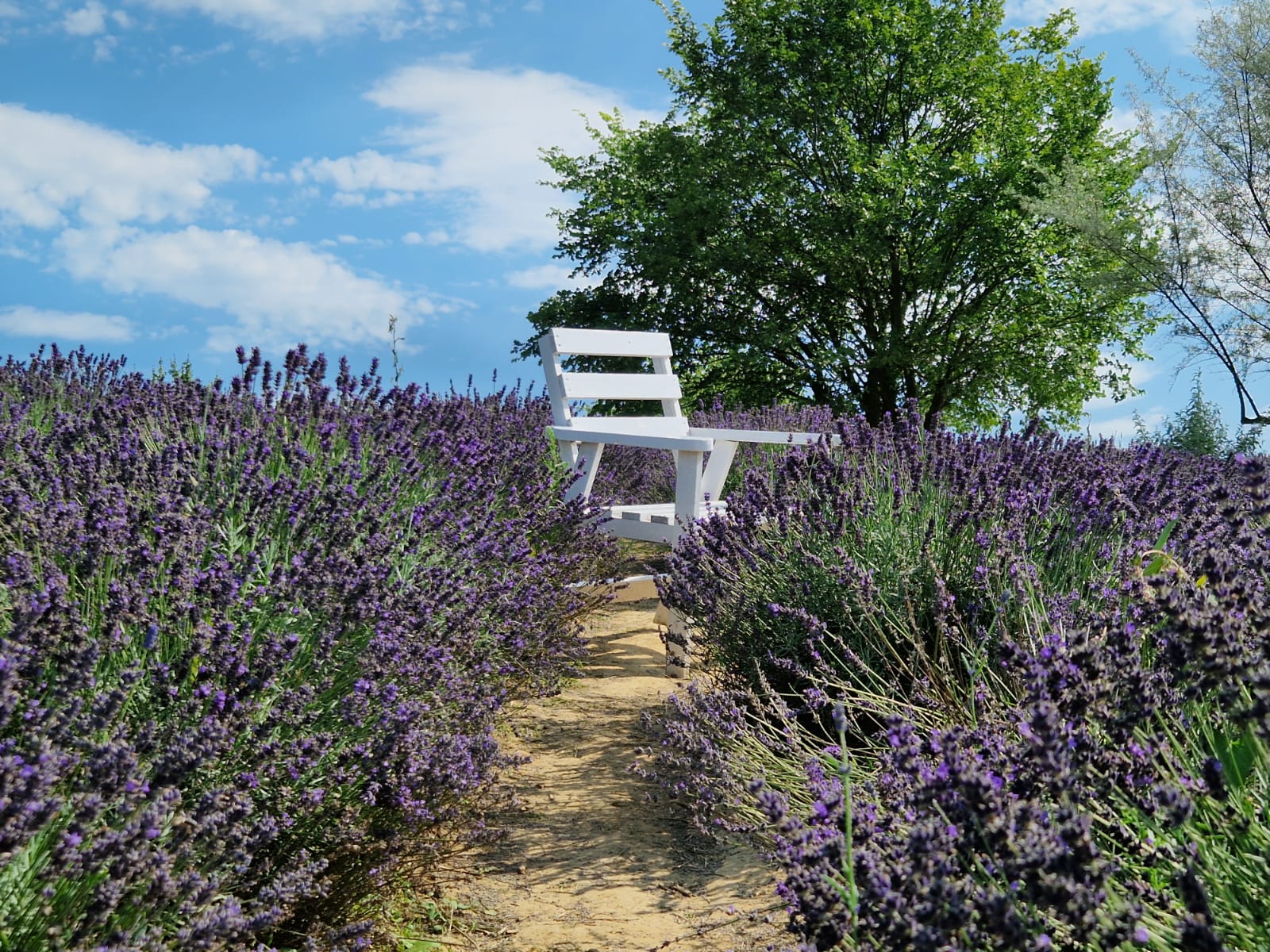
Lavender may be strongly associated with the sun-drenched landscapes of Provence, but Poland has quietly developed its own lavender tradition. Across different parts of the country, growers have transformed patches of farmland and gardens into places where the purple flowers have become a seasonal attraction in their own right. When the plants reach full bloom, people begin planning weekend journeys around them. Families pack the car, couples search for a peaceful summer escape, photographers arrive with their cameras, and groups of friends come looking for the perfect backdrop for photographs. What was once primarily an agricultural crop has become part of a new kind of rural tourism — one based not on grand monuments or famous historical events, but on the simple beauty of a landscape that exists for only a short time each year.
The attraction is immediately obvious when you arrive. Lavender fields have a visual quality that is difficult to reproduce anywhere else. The plants grow in long, orderly lines, creating a natural perspective that seems to draw the eye towards the far end of the field. On a sunny afternoon, the purple flowers appear almost luminous against the surrounding green vegetation. When the wind moves across the plants, the rows seem to ripple gently, while the constant activity of bees gives the landscape a sense of life. Visitors often arrive expecting to take a few photographs and leave, only to find themselves staying much longer than planned. There is something about the combination of colour, scent, sunshine and silence that encourages people to slow down.
That sense of slowing down may be one of the most important reasons these places have become so popular. Modern travel often involves movement from one attraction to another: a historic square in the morning, a museum before lunch, a viewpoint in the afternoon and a restaurant in the evening. Lavender fields offer almost the opposite experience. There is no complicated itinerary and no long list of things to see. You walk, sit, look and breathe. Children can explore the paths, photographers can wait for the right light, and older visitors can simply enjoy the surroundings. The experience is uncomplicated, but that does not make it insignificant. In fact, its simplicity is part of what makes it memorable.
For many Polish visitors, a trip to a lavender field also represents a different way of discovering their own country. Poland is often introduced through its historic cities — Kraków, Warsaw, Gdańsk, Wrocław or Poznań — or through its great natural landscapes, from the Baltic coast to the Masurian lakes and the Tatra Mountains. Yet between these famous destinations lies another Poland, made up of small villages, farms, gardens, forest roads and agricultural landscapes that rarely make the front page of a tourist guide. Lavender farms belong to this quieter world. They offer travellers a reason to leave the major tourist routes and discover places where the rhythm of the day is determined less by sightseeing schedules and more by the weather, the growing season and the work of the people who cultivate the land.
The journey itself can therefore become part of the experience. A visitor may leave a busy city in the morning and, within an hour or two, find themselves travelling through a landscape of wheat fields, meadows, roadside trees and small villages. The roads become quieter. Buildings become less frequent. Eventually, the first signs of the lavender farm appear, and what began as an ordinary summer drive turns into something much more distinctive. This is one of the pleasures of travelling through rural Poland: beautiful places are often not announced by monumental entrances or enormous tourist signs. Sometimes you simply turn off a country road and discover that an entire hillside or field has been transformed by flowers.
Some farms have developed the visitor experience even further, offering workshops, seasonal events, tastings, photography sessions and small cafés or refreshment areas. These additions have helped turn lavender cultivation into a form of agritourism, allowing visitors to connect the beauty of the landscape with the people who maintain it. This is important because the fields are not simply ornamental gardens created for tourists. They are working landscapes, and their appearance depends on agricultural knowledge and constant care. The spectacular few weeks of flowering that visitors see are the result of much more work throughout the rest of the year.
The timing of a visit is therefore crucial. Lavender does not wait for the tourist season, and the exact moment of peak flowering can change from year to year depending on temperatures, rainfall and local conditions. For travellers, this creates a certain sense of urgency. Miss the season and the landscape will look completely different. Arrive at exactly the right time, however, and you may find the field at its most dramatic, with thousands of flowers in bloom and the air filled with their fragrance. It is one of those travel experiences that cannot be entirely controlled, which is perhaps another reason it feels special.
Early morning is particularly beautiful. The crowds are smaller, the air is cooler and the light has a softness that disappears as the day becomes brighter. In some places, dew can still be visible on the plants, while the surrounding countryside remains quiet. Later in the day, the atmosphere changes. Families arrive, photographers position themselves between the rows and the field becomes livelier. On a warm summer weekend, the same place that felt almost solitary at sunrise can become a gathering point for visitors from several different parts of Poland.
You don’t need to travel to Provence to walk among purple fields. Every summer, the countryside around Kraków turns into a fragrant landscape of lavender, drawing photographers, families and travelers looking for a slower kind of escape.
For a few weeks each summer, parts of Małopolska seem to change color.
The green countryside around Kraków gives way to rows of violet and purple, and the air carries the unmistakable scent of lavender. What was once primarily an agricultural crop has become one of the region’s most charming seasonal attractions.
Lavender generally blooms in Poland from mid-June through late July, although the exact timing depends on weather and location. The most spectacular period is usually during June and July, when the plants are in full bloom.
And in Małopolska, there are several places where you can experience it.
A little Provence near Kraków
One of the best-known spots is Ogród Pełen Lawendy, or Garden Full of Lavender, in Ostrów near Proszowice.
It is the kind of place that seems designed for a summer afternoon.
Rows of lavender stretch across the countryside, while visitors come to wander among the plants, photograph the flowers and simply enjoy the scent. The regional tourism organization describes it as one of the most picturesque lavender destinations in Małopolska and notes that visitors can enjoy lavender ice cream, coffee, lemonade and cookies.
It is easy to understand the appeal.
You arrive expecting flowers.
You discover an atmosphere.
Where the hills become purple
For something more dramatic, head toward the hills around Zakliczyn.
Lavender Galicia spreads across approximately 60 acres near Zakliczyn, with rows of lavender set against the surrounding countryside. From the fields, the landscape opens toward the hills and the castle in Melsztyn, creating the sort of view that makes it difficult to believe you are still in southern Poland.
The farm also hosts activities such as photography and painting workshops, as well as workshops connected with lavender products.
This is perhaps where the experience becomes more than a flower field.
It becomes a destination.
Sunset at Witanowice
Another beautiful option is Lavender on Nowy Świat in Witanowice.
The attraction is smaller and more intimate, but its position gives it a special quality. The lavender grows alongside panoramic countryside views, and the regional tourism organization specifically highlights the sunsets here.
If you are looking for photographs, late afternoon may be the moment to aim for.
The light softens.
The purple becomes warmer.
And the countryside beyond the field begins to glow.
A place for bees, flowers and slow travel
At Lawendowe Zacisze in Fałkowice, lavender is part of a broader story about plants and bees.
The farm covers around 15 acres and contains more than 2,500 lavender bushes of different varieties. It also has an apiary, with locally produced honey available to visitors, as well as workshops for people interested in herbs and natural products.
There is something particularly appealing about places like this.
The lavender isn’t simply there to be photographed.
It is part of a working landscape.
Bees move between the flowers, the scent fills the air and visitors are reminded that the beauty of a lavender field is also connected to agriculture and pollinators.
Another field worth knowing
If you are traveling around Małopolska and want something closer to Kraków, Lawendowa Sosnówka in Prandocin-Iły is another option.
Lawendowa Sosnówka – pole lawendy is currently listed as open daily, with hours extending into the evening during the season.
For visitors staying in Kraków, that makes a lavender-field excursion particularly easy to combine with a countryside drive.
When should you go?
Timing is everything.
Lavender season is short, and a field can look dramatically different from one week to the next. In Małopolska, the general flowering season runs from mid-June to late July, but warmer weather can bring the flowers into bloom earlier.
If your main goal is to see the fields at their most vibrant, check each farm’s social-media channels or website before setting out.
And don’t assume that every field peaks at exactly the same time.
The weather decides.
Come for the color. Stay for the countryside.
The lavender fields of Małopolska may not have the scale of Provence.
That is part of their charm.
Here, the experience feels closer to discovering a beautiful local secret: a small farm beyond the city, a hillside covered in purple, bees humming between the flowers and the smell of summer hanging in the air.
For travelers based in Kraków, it is an easy way to escape the crowds without going far.
And perhaps the best part is that you don’t need a special reason to visit.
Go with a camera.
Go with your family.
Go for a quiet afternoon.
Or simply go because, for a few precious weeks each year, Małopolska turns purple.
Travel tip: Lavender is a seasonal attraction, so always check current bloom conditions before making the trip. The regional tourism authority recommends following individual farms for updates on flowering.
For a nearby option, Lawendowa Sosnówka – pole lawendy is in Prandocin-Iły, while Lawendowe Pole Filipowice Jurajskie LawendLove offers another lavender-field experience in the Kraków-area countryside.
Leave a Reply