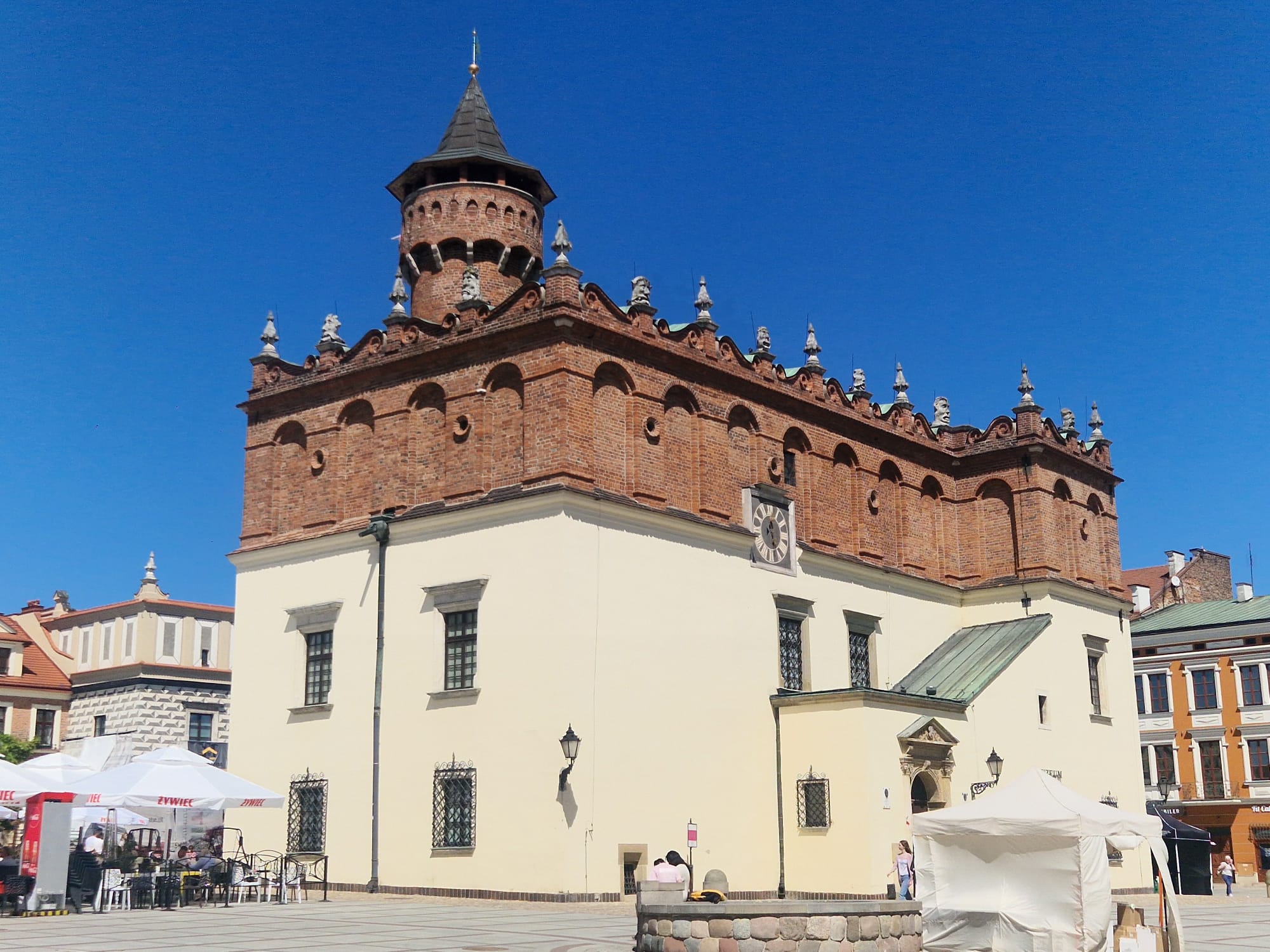
There are Polish cities that announce themselves immediately. Kraków has Wawel. Gdańsk has its waterfront and extraordinary Hanseatic architecture. Wrocław has its colourful Market Square and hundreds of small bronze dwarfs hiding around the streets. Tarnów is different. It does not need to shout.
The city in southern Poland rewards those who slow down.
Its historic centre is compact enough to explore on foot, yet rich enough to keep revealing new details long after the first impression has passed. Renaissance townhouses surround one of the most beautiful market squares in Małopolska, narrow streets lead towards churches and old defensive walls, and the city’s history reaches far beyond the familiar story of medieval Poland. Tarnów has been shaped by merchants, nobles, craftsmen, Jewish families, artists, soldiers and politicians, and traces of all of them remain visible in its streets.
There is also something slightly unexpected about Tarnów. For a city of its size, it has an extraordinary number of stories. It was once one of the most important towns in the region. It became an important centre of Jewish life before the Second World War. It was associated with Józef Bem, one of the most fascinating military figures of nineteenth-century Europe. Its architecture carries echoes of the Renaissance, while its streets also preserve painful reminders of the twentieth century.
Today, Tarnów is one of those destinations that can surprise travellers who arrive expecting a pleasant provincial town and discover something much more layered.
If you are travelling through southern Poland, here are the places that deserve a closer look.
Begin in Tarnów’s Remarkable Old Town
The best way to discover Tarnów is not to begin with a museum.
Begin in the centre.
The Old Town is compact, and that makes it particularly enjoyable for travellers who prefer to explore without constantly checking a map. The heart of it all is Rynek, the Market Square, where colourful historic buildings surround the remains of the Renaissance town.
At first glance, the square feels typically Central European. Look closer, however, and the details begin to separate Tarnów from the better-known cities of Poland.
The Renaissance townhouses are among the great architectural treasures of the city. Their façades, proportions and decorative details reflect the wealth Tarnów enjoyed during its most prosperous periods. The town’s location on important trade routes helped merchants and craftsmen flourish, while powerful noble families invested in its development.
The result is a square that feels elegant rather than monumental.
It is a place to sit.
Have a coffee.
Watch people crossing the square.
Look up at the façades.
And then start walking.
Tarnów becomes more interesting the farther you move away from the centre.
Climb Towards Tarnów Cathedral
Rising above the Old Town, Tarnów Cathedral is impossible to miss.
The Gothic-Renaissance church has been one of the city’s most important landmarks for centuries, and its interior contains some of the most remarkable examples of monumental tomb sculpture in Poland.
This is not simply a church that you visit because it appears on a tourist map.
It tells the story of the families who once held enormous influence in Tarnów.
The monumental tombs of the Tarnowski and Ostrogski families are particularly impressive, revealing the wealth and ambition of Renaissance Poland. Carved stone becomes a kind of historical document, showing how the powerful wanted to be remembered and how much importance was attached to family, status and memory.
The cathedral tower also provides one of the city’s defining silhouettes.
From the streets below, it rises above the rooftops and helps orient visitors as they move around the Old Town.
Spend a few minutes outside and look back towards the square.
You begin to understand Tarnów’s historic centre not as a collection of separate monuments, but as one carefully connected urban landscape.
Find the Remains of Tarnów’s Medieval Walls
Tarnów was once a fortified town, and fragments of its defensive walls still survive around the Old Town.
They are easy to miss.
That is part of their charm.
Unlike a grand castle wall that dominates the landscape, these surviving sections appear almost quietly between buildings and streets. Yet they reveal something important about medieval Tarnów: this was a town that needed protection, and its position made it strategically significant.
Walking along the surviving fortifications gives you another perspective on the old city.
The market square was not simply a beautiful gathering place.
Beyond it were houses, workshops, churches and streets enclosed within a defensive system.
The city that appears peaceful today once had a very different rhythm.
Merchants arrived through gates.
Guards watched the walls.
Craftsmen worked within the protected town.
And after dark, the gates could be closed.
The fragments that remain are modest, but imagination fills in the missing pieces.
Discover the Story of Józef Bem
One of Tarnów’s most surprising connections is with Józef Bem, the Polish general and national hero who became an important figure not only in Polish history but also in Hungary.
Bem was born in Tarnów in 1794 and later played a significant role during the Hungarian Revolution of 1848–49. His military career took him far beyond Poland, and his reputation became particularly strong in Hungary, where he remains a celebrated historical figure.
His monument stands in Tarnów, and his memory appears throughout the city.
For visitors, Bem’s story is a reminder that Polish history cannot always be contained within Poland’s present borders.
The nineteenth century was a period when Polish political figures, soldiers and intellectuals often travelled across Europe, participating in movements connected with national independence and political change.
Bem’s life is one of those stories.
A man born in a relatively small city in southern Poland became an international military figure whose name is still recognised thousands of kilometres away.
That makes his connection with Tarnów particularly fascinating.
The city did not simply produce a local hero.
It produced a figure whose story crossed borders.
Visit the Old Jewish Quarter
Perhaps nowhere in Tarnów is the city’s complicated history more visible than in the former Jewish quarter.
Before the Second World War, Jewish residents made up a significant part of Tarnów’s population, contributing to the city’s commercial, cultural and social life. Shops, workshops, synagogues and homes filled the streets, and Jewish life was deeply woven into the identity of the city.
The Holocaust destroyed that world.
Today, the streets are quieter, but the traces remain.
One of the most important reminders is the surviving bimah of the old Tarnów synagogue. The synagogue itself was destroyed during the German occupation, but the exposed metal structure of the bimah remains as a stark memorial.
It is an unusual monument because there is so little left.
There is no magnificent building to photograph.
Instead, there is an absence.
And sometimes absence tells history more powerfully than architecture.
Walking through this part of Tarnów requires a different pace from strolling around the Market Square. The colourful façades and cafés disappear, replaced by a quieter atmosphere. Information panels and memorials help explain the Jewish history of the city and the destruction of its community.
It is one of the places where Tarnów asks visitors not simply to look, but to remember.
The Tarnów Jewish Cemetery: A Place of Memory
The Jewish cemetery is another important place for understanding the city’s history.
Founded centuries ago, it contains thousands of graves and monuments, many of which survived the destruction of the Jewish community during the Second World War.
The cemetery is atmospheric in a way that is difficult to describe through photographs alone.
Old stones stand among vegetation, Hebrew inscriptions preserve names and fragments of family histories, and the quiet contrasts sharply with the activity of the modern city.
For travellers interested in Jewish heritage in Poland, this is one of the most significant places to visit in Tarnów.
It also demonstrates why travelling beyond Poland’s most famous destinations can be so rewarding.
Kraków receives enormous numbers of visitors interested in Jewish history, particularly around Kazimierz and Podgórze.
Tarnów offers another perspective.
Here, the story is smaller in scale but no less important.
You can see how Jewish life was woven into an ordinary Polish city — not as something separate from it, but as part of its everyday existence.
Take a Walk Along Bernardyńska Street
Not every attraction in Tarnów requires an entrance ticket.
Some of the city’s pleasures are found simply by walking.
Bernardyńska Street and the surrounding streets are particularly rewarding because they preserve the atmosphere of the old town while allowing visitors to move away from the main tourist routes.
Look at the façades.
Notice the doorways.
Watch how the streets narrow and widen.
Pay attention to the relationship between the old buildings and the more recent layers of the city.
This is the kind of exploration that is easy to overlook when travelling with a strict checklist.
But Tarnów is not a city that needs to be rushed.
Its scale encourages wandering.
You can leave the Market Square without knowing exactly where you are going and still find your way back within minutes.
That freedom is one of the reasons the city feels so pleasant.
Explore Tarnów’s Museums
For a relatively small city, Tarnów has an impressive cultural offering.
The Tarnów District Museum operates several branches, including spaces connected with the city’s historic architecture and artistic heritage.
One of the most interesting is located in the historic Rynek area, where exhibitions help explain the development of Tarnów and the surrounding region.
Another branch is associated with the history of Józef Bem.
Together, these museums create a broader picture of the city.
You begin to see that Tarnów’s story is not simply about beautiful buildings.
It is about the people who lived inside them.
The merchants who built businesses.
The artists who worked here.
The political figures who left.
The families who remained.
The communities that disappeared.
And the people who later tried to preserve their memory.
That is what makes a smaller museum valuable.
It gives a city a voice.
See the Painted Village of Zalipie Nearby
If you have more than one day in Tarnów, one of the most memorable excursions is to Zalipie, a small village famous for its colourful floral decorations.
The village lies outside Tarnów, but its connection with the city makes it a natural addition to a southern Poland itinerary.
Zalipie became famous for the tradition of decorating houses, farm buildings, wells and other structures with hand-painted flowers. What began as a local folk tradition eventually developed into one of the most recognisable examples of Polish rural decorative art.
The effect is extraordinary.
Against the quiet countryside, colourful flowers appear on whitewashed walls and wooden structures.
It feels almost unreal.
For travellers who have spent several days exploring castles and churches, Zalipie offers something completely different: a glimpse into the artistic traditions of rural Małopolska.
The village is also a reminder that Polish culture does not exist only inside museums.
Sometimes it is painted directly onto someone’s home.
Look for Tarnów’s Modern Side
One of the most interesting things about Tarnów is the contrast between its historic centre and the city beyond it.
Leave the Old Town and you begin to encounter a more ordinary Polish city: apartment blocks, schools, shops, parks and neighbourhoods where daily life continues far away from the tourist routes.
That may sound unremarkable.
It is not.
For travellers who want to understand Poland rather than simply photograph it, these ordinary spaces are valuable.
They show how historic cities function today.
People still live around the medieval centre. Children go to school. Residents shop for groceries. Cafés fill with locals rather than tourists. The old architecture is not a museum backdrop; it exists alongside modern life.
This is one reason Tarnów can feel more intimate than some of Poland’s larger tourist destinations.
The historic centre is beautiful, but it remains part of a living city.
Try Tarnów’s Local Food
No visit to southern Poland should be separated from food.
Tarnów sits in Małopolska, a region with a rich culinary tradition shaped by farming, mountain influences and centuries of cultural exchange. In local restaurants, you can expect to encounter many of the dishes that define Polish cuisine, from pierogi and soups to regional meat dishes and pastries.
But one of the pleasures of eating in Tarnów is the lack of pressure.
You do not have to make dinner into an event.
Find a restaurant around the Old Town.
Order something traditional.
Take your time.
Try a local cake with coffee.
Watch the evening settle over the square.
The city is particularly pleasant after the main sightseeing hours, when day visitors begin to leave and the Old Town takes on a quieter character.
Why Tarnów Deserves a Place on Your Poland Itinerary
Tarnów may never compete with Kraków for visitor numbers.
That may be precisely why you should go.
It offers many of the things travellers search for in southern Poland — beautiful architecture, fascinating history, traditional food, cultural attractions and easy access to the countryside — without the feeling that every street has been designed for tourism.
The city rewards attention.
Its Renaissance façades tell one story.
The cathedral tells another.
The old Jewish quarter tells a much darker one.
Józef Bem’s monument opens a window onto nineteenth-century European history.
The surviving medieval walls reveal the city’s defensive past.
And beyond Tarnów, villages such as Zalipie show that the cultural landscape of Małopolska extends far beyond the famous cities.
Perhaps the biggest surprise is how much history can be found in such a manageable place.
You can spend a morning walking around the Market Square, have lunch beneath historic façades, visit a museum in the afternoon and finish the day watching the sun fall across the rooftops of the Old Town.
There is no need to rush from attraction to attraction.
Tarnów invites you to look closer.
And that is exactly when the city begins to reveal itself.
Leave a Reply