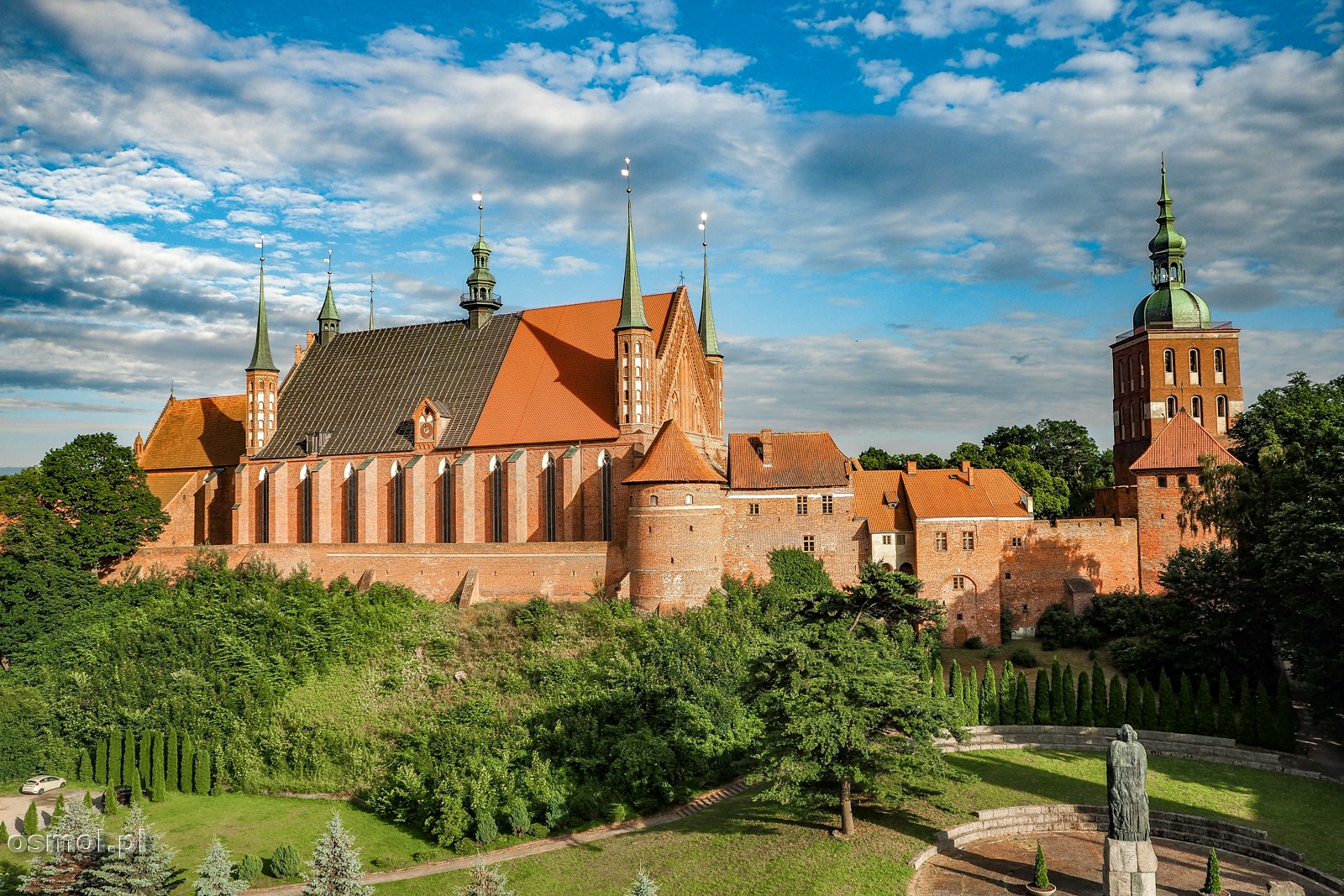
On the shores of the Vistula Lagoon, in Poland’s northern Warmian-Masurian region, a small historic town rises above the water with a remarkably large place in the history of science.
This is Frombork, the city most closely associated with Nicolaus Copernicus—the Renaissance astronomer who changed humanity’s understanding of its place in the universe.
But Frombork is more than the place where Copernicus lived and worked.
With its cathedral hill, medieval architecture, astronomical heritage and views across the lagoon, it makes an unusually rewarding destination for travellers looking beyond Poland’s better-known cities.
Come for Copernicus.
Stay for the history, the views and the atmosphere.
The Cathedral Hill: Frombork’s heart
The best place to begin is Cathedral Hill, the fortified complex that dominates Frombork.
From below, its medieval walls and towers give the town an almost cinematic appearance. Inside, the complex contains the Cathedral Basilica of the Assumption of the Blessed Virgin Mary and St Andrew, historic residences, defensive structures and museums.
The cathedral itself is the centrepiece.
Construction began in the 14th century, and the building became closely connected with the Warmian cathedral chapter. It was here that Copernicus spent much of his adult life as a canon.
Walking through the cathedral today, it is easy to forget how extraordinary this setting once was.
Beyond the walls lies the lagoon.
Inside them, scholars, clergy and administrators worked in an institution that connected Frombork with the intellectual life of Renaissance Europe.
Where Copernicus looked at the stars
For many visitors, the most compelling reason to come is the connection with Copernicus.
He arrived in Frombork in 1510 and spent much of the rest of his life connected with the cathedral chapter. Here, he pursued his astronomical observations and developed ideas that would eventually transform European science.
His great work, De revolutionibus orbium coelestium—On the Revolutions of the Heavenly Spheres—was published in 1543, the year of his death.
Its central proposition was revolutionary for its time: the Earth was not the unmoving centre of the universe. Instead, Earth and the other planets moved around the Sun.
Frombork therefore occupies a special place in the history of science.
You are not simply visiting the birthplace of a famous scientist.
You are visiting one of the places where a new picture of the cosmos was developed.
The Copernicus Museum
Inside the Cathedral Hill complex, the Nicolaus Copernicus Museum explores the astronomer’s life, work and scientific legacy.
The museum is spread through historic buildings and includes exhibitions devoted to astronomy, Renaissance science and Copernicus himself.
It is worth visiting even if you are not particularly interested in astronomy.
The story is ultimately about much more than planets and mathematics. It is about what happens when an established understanding of the world is questioned—and how difficult it can be for a new idea to take its place.
That makes Frombork surprisingly relevant centuries later.
The Radziejowski Tower and the view
For one of the best perspectives over Frombork and the surrounding landscape, climb the Radziejowski Tower.
The tower rises above the Cathedral Hill and offers a panoramic view across the town, the Vistula Lagoon and the countryside beyond.
On a clear day, the landscape explains something important about Frombork’s appeal.
This is not a city built around a dense urban centre.
It is a small historic settlement surrounded by water, fields and open sky.
For an astronomer, that expansive horizon must have been irresistible.
For a traveller, it remains one of the pleasures of visiting.
The Planetarium
Copernicus’s legacy naturally continues with astronomy.
The planetarium in Frombork offers visitors the chance to explore the night sky through presentations about the planets, stars and universe.
It is a particularly good stop if you are travelling with children, but adults fascinated by Copernicus will find plenty to enjoy too.
There is something satisfying about sitting beneath a projected night sky in the same town where Copernicus spent years trying to understand the real one.
The Water Tower
Another unusual Frombork landmark is the historic Water Tower, dating from the 16th century.
The structure was once part of the town’s water-supply system, powered by a mechanism that used the waters of the Bauda River.
Today, the tower is another reminder of the practical ingenuity that existed alongside the intellectual life of Renaissance Frombork.
It also contributes to the town’s distinctive skyline.
Frombork is full of these details: buildings that might look like atmospheric ruins at first glance but reveal sophisticated stories when you stop to investigate them.
The Vistula Lagoon
Eventually, though, you should leave the monuments behind.
Frombork’s relationship with the Vistula Lagoon is one of its greatest attractions.
The lagoon is a vast body of water separated from the Baltic Sea by the Vistula Spit. Its shoreline gives the town a spacious, almost maritime character.
Walk along the waterfront.
Watch the boats.
Look across the water toward the distant shore.
The atmosphere changes completely from that of Cathedral Hill.
And this contrast is part of Frombork’s charm: within a few minutes, you can move from medieval fortifications and Renaissance astronomy to a quiet waterfront landscape.
A town shaped by war and rebuilding
Frombork’s history has not been peaceful.
The town and cathedral complex suffered repeated destruction and damage over the centuries, including during the Second World War.
Much of what visitors see today has therefore been restored.
That restoration is itself part of the story.
The town’s survival is a reminder that historic Poland is not simply a collection of perfectly preserved medieval streets. Many of its monuments have been rebuilt, reconstructed and painstakingly conserved after periods of conflict and neglect.
Frombork’s cathedral complex is particularly impressive because it retains the sense of a fortified medieval institution while remaining part of a living town.
Follow in Copernicus’s footsteps
One of the best ways to experience Frombork is to think about Copernicus as you walk.
He would have known these walls.
He would have looked across this same landscape.
He would have worked within the cathedral chapter and spent nights observing the heavens.
The details of his daily life can make the history feel surprisingly immediate.
And perhaps that is why Frombork works so well as a destination.
The town does not need to manufacture a connection to Copernicus.
It is everywhere.
His name appears on museums, monuments and astronomical attractions, but the strongest connection is the landscape itself—the open horizon, the quiet streets and the enormous sky above the lagoon.
Why Frombork belongs on your Poland itinerary
Frombork is not a destination for travellers looking for nightlife or endless shopping.
Its appeal is quieter.
It is for people who enjoy historic architecture, museums, science, unusual landscapes and places where the past remains visible in everyday surroundings.
A day is enough to see the principal attractions, but the town rewards travellers who slow down.
Visit the cathedral.
Explore the Copernicus Museum.
Climb the tower.
See the planetarium.
Walk beside the lagoon.
Then look up.
That last part is important.
Because the most remarkable thing about Frombork is not simply that Nicolaus Copernicus lived here.
It is that in this small town on Poland’s northern coast, a man once looked at the same sky everyone else could see—and concluded that the universe worked differently from what most people believed.
More than five centuries later, that makes Frombork one of Poland’s most fascinating cultural stops.
Come for Copernicus. Come for the cathedral. But leave some time to simply stand by the lagoon and look toward the horizon.
You may find yourself looking at Frombork the way Copernicus once looked at the sky: with a little more curiosity than when you arrived.
Leave a Reply