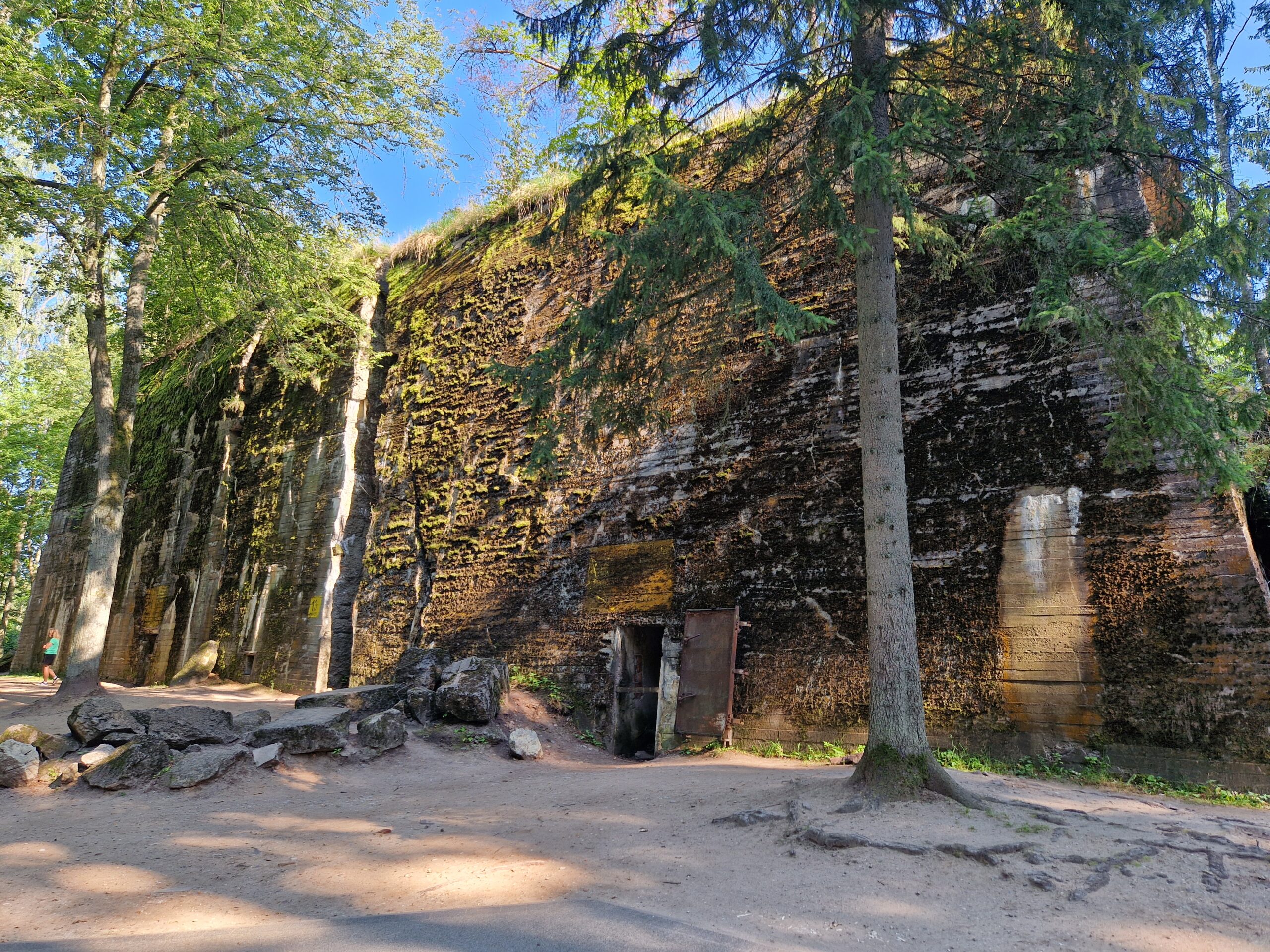
The road into the forest is almost too peaceful.
Northeastern Poland is a landscape of lakes, meadows and dense woodland, the kind of countryside where the horizon seems deliberately low and the silence feels uninterrupted. Near the town of Kętrzyn, the road narrows and the trees close in.
Then the concrete appears.
Half-swallowed by moss and vegetation, enormous slabs of reinforced concrete rise between the trees. Walls tilt at impossible angles. Roofs have collapsed inward. Tree roots creep over structures designed to withstand bombs. What first looks like a collection of industrial ruins gradually reveals itself as something far more disturbing.
This is the Wolf’s Lair, or Wolfsschanze—the former wartime headquarters of Adolf Hitler in what was then East Prussia and is now northeastern Poland.
Wolf’s Lair
Between 1941 and 1944, this remote forest complex was one of the most important command centres of Nazi Germany. Nearly 200 buildings formed a concealed military settlement of bunkers, shelters, barracks and infrastructure. At its height, roughly 2,000 people lived and worked inside the heavily protected compound.
Today, much of it lies broken beneath the trees.
And that is precisely what makes the place so haunting.
A city hidden in the forest
The Wolf’s Lair was not simply a bunker.
It was a secret city.
The complex included power facilities, water infrastructure, a railway station, airfields, barracks and enormous reinforced shelters. Its location was chosen partly because the surrounding forest provided natural concealment and because the area was strategically close to the Soviet border.
The camouflage was extraordinary.
From above, the headquarters was intended to disappear into the landscape. Inside, however, it was a highly organised military centre from which Germany’s eastern war was directed.
Hitler spent around 800 days here.
The scale of that figure is difficult to comprehend until you begin walking.
The paths pass from one ruined structure to another. Some bunkers are little more than shattered concrete shells; others remain massive enough to resemble fragments of a buried fortress. The forest constantly competes with the architecture. Trees grow through cracks. Moss softens the edges. Birds move through rooms that once held some of the most powerful figures in Nazi Germany.
Nature has been slowly reclaiming a place designed to dominate it.
The war was directed from here
The Wolf’s Lair became Hitler’s principal headquarters for the Eastern Front.
From here, Nazi Germany coordinated military operations during the invasion and occupation of the Soviet Union. Senior figures of the Third Reich—including Hermann Göring, Martin Bormann, Wilhelm Keitel and Alfred Jodl—were also associated with the complex.
It is one of the uncomfortable realities of visiting historical sites like this: the landscape itself is beautiful.
The Masurian countryside surrounding the Wolf’s Lair is among Poland’s most picturesque regions. Lakes and forests draw visitors for sailing, cycling and summer holidays.
Yet within this peaceful landscape was a place where decisions made during the Second World War had consequences far beyond these trees.
The contrast is impossible to ignore.
The bomb that failed
Perhaps the most famous moment in the Wolf’s Lair’s history came on July 20, 1944.
Colonel Claus von Stauffenberg entered Hitler’s headquarters carrying a bomb as part of a German military conspiracy to assassinate the dictator and overthrow the Nazi regime.
The bomb exploded.
Hitler survived.
The failed assassination attempt became one of the defining episodes of the German resistance against Hitler, and the Wolf’s Lair remains closely associated with the plot.
Standing in the ruins today, it is strange to think that this forest once contained the centre of such an extraordinary moment.
There is no cinematic soundtrack here. No dramatic reconstruction is necessary.
There is only concrete, trees and the knowledge of what happened.
The destruction of the Wolf’s Lair
The site visitors see today is not the Wolf’s Lair as Hitler knew it.
As German forces withdrew in January 1945, much of the complex was deliberately destroyed with explosives. The result was a landscape of shattered bunkers—enormous structures damaged but not erased.
The ruins are sometimes more powerful than intact buildings would have been.
A perfectly preserved bunker could turn the place into a museum piece. These broken structures instead leave room for imagination—and reflection.
You can see how thick the walls were. You can understand the extraordinary amount of concrete and engineering involved. But you can also see how completely the forest has changed the meaning of the place.
The headquarters was designed to project permanence.
It became a ruin.
The strange power of abandoned places
There is a temptation, when visiting sites associated with dictatorships and war, to be fascinated by the architecture.
The Wolf’s Lair certainly inspires that reaction.
The bunkers are enormous. Some walls are several metres thick, and the surviving structures demonstrate the extraordinary scale of the engineering project.
But the more interesting experience is to resist the architecture’s spectacle.
This is not a monument to Hitler.
It is a place to understand the machinery of a regime, the geography of war and the consequences of decisions made behind concrete walls.
The ruins are valuable precisely because they refuse to make the past comfortable.
A darker discovery beneath the ruins
In 2024, the Wolf’s Lair made headlines again after archaeologists and history enthusiasts discovered five human skeletons beneath a former building associated with Hermann Göring.
The remains—three adults, an older child and a baby—were found without hands or feet, and their identities and circumstances remained unclear. Investigations into the discovery followed. Later reporting suggested the burials may even predate the Nazi occupation of the site, illustrating how much uncertainty can remain beneath apparently familiar historical landscapes.
The discovery added another layer of mystery to an already complicated place.
It was a reminder that archaeology does not always confirm the stories we expect to find.
Sometimes it creates new questions.
Visiting the Wolf’s Lair today
The Wolf’s Lair is now a historical attraction in the village of Gierłoż, near Kętrzyn in Poland’s Warmian-Masurian region. Visitors can walk through the forested grounds and explore the surviving ruins and exhibitions.
It is best approached as a historical site rather than a curiosity.
Allow several hours. Walk slowly. Read the information provided at the site. Pay attention to the geography as much as the buildings.
The forest is part of the story.
Without it, the Wolf’s Lair would simply be a collection of ruins. With it, the site becomes an unsettling study in concealment, power and time.
The forest remembers differently
Perhaps the most striking thing about the Wolf’s Lair is what surrounds it.
There are no grand boulevards here. No monumental statues. No intact palace.
Instead, there are trees.
The same landscape that once concealed Hitler’s headquarters now conceals its ruins. Roots push through military concrete. Leaves fall into rooms where officers once planned campaigns. Rain collects in bomb craters.
The forest has no ideology.
It simply continues.
And that may be the most powerful way to leave the Wolf’s Lair: not thinking about the men who occupied it, but about how temporary their power ultimately was.
The bunkers were built to last.
The regime did not.
The forest remained.
Leave a Reply