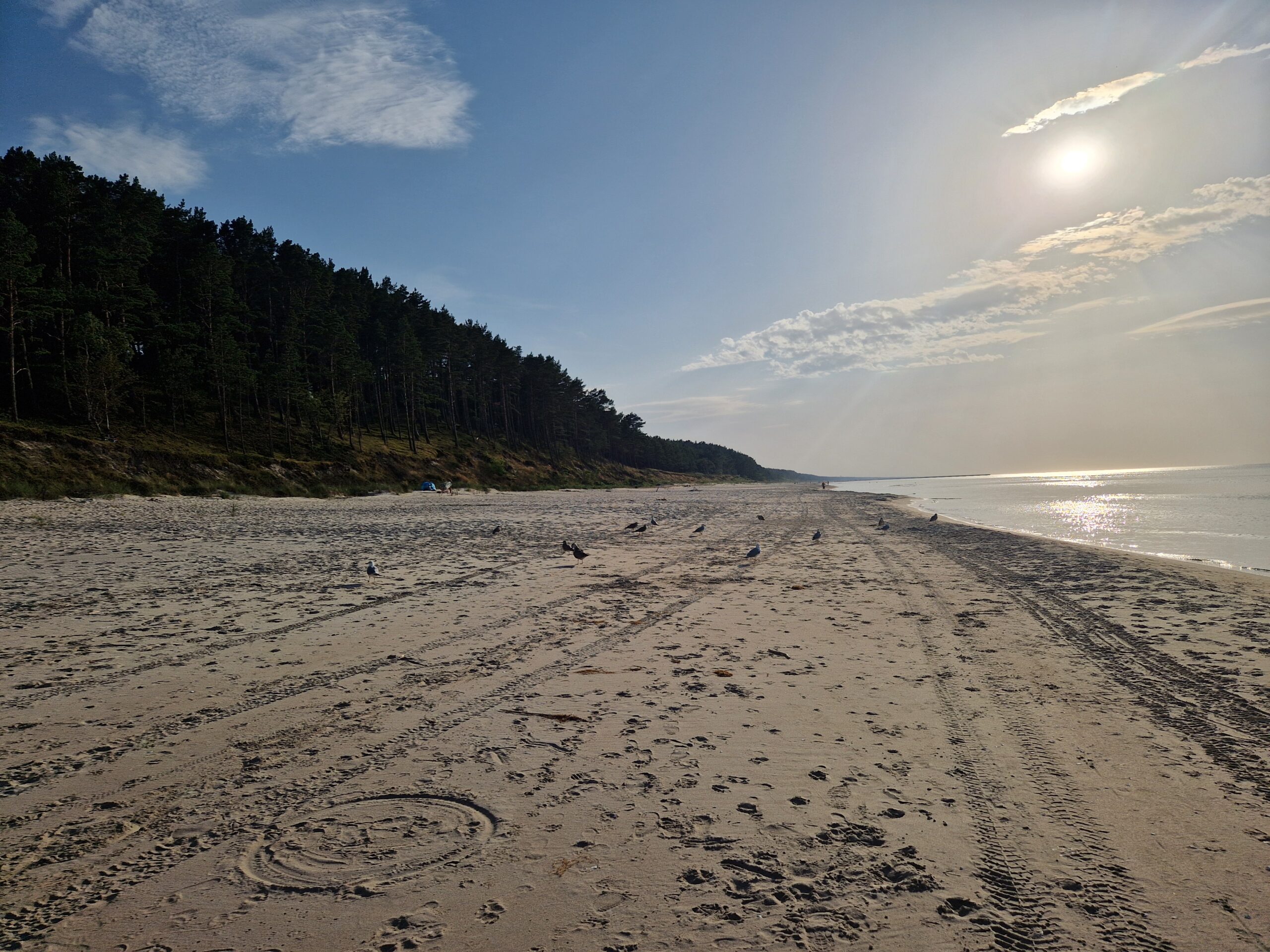
The Baltic Sea does not immediately conjure images of beach holidays.
For many travellers, the region means medieval old towns, pine forests, cool summers and long northern evenings. Yet along the coasts of Poland, Lithuania, Latvia and Estonia, the Baltic reveals another side: miles of pale sand, dunes covered in marram grass, pine-fringed shorelines and seaside towns where summer life moves at an unhurried pace.
The water may be cooler than the Mediterranean.
But the beaches can be every bit as beautiful.
And in some places, considerably quieter.
From Poland’s great Baltic resorts to Lithuania’s Curonian Spit and Estonia’s island beaches, here is where to find some of the best stretches of sand around the Baltic Sea.
Sopot, Poland: The classic Baltic escape
Few Baltic beach destinations are as famous as Sopot.
Part of Poland’s Tri-City area alongside Gdańsk and Gdynia, Sopot combines a broad sandy beach with elegant 19th-century architecture, restaurants, cafés and one of Europe’s longest wooden piers.
The beach is easy to reach and lively in summer, which makes Sopot particularly appealing if you want your seaside holiday with plenty of urban comforts.
Come early in the morning and the atmosphere is remarkably different. Walk along the shore as the sun rises over the Baltic, then head into town for breakfast.
Sopot is not the place for solitude.
It is the place for a classic European seaside weekend.
Hel Peninsula, Poland: Beaches between two seas
For something wilder, head north from Gdańsk to the Hel Peninsula.
The narrow strip of land stretches into the Baltic like a sandy finger, with beaches on either side and forests covering much of the interior.
The peninsula is one of Poland’s great summer destinations, but its geography means that it is possible to escape the busiest stretches.
The further you travel, the more the landscape begins to feel like a meeting point between forest and sea.
At the tip, the town of Hel gives the peninsula its name. Elsewhere, small resort settlements offer cafés, cycling paths and long beaches backed by dunes and pine trees.
The peninsula is particularly good for travellers who want a combination of beach time and exploration.
Łeba, Poland: Where the dunes move
On Poland’s central Baltic coast, Łeba is famous for something unusual: enormous shifting sand dunes.
The nearby Słowiński National Park contains one of the country’s most distinctive coastal landscapes, where dunes rise dramatically above the surrounding terrain.
The beach itself is broad and open, but the dunes are the real attraction.
Walking among them can feel less like Poland and more like a miniature desert beside the sea.
It is one of the Baltic’s most memorable landscapes—and a reminder that the coast is about much more than simply lying on the sand.
Curonian Spit, Lithuania: The Baltic at its most atmospheric
Few Baltic landscapes are as beautiful as the Curonian Spit.
This long, narrow peninsula separates the Baltic Sea from the Curonian Lagoon and stretches between Lithuania and Russia’s Kaliningrad region.
On the Lithuanian side, the landscape is protected as Curonian Spit National Park, with forests, dunes and quiet coastal villages.
The beaches here are expansive and remarkably peaceful outside the busiest summer periods.
Nida is the best-known base, a small resort town surrounded by pine forest and dunes.
The experience is less about a conventional resort holiday and more about being immersed in the landscape.
Cycle through the forest.
Walk over the dunes.
Find a quiet section of beach.
Then watch the Baltic stretch almost endlessly toward the horizon.
Palanga, Lithuania: Lithuania’s great seaside resort
If the Curonian Spit is the Baltic in its contemplative mood, Palanga is its social side.
Lithuania’s most famous seaside resort has a long sandy beach, a lively pedestrian street and a strong summer atmosphere.
The highlight is the long pier extending into the sea.
Come at sunset and the pier becomes one of the best places on the Lithuanian coast to watch the Baltic change colour.
Palanga is particularly good for travellers who want more than an isolated beach. Restaurants, cafés, nightlife and cultural attractions are all close by.
It is the kind of place where a morning swim can easily turn into an afternoon of wandering and an evening out.
Jūrmala, Latvia: Riga’s beach retreat
Just outside Riga lies Jūrmala, Latvia’s celebrated seaside resort.
The town stretches for roughly 30 kilometres along the Gulf of Riga and is known for its long sandy beaches, pine forests and distinctive wooden villas.
The proximity to the Latvian capital makes Jūrmala an easy addition to a city break.
You can spend the morning exploring Riga’s Art Nouveau architecture and the afternoon walking barefoot along the Baltic.
That combination is difficult to beat.
Jūrmala is also a good choice for travellers who prefer a more established resort atmosphere, with restaurants, spas and accommodation spread throughout the coastal area.
Pärnu, Estonia: Estonia’s summer capital
Further north, Pärnu is one of Estonia’s most popular seaside destinations.
The town sits on the coast of Pärnu Bay, where shallow water can make the sea feel noticeably warmer in summer than the open Baltic.
The beach is broad, sandy and backed by a promenade and parkland.
Pärnu’s appeal lies partly in its atmosphere. It has the feel of a traditional European spa town combined with a relaxed summer resort.
For Estonians, it is closely associated with summer holidays.
For international visitors, it offers an easy introduction to the country’s Baltic coastline.
Saaremaa, Estonia: For a quieter coast
If your ideal Baltic beach involves fewer people and more wilderness, look toward Estonia’s islands.
Saaremaa, the country’s largest island, has a rugged coastline dotted with beaches, forests and small villages.
The experience is slower here.
There are no huge resort complexes competing for your attention. Instead, you get open landscapes, juniper-covered coastal areas, dramatic rocks and secluded stretches of sand.
Saaremaa is particularly appealing for road trips.
Rent a car, explore the island, stop whenever the landscape looks interesting and let the journey determine the day.
The Baltic feels different here—more elemental and much less developed.
The Baltic beach season
The obvious question is whether the Baltic is warm enough for swimming.
The answer is: sometimes.
July and August offer the best chance of genuinely summery weather, although conditions vary considerably from year to year. The sea remains cooler than the Mediterranean, but on a warm day the combination of sunshine, soft sand and refreshing water can be perfect.
And there is an advantage to the cooler climate.
The Baltic coast is not defined entirely by swimming.
You can come for long walks, cycling, birdwatching, photography, dunes and sunsets.
In spring and autumn, when swimming becomes less appealing, the beaches become almost meditative.
So, which Baltic beach should you choose?
For classic seaside glamour, choose Sopot.
For long sandy beaches and a coastal road trip, choose the Hel Peninsula.
For dunes and wild landscapes, go to Łeba.
For dramatic scenery and tranquillity, choose Lithuania’s Curonian Spit.
For summer energy, head to Palanga.
For a beach break combined with a city trip, Jūrmala is hard to beat.
For a traditional Estonian seaside holiday, choose Pärnu.
And for quiet, rugged island landscapes, make the journey to Saaremaa.
The Baltic may never compete with the Mediterranean on water temperature.
But that is missing the point.
Its beaches have their own character: cool water, enormous skies, pine forests, shifting dunes and long stretches of sand where the horizon seems to go on forever.
Come in summer and you may discover the Baltic as a beach destination.
Come outside the season and you may discover something even better—a coast with room to breathe.
Leave a Reply