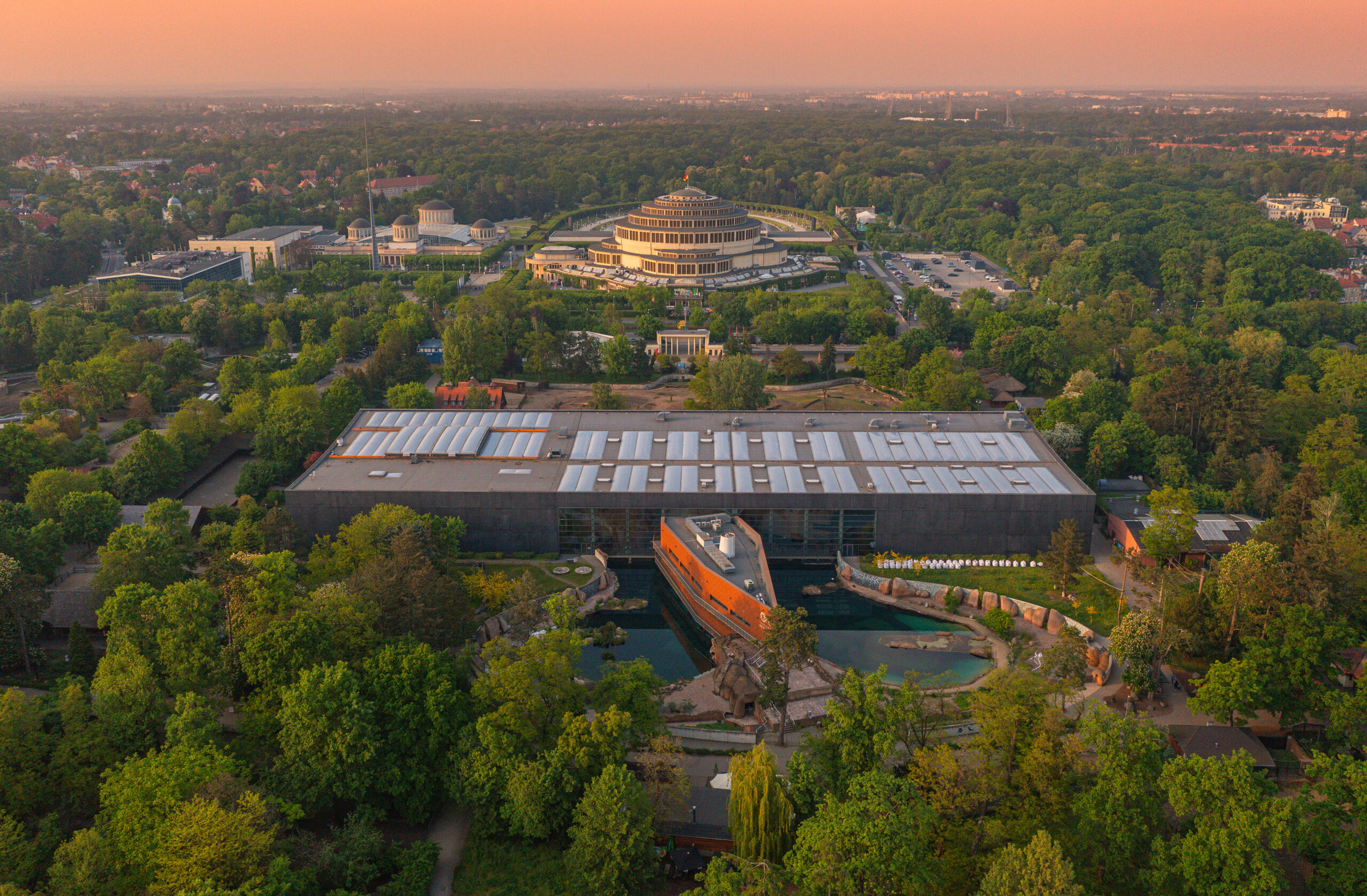
There are plenty of reasons to take the family to Wrocław. The city has its colourful Market Square, bridges crossing the Oder, beautiful historic buildings, riverside walks and the famous little dwarfs that children love searching for in the streets. But for families travelling with children, one attraction stands apart from the rest because it can easily turn an ordinary day in the city into a full adventure: Wrocław Zoo.
Spread across a large area of the city, the zoo is one of Poland’s best-known zoological gardens and one of the country’s most popular attractions. For generations of Polish families, a visit here has been part of growing up. Today, however, the zoo is very different from the traditional animal parks many adults may remember from childhood. Its most famous addition, the Afrykarium, has transformed the experience, while modern enclosures and conservation programmes have given the institution a much broader role than simply displaying animals.
So, is it worth spending a day there with children?
For most families visiting Wrocław, the answer is yes — but the real reason may have less to do with the number of animals and more to do with how much there is to discover.
The first thing you notice about Wrocław Zoo is its scale. This is not an attraction that can comfortably be squeezed into an hour between two other sightseeing stops. Once inside, you are entering a large collection of paths, habitats, buildings and exhibits that can easily occupy several hours. Children who arrive expecting to see a few familiar animals may quickly discover that the day has become a much larger expedition.
There are big cats, primates, elephants, giraffes, birds, reptiles, amphibians and many other species, but the experience is not simply about walking from one enclosure to another. Different parts of the zoo have their own atmosphere, and the variety means that even children with short attention spans are likely to find something that captures their imagination.
For younger visitors, the appeal is obvious. Animals that they have previously encountered only in books or on screens suddenly become real. A giraffe is no longer just a picture on a page. An elephant moves in front of them. Penguins swim underwater. A crocodile lies almost motionless while visitors gather around. Birds move through carefully designed habitats, and monkeys provide the kind of unpredictable entertainment that no timetable can guarantee.
But the most impressive part of the zoo is undoubtedly the Afrykarium.
Opened in 2014, the Afrykarium was designed around the aquatic ecosystems of Africa and quickly became one of Wrocław’s most recognisable attractions. Rather than presenting Africa as a single environment, it takes visitors through different aquatic landscapes and introduces them to animals associated with them. The building combines large aquariums, underwater viewing areas and carefully designed environments, creating a very different experience from walking through the outdoor parts of the zoo.
For children, the underwater tunnel is usually one of the highlights.
Walking beneath the water while fish move above and around you changes the scale of the experience. Instead of looking through the glass at an aquarium from the outside, you feel temporarily surrounded by the underwater world. Large fish glide overhead, rays move through the water and colourful species appear from different directions. It is the kind of environment that can make even a child who was beginning to complain about tired legs suddenly become interested again.
The Afrykarium is also one reason adults tend to enjoy the zoo as much as children.
There is something genuinely impressive about the architecture and engineering required to create these large aquatic habitats. The visit can therefore become educational without feeling like a school lesson. Children learn about ecosystems and species almost naturally because the animals are presented in environments that encourage observation.
That is an important difference between a good modern zoo and an old-fashioned animal collection.
The best experiences do not simply tell you what an animal is. They give you some sense of where it comes from, how it lives and what makes its environment important.
Wrocław Zoo has increasingly placed conservation and education at the centre of its identity. Like major zoos around the world, it participates in breeding and conservation programmes for threatened species and uses its popularity to introduce visitors to wider environmental issues. This gives a family visit another dimension. Children can enjoy seeing animals, but they can also begin to understand that some of the creatures in front of them face serious threats in the wild.
That can be a difficult subject to explain to young children, but it can also be one of the most valuable lessons a zoo can offer.
A zoo visit should not leave children believing that wild animals exist primarily for human entertainment. Ideally, it should make them more curious about the natural world and more aware of the responsibility humans have towards it.
Wrocław Zoo provides opportunities for that kind of learning.
Of course, children will not necessarily be thinking about conservation while watching penguins swim.
And that is perfectly normal.
A family day out should be enjoyable first. The educational value works best when it is woven naturally into the experience rather than forced upon visitors. A child who becomes fascinated by an elephant may later ask where elephants live. A visit to the aquarium may lead to questions about oceans. Seeing a rare species may encourage curiosity about why it is endangered.
Those questions can be more valuable than memorising facts.
The zoo’s history also makes it an important part of Wrocław itself. It opened in the nineteenth century, making it one of the country’s oldest zoological gardens. Over the decades, it has survived enormous changes in the city and in the way people think about zoos.
Wrocław itself has experienced an extraordinary history. The city has belonged to different states and political systems, its population has changed dramatically, and it suffered enormous destruction during the Second World War. The zoo’s survival and development form a small part of that larger story.
For visitors interested in the history of Wrocław, this makes the zoo more than a children’s attraction.
It is also part of the city’s cultural landscape.
Yet the best way to visit with a family is not to spend the entire day thinking about history.
Come prepared to walk.
This is perhaps the most important practical point for parents. A large zoo sounds exciting when everyone is fresh, but after several hours, small children can become tired. Comfortable shoes are essential, and it is sensible to plan breaks rather than trying to see every single enclosure.
You probably will not see everything.
And you do not need to.
A common mistake is treating a zoo like a checklist. Families hurry from one animal to another, trying to complete the entire map, only to discover that everyone is exhausted before the afternoon is over. Instead, choose the areas that interest your family most and allow some time for unexpected discoveries.
Maybe the children will spend twenty minutes watching one group of animals.
Let them.
That is often where the real experience happens.
The zoo is also a good place to practise something that modern travel can make surprisingly difficult: slowing down. Children do not necessarily experience attractions in the same way adults do. An adult may want to see ten exhibits in an hour. A child may become completely absorbed by one animal doing something apparently ordinary.
Watching is part of learning.
If a penguin is swimming, watch it.
If a monkey is interacting with another monkey, stay a little longer.
If a child becomes fascinated by a particular bird, there is no need to move immediately to the next attraction.
A family trip becomes much more enjoyable when the schedule leaves room for curiosity.
Food and breaks should also be part of the plan. A long day of walking and looking at animals can make everyone hungry, particularly younger children. Depending on the season and current facilities, visitors can use food outlets within the zoo or plan meals around their visit. Bringing water is especially important during warmer weather.
Weather can make a significant difference as well. Wrocław’s summers can be warm, while spring and autumn can be much cooler. The zoo contains both outdoor and indoor spaces, which means a mixed-weather day does not necessarily ruin the visit, but families should dress accordingly.
The time of day matters too.
Arriving earlier generally gives you a better chance of exploring before the busiest periods. It also means you have more time to move at a comfortable pace. Some animals may be more active earlier in the day, although animal behaviour is naturally unpredictable — one of the reasons a zoo visit can never be completely planned.
And that unpredictability is part of the fun.
You may arrive at an enclosure just as an animal disappears from view.
Then, five minutes later, it returns.
You may walk past a sleeping animal and assume nothing is happening, only to discover something interesting on your way back.
The zoo cannot guarantee a performance.
It should not.
Animals are not there to perform according to a timetable, and teaching children to observe them patiently is arguably one of the best lessons the visit can offer.
For families travelling to Wrocław from elsewhere in Poland, the zoo can easily become one of the central activities of the trip. It works particularly well as part of a longer weekend because the city has enough other attractions to create a varied itinerary. A morning or afternoon in the Old Town can be followed by time at the zoo, or the zoo can take up most of a day before an evening walk along the Oder.
If you are travelling with very young children, it may make sense to dedicate most of the day to the zoo rather than attempting to combine it with several distant attractions. Older children may have the energy to continue sightseeing afterwards.
One of Wrocław’s advantages is that the city does not force families to choose between culture and entertainment. The zoo is only one part of a city that also offers museums, parks, historic architecture, river cruises and plenty of outdoor space.
This makes Wrocław particularly comfortable for a family holiday.
There is another reason the zoo stands out: it has become a destination in its own right.
Many city zoos are pleasant additions to a trip but rarely justify planning a day around them. Wrocław Zoo is different. Its size, the diversity of its animal collection and especially the Afrykarium mean that families can genuinely make it one of the main reasons for visiting the city.
So, is it worth it?
If your children love animals, absolutely.
If you are looking for an activity that can entertain different age groups, it is one of the safer choices in Wrocław.
If you want something educational without turning the day into a formal lesson, it works particularly well.
And if you simply want to spend a day walking through a large green space and seeing animals that you would never encounter in the Polish countryside, the experience is difficult to beat.
The most important thing is to adjust your expectations. Do not arrive thinking you will see every corner of the zoo, read every information panel and photograph every species. That is likely to turn a pleasant day into an exhausting one.
Instead, choose a few highlights.
Give yourself time for the Afrykarium.
Take breaks.
Let children decide which animals deserve another look.
And accept that some of the best moments will be completely unplanned.
By the time you leave, tired children may be carrying souvenirs, parents may be checking how many steps they have walked and everyone may have a favourite animal that nobody expected to care about before the visit.
That is the sign of a successful family day.
Wrocław Zoo is not simply a place where children can see animals. At its best, it is a place where curiosity takes over — where a child stops asking how much longer they have to walk because something fascinating has appeared in front of them.
And perhaps that is the strongest reason to visit.
Long after the details of the day have blurred together, they may remember the moment an enormous fish passed above their heads in the Afrykarium, the first time they saw an elephant up close, or the unexpected animal that made them stop and stare.
Those are the moments that make a family trip worthwhile.
And for families visiting Wrocław, there are few places better equipped to create them than this extraordinary zoo.
Leave a Reply