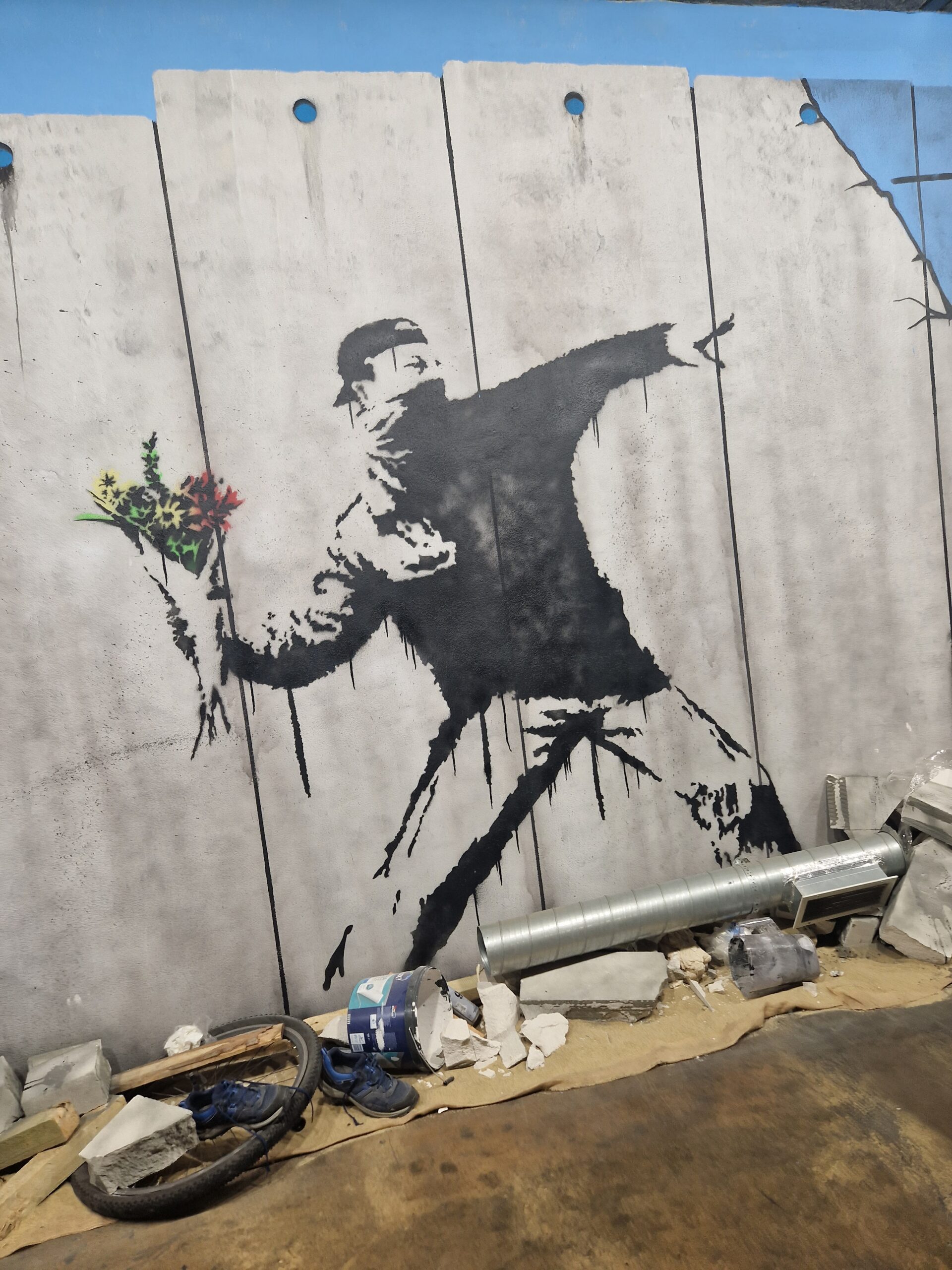
There is something almost poetic about discovering Banksy in Kazimierz.
Outside, Kraków moves at its usual pace. Café tables spill onto pavements, bicycles slip between pedestrians, trams rumble through the city and visitors wander between centuries-old synagogues, restaurants and the faded façades of one of the city’s most atmospheric neighbourhoods. But behind one of Kazimierz’s streets, the mood changes. Enter the old industrial building on Berka Joselewicza Street and the polished Kraków of guidebooks gives way to something rougher, darker and much more contemporary.
Inside the former Marcin Jarra factory, the walls become canvases.
More than 150 full-scale reproductions of Banksy’s work fill the post-industrial interiors, which date back to 1886 and cover more than 1,000 square metres. The exhibition brings together images associated with cities including London, Paris, New York, Naples, Venice, Bethlehem and Kyiv, turning the building into a kind of journey through the places where Banksy’s visual language has appeared.
There are rats and children, soldiers and protesters, balloons and flowers. There is humour, anger, tenderness and a great deal of political unease.
And somewhere between the satire and the provocation, something gentler begins to emerge.
Love.
Not the sentimental kind found on Valentine’s Day cards, but the more difficult kind: compassion for strangers, tenderness towards children, resistance to violence and the stubborn belief that another way of seeing the world might still be possible.
That is what makes the exhibition worth lingering over.
The Museum Feels More Like a Street Than a Gallery
Banksy’s art has always had an uneasy relationship with the traditional museum.
His work was born on city walls rather than behind glass. It appeared overnight, sometimes in places where nobody expected it, confronting commuters, tourists and passers-by before disappearing beneath layers of paint, weather or redevelopment.
The Kraków exhibition understands that.
Rather than placing the works neatly inside conventional white rooms, the exhibition uses the old industrial architecture as part of the experience. The organisers describe the space as an immersive presentation created with the involvement of international street artists, with animated visual elements and films accompanying the reproductions.
The effect is deliberately theatrical.
You move from one image to another almost as though walking through a city after dark, discovering something painted on a wall that you were not expecting to see.
The rough surfaces of the building help.
So does the scale.
A Banksy image that might normally appear on a computer screen or in a photograph suddenly occupies an entire wall. The relationship between the viewer and the artwork changes when you are standing in front of it rather than looking at it through a phone.
It feels closer to the street.
And that matters.
First, an Important Detail About the Exhibition
There is one thing travellers should know before visiting.
This is not an official Banksy exhibition authorised or curated by Banksy. The Kraków museum presents reproductions of his works, rather than a collection of original murals created by the artist specifically for this exhibition. Kraków’s official city information describes the display as more than 150 reproductions, while the museum itself explains that the exhibition recreates works from Banksy’s street career and includes reproductions of some studio pieces.
That distinction is important, particularly for anyone expecting to see original Banksy works.
But it does not necessarily diminish the experience.
In fact, there is an argument that reproduction is particularly appropriate to Banksy’s work. So many of his most famous pieces have vanished from the places where they originally appeared — painted over, damaged, removed, dismantled or simply lost to time. The Kraków exhibition attempts to bring some of those images together in one place.
You are not seeing the original wall.
You are seeing the memory of the wall.
And that is a rather Banksy-like idea in itself.
The Art of Saying More With Less
Banksy’s genius lies partly in his ability to communicate enormous ideas with very little.
A child holds a balloon.
A protester carries flowers.
A soldier searches a little girl.
A rat walks across a wall.
A couple kisses.
The image is simple.
The meaning is not.
His best work does not require a long explanation beside it. You see the image and understand the joke almost immediately. Then, a few seconds later, the joke becomes uncomfortable.
That second reaction is where the real work begins.
Banksy has built an international reputation by making political and social commentary accessible without making it simplistic. His images can be funny enough to attract attention and serious enough to stay in your head long after you have walked away.
The Kraków exhibition is full of those moments.
When Flowers Become Weapons
Perhaps the clearest example is the image commonly known as Rage, the Flower Thrower.
A masked man stands with his body twisted as if he is preparing to throw something. His clothing and posture suggest confrontation. You expect a stone, perhaps a weapon.
Instead, he holds a bouquet of flowers.
The contradiction is immediate.
The body says violence.
The flowers say peace.
It is one of those images that requires almost no explanation, yet the longer you look at it, the more questions appear.
Can anger be transformed?
Can protest remain peaceful?
Can resistance be beautiful?
And perhaps most importantly, what would happen if the instinct to destroy were replaced by the instinct to care?
That is where Banksy’s work becomes unexpectedly tender.
He is not simply making fun of the world.
He is imagining a different one.
A Child in a World Built by Adults
Children appear repeatedly in Banksy’s visual universe, often placed in situations where the innocence of childhood collides with the failures of adults.
The contrast is powerful.
A child does not understand borders in the same way an adult does. A child does not invent wars, build prison walls or write political speeches. Yet children are often among the first to suffer when adults make those decisions.
Banksy uses that vulnerability deliberately.
The children in his work can represent innocence, but they can also act as witnesses.
They look at us.
And sometimes it feels as though they are asking why the adult world has become so complicated.
The simplicity of the images makes the question harder to avoid.
The Girl and the Soldier
Among the works presented by the museum is The Girl and the Soldier, associated with Bethlehem and dated to 2008.
Bethlehem is not an incidental setting for Banksy.
The city and the wider Palestinian territories have been central to some of his most politically charged work, particularly his interventions around the separation wall.
Walls are a recurring subject in Banksy’s art because they are both physical and symbolic.
They divide.
They protect.
They imprison.
They separate people who might otherwise meet.
And yet Banksy repeatedly turns walls into places where people can communicate.
A concrete barrier becomes a canvas.
A political boundary becomes a place for imagination.
That transformation lies at the heart of his appeal.
Love in a Place of Conflict
It is tempting to describe Banksy purely as an artist of protest.
But that misses something.
His work is often angry, certainly. It can be cynical, funny, brutal and deliberately provocative. Yet underneath the politics there is a recurring concern with people.
People who are displaced.
People who are poor.
People who are ignored.
People caught in wars.
People who live behind borders.
People who simply want to be left alone.
That is why love can become a political idea in Banksy’s work.
To care about someone you have been encouraged to see as an enemy is itself a form of resistance.
To place flowers in the hands of a protester is to imagine a different response to violence.
To put a child at the centre of a political image is to remind us of the human cost hidden behind abstract words.
The message is not always optimistic.
But hope is there.
Usually hiding in plain sight.
And Then There Are the Rats
No Banksy experience would feel complete without the rats.
They scurry through his work with the confidence of creatures that know they will always survive the city.
They are unwanted.
They are persistent.
They are everywhere.
And perhaps that is why Banksy has used them so effectively.
The rat can represent the outsider, the rebel, the anonymous citizen or simply anyone who exists beyond the respectable surface of society.
There is humour in it, but there is also something uncomfortable.
Cities are designed to make some people visible and others invisible.
Banksy’s rats belong to the invisible side.
They live behind walls, under streets and in places people prefer not to think about.
Then suddenly one appears in enormous black paint on a city wall, and everyone notices.
A Journey Across Cities
One of the pleasures of the Kraków exhibition is the sense that you are moving through a fragmented map of Banksy’s career.
London.
Bristol.
Paris.
New York.
Venice.
Naples.
Bethlehem.
Ukraine.
The exhibition brings works associated with these different places together, allowing visitors to see how Banksy’s ideas have travelled across borders while remaining surprisingly recognisable.
His style is immediately identifiable.
A few lines.
A small number of colours.
A familiar figure.
A visual joke.
Yet the meaning changes depending on where the image appears.
Street art is never completely separate from its surroundings.
A stencil on a wall in London is part of London.
A piece created in a place marked by conflict carries another emotional weight.
A work appearing in a wealthy European city may make a completely different point from the same image in a refugee camp or war-torn neighbourhood.
The exhibition cannot reproduce those original streets.
But it can make you think about them.
Why the Old Factory Matters
The building itself adds another layer.
The former factory dates to 1886, a period when Kraków was undergoing its own industrial transformation. Today, the raw brick and industrial interiors contrast beautifully with the polished Renaissance architecture elsewhere in the city.
That contrast is part of the attraction.
Kraków is usually presented through its most beautiful face: Wawel Castle, the Main Market Square, Gothic towers and elegant historic streets.
But the city has another personality.
There are courtyards, workshops, old factories and fragments of industrial architecture hidden among the more famous sights.
The Banksy exhibition belongs to that side of Kraków.
It is rough around the edges.
It is contemporary.
And it refuses to behave like a traditional museum.
An Exhibition for People Who Don’t Normally Visit Art Museums
You do not have to know much about contemporary art to enjoy this exhibition.
That may be one of its greatest strengths.
Banksy’s images are deliberately democratic.
You do not need an art-history degree to understand why a flower is more hopeful than a weapon.
You do not need to know the entire political history of a country to understand that a wall can separate people.
You do not need to know who Banksy is to recognise the humour of a rat wearing a mask.
The exhibition works at the level of instinct.
You see.
You react.
Then you think.
For families, teenagers and travellers who normally skip galleries, that can make it an especially accessible cultural stop.
Kazimierz Outside the Museum
And then there is the neighbourhood.
Once you leave the exhibition, you are immediately back in Kazimierz, one of Kraków’s most atmospheric districts.
The contrast is worth embracing.
Spend an hour surrounded by Banksy’s political images, then step outside and wander through the streets.
Look at the old synagogues.
Stop for coffee.
Find a small restaurant.
Explore a courtyard.
Walk towards the Vistula.
The exhibition works particularly well as part of a wider afternoon in Kazimierz because the neighbourhood itself is full of layers — Jewish heritage, post-war history, contemporary culture, nightlife and a constantly changing creative scene.
You do not have to rush away after the last room.
In fact, you probably shouldn’t.
What Makes the Exhibition Memorable
It is not the number of artworks.
It is not even the famous name on the door.
It is the feeling that the exhibition keeps changing the emotional temperature.
You laugh.
Then you become uncomfortable.
You admire the visual simplicity.
Then you realise what the image is saying.
You photograph something.
Then you stop taking photographs and simply look.
That shift is important.
Good travel experiences often work in the same way.
They begin as something you want to see.
Then they become something you want to understand.
Leave Room for the Message
There are plenty of places in Kraków where you can spend an afternoon admiring beautiful things.
The Banksy exhibition asks for something different.
It asks you to look at the world you live in.
To think about who gets heard and who disappears.
To question violence.
To notice inequality.
To laugh at absurdity.
And, perhaps most importantly, to remember that compassion is not weakness.
The flowers matter.
The children matter.
The walls matter.
The people on the other side of them matter.
The Last Image You Carry With You
Eventually, you step back into the daylight.
Kazimierz is still there.
People are eating lunch.
Someone is riding past on a bicycle.
A couple is talking outside a café.
The city carries on.
But after an hour inside Banksy’s world, the streets can look slightly different.
A wall is no longer just a wall.
A flower can be a protest.
A child can be a political statement.
A joke can be an act of resistance.
And art can be a way of saying something difficult without shouting.
The Kraków exhibition may not give you the experience of discovering an original Banksy mural unexpectedly on a London street. Nor does it claim to. It is an immersive presentation built from reproductions, films and street-art-inspired installations inside an old industrial building.
But perhaps that is enough.
Because Banksy’s most enduring ideas do not belong to one wall.
They belong to everyone who sees them.
And among all the anger, irony and political commentary, there is a quieter message waiting underneath.
That people matter.
That kindness can be radical.
That beauty can survive in ugly places.
And that sometimes the most powerful thing you can put into the hands of someone ready to throw a stone is not another weapon at all.
It is a flower.
Leave a Reply