There are cities that ask to be visited slowly, and Kraków is one of them. Even on a first visit, it is tempting to move quickly between the famous sights — Wawel Castle, the Main Market Square, St Mary’s Basilica, the old streets of Kazimierz — trying to fit as much as possible into a single day. But Kraków rewards a different approach. Its greatest pleasure is not simply seeing its monuments; it is allowing one place to lead naturally to another, walking without constantly checking the map, stopping for coffee when a small café catches your attention, lingering in a church because the afternoon light has changed, and watching the city gradually shift from the quiet of the morning to the lively atmosphere of the evening.
A perfect day in Kraków therefore begins early, before the centre fills with visitors. The first destination should be Wawel Hill, rising above the Vistula in the heart of the city. There is something particularly beautiful about arriving here in the morning, when the streets are still relatively quiet and the castle complex seems to belong more to Kraków itself than to the crowds that will arrive later. The hill has been one of the most important places in Polish history for centuries. Kings lived here, rulers were buried here, and decisions that shaped the country were made within these walls. Even for visitors who know little about Polish history, the setting immediately communicates that this is not an ordinary castle on a hill.
The approach to Wawel is part of the experience. As you walk upwards, the city begins to open behind you, and the Vistula becomes visible below. The castle and cathedral dominate the hill, their different architectural forms reflecting the many centuries during which Wawel was developed and rebuilt. This is one of those places where the history of Poland is not presented as a distant story but as something physically surrounding you. Stone walls, courtyards, towers and chapels have survived through political changes, wars and generations of Kraków residents, and today they form one of the most recognisable silhouettes in the country.
Give yourself time to explore Wawel rather than treating it as a quick photo stop. The Royal Castle contains collections and historic interiors that reveal a different side of the complex, while Wawel Cathedral is closely connected with the religious and political history of Poland. The cathedral’s chapels, tombs and monumental interior provide a reminder of how closely religion and monarchy were once connected. For centuries, Wawel was not simply a royal residence. It was one of the great centres of Polish political and spiritual life.
Yet one of the pleasures of Wawel is that you do not need to know every historical detail to appreciate it. The architecture alone is enough to slow you down. Look closely at the courtyards, notice the mixture of architectural periods and then step outside towards the river. From the hill, Kraków feels surprisingly green. The Vistula moves quietly below, trees line sections of the riverbank and the dense centre of the city stretches away beyond it. It is a useful perspective before entering the streets of the Old Town.
After leaving Wawel, resist the temptation to rush directly towards the Main Market Square. Instead, walk north through the historic centre and allow Kraków to reveal itself gradually. The streets around the Old Town are among the most enjoyable places to explore on foot because the distances are manageable and there is always another architectural detail waiting around the corner. Medieval and Renaissance buildings stand beside later structures, while courtyards and narrow passages occasionally open into unexpected spaces.
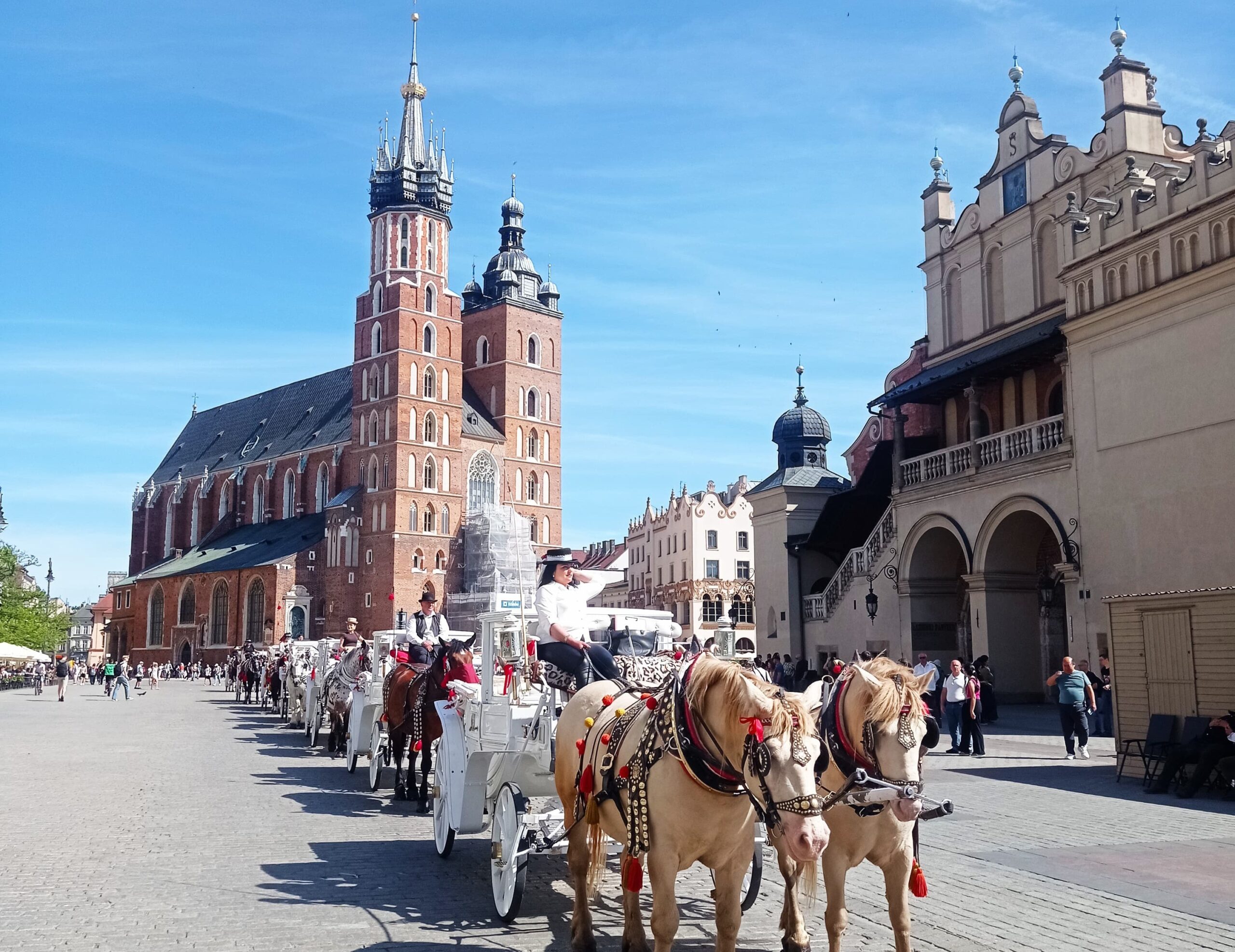
Eventually, the towers of St Mary’s Basilica appear and the city opens onto Rynek Główny, the Main Market Square. It is one of the largest medieval squares in Europe and one of the defining spaces of Kraków. The square can feel enormous when you first arrive, particularly after walking through the narrower streets surrounding it. At its centre stands the Cloth Hall, while St Mary’s Basilica dominates one side, its two towers rising above the surrounding buildings.
This is a good place to stop for breakfast or a second coffee, depending on how early you started. Kraków’s café culture makes it easy to turn a sightseeing break into part of the experience. Rather than choosing a place simply because it has a famous name, look for a café that feels comfortable and sit outside if the weather allows. From a table near the square, you can watch the city begin its daily rhythm: residents crossing the square on their way somewhere, visitors gathering around the monuments, bicycles passing through nearby streets and the first groups of tourists preparing for another day of sightseeing.
The Main Market Square is also the place to pay attention to sound. Every hour, the traditional trumpet call from St Mary’s Basilica can be heard across the square, a brief musical signal that has become one of Kraków’s most recognisable traditions. The story behind the interrupted melody is part of the city’s folklore, and hearing it in person gives the square a connection to the past that photographs cannot provide.
From the square, continue through the Old Town, but do not feel obliged to follow the most direct route. Kraków’s beauty often appears between the major attractions. Walk along streets such as Floriańska, look into old courtyards, pause beside church façades and notice the details above street level. The city is full of ornamental doorways, sculptures, painted façades and fragments of architectural history that are easily missed if you spend the entire day looking at a map.
By lunchtime, Kraków begins to change. The quiet of the early morning disappears, restaurant terraces become busy and the streets fill with people. This is a good moment to head towards one of the city’s most distinctive neighbourhoods: Kazimierz.
The walk from the Old Town to Kazimierz is short enough to make on foot, and that is exactly how you should travel between them. Kraków is compact enough that walking becomes part of the sightseeing. You see the transition gradually rather than arriving suddenly in another neighbourhood. The grand historic centre becomes more intimate, the streets change character and eventually the atmosphere of Kazimierz begins to emerge.
Kazimierz carries a history that is both rich and painful. For centuries, it was home to a flourishing Jewish community, and its synagogues, cemeteries, streets and surviving buildings remain important parts of Kraków’s cultural heritage. The neighbourhood was devastated during the Second World War and the Holocaust, when Kraków’s Jewish population suffered persecution, deportation and mass murder. Today, Kazimierz is lively and fashionable, filled with restaurants, cafés, bars, galleries and small shops, but its modern atmosphere exists alongside the memory of the community that once lived here.
That contrast is one of the reasons Kazimierz deserves to be explored thoughtfully.
Spend part of the afternoon walking through the neighbourhood rather than simply searching for a restaurant. Visit the historic synagogues if they are open, walk through Szeroka Street and take time to understand the layers of history beneath the lively modern scene. Around the old Jewish quarter, the past is not always presented dramatically. Sometimes it is visible in a doorway, a plaque, an old building or a cemetery wall. These details reward visitors who slow down.
Then there is the food.
Kazimierz has become one of Kraków’s most interesting places to eat, particularly for travellers who want something less formal than the restaurants surrounding the Main Market Square. The neighbourhood is known for Jewish-inspired cuisine, Polish dishes, cafés, bakeries and the casual food culture that has developed around its squares and side streets. A visit to Plac Nowy is almost obligatory for anyone wanting to experience the more informal side of Kazimierz. The square has long been associated with local street food, cafés and nightlife, and it offers a completely different atmosphere from the grand historic spaces of the Old Town.
For lunch, this is where the day can become less structured. Order something local, sit down and take your time. Polish cuisine is far broader than the pierogi that appear on almost every tourist menu, although a good plate of pierogi is certainly worth having. Depending on the season, you might encounter soups, potato dishes, regional meats, pickled vegetables, seasonal produce and desserts that tell their own story about Polish food traditions.
After lunch, walk again.
This may sound obvious, but it is one of the best pieces of advice for a day in Kraków. The city is small enough to cross on foot, and some of its most memorable moments happen between destinations. From Kazimierz, head towards the Vistula and follow the river for a while. The riverbank offers a welcome change after several hours among buildings and narrow streets. People cycle along the paths, locals sit beside the water and boats move slowly along the river during the warmer months.
From here, Kraków looks different again.
Wawel Hill rises above the river, and if you have walked from there in the morning, seeing the castle from below provides a satisfying sense of the city’s geography. The places you visited earlier are no longer isolated attractions on a tourist itinerary. They form a connected landscape: the hill, the river, the Old Town and Kazimierz all belong to the same historic city.
As afternoon turns towards evening, make your way back into Kazimierz. This is when the neighbourhood begins to show another personality. The cafés fill, tables move onto pavements, lights appear in windows and the streets become more sociable. What felt historical and contemplative earlier in the day now becomes lively. Kraków is a city that does not have a single atmosphere; it changes with the hour.
If you still have energy, continue towards Podgórze, across the river. It is another part of Kraków that rewards visitors willing to go beyond the standard route. The neighbourhood contains important sites connected with the city’s wartime history, including the area of the former Kraków Ghetto and the remnants of its wartime story. The atmosphere here is quieter, and the history demands more reflection than sightseeing.
For a first day in Kraków, however, you may prefer to remain in Kazimierz and let the evening unfold there. There is no need to see everything. One of the mistakes visitors make in historic cities is believing that a successful day is measured by the number of attractions completed. Kraków works better when you leave some things unseen. It gives you a reason to return.
Dinner is another opportunity to experience the city rather than simply refuel. Choose a restaurant that focuses on Polish or regional cuisine, or return to one of the neighbourhood’s smaller establishments. Take your time. A long dinner is not a failure to keep sightseeing; it is part of discovering the culture of the place you are visiting.
And then, when the evening is fully underway, walk back towards the Old Town.
Kraków at night is a different city from the one you encountered in the morning. The Main Market Square is illuminated, the historic façades take on warmer tones and the crowds become a mixture of locals and visitors enjoying the evening. The churches and medieval buildings appear more dramatic after dark, while the narrow streets around the square seem to draw you deeper into the city.
This is the moment when the whole day begins to make sense.
You started on a royal hill overlooking the Vistula, walked through the medieval centre, sat in one of Europe’s great historic squares, crossed into a neighbourhood shaped by centuries of Jewish history, ate local food, followed the river and returned to the heart of the city after sunset. It is not everything Kraków has to offer, but it is enough to understand why the city has such a powerful hold on visitors.
The perfect day in Kraków is therefore not really about following a perfect itinerary.
It is about connecting different parts of the city.
Wawel tells the story of kings and the Polish state. The Old Town reveals the medieval and commercial heart of Kraków. Kazimierz introduces a more complicated history, one marked by Jewish culture, war, loss and remarkable renewal. The Vistula provides the landscape that ties these places together. And the cafés, restaurants, markets and ordinary streets add the contemporary life that prevents the city from becoming simply an open-air museum.
There will always be another museum to visit, another church to enter and another street to explore. But if you have only one day, do not try to conquer Kraków.
Walk it.
Begin with the castle when the morning is still quiet. Let the Old Town slowly become busy around you. Take your time over lunch. Explore Kazimierz without rushing. Follow the river when you need a break from the crowds. And when evening arrives, find a table somewhere in the historic centre and watch Kraków settle into the night.
You may leave without having seen everything.
That is perfectly fine.
Kraków is not a city that rewards completion. It rewards curiosity — and one day is just enough to make you want another.
Leave a Reply