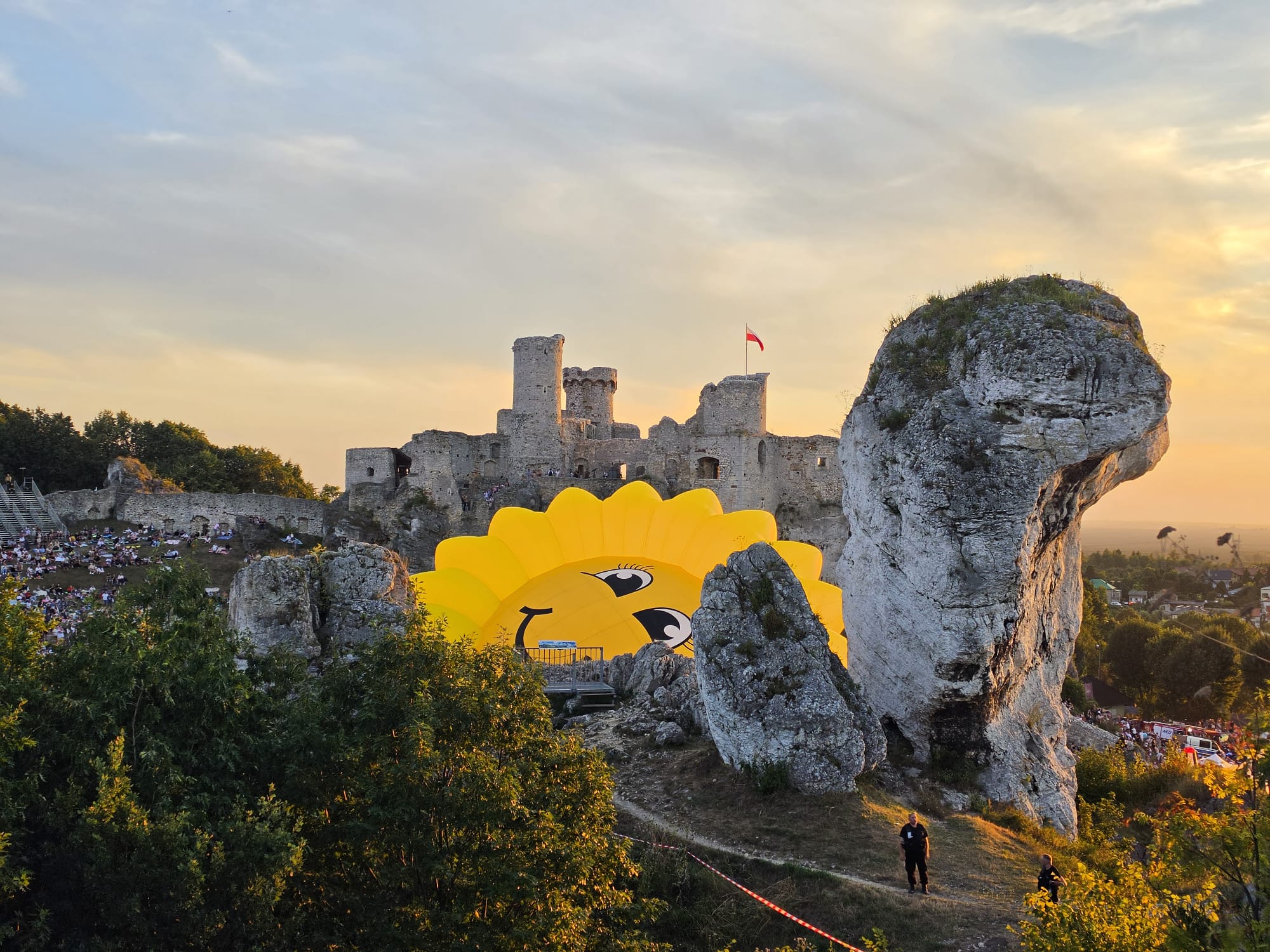
High above the limestone hills of the Kraków-Częstochowa Upland, the ruins of Ogrodzieniec Castle rise from the landscape like something from a forgotten medieval kingdom. Broken walls climb over pale rocks, towers emerge from the surrounding forest, and narrow passages lead visitors through a maze of courtyards and ruined chambers. From a distance, the castle appears almost inseparable from the dramatic landscape beneath it. The rocks seem to have grown around the fortress, while the fortress itself appears to have been built precisely for this place — high, difficult to reach and surrounded by a landscape that once offered both protection and a commanding view of the surrounding countryside.
Today, Ogrodzieniec is one of the most important tourist attractions in the Silesian Voivodeship and one of the most spectacular castle ruins in southern Poland. It attracts visitors interested in history and architecture, but its appeal goes beyond the remains of the medieval fortress. People come for the views, the legends, the unusual limestone formations and the atmosphere of a place where centuries of Polish history seem to remain embedded in the stones. Walking through the ruins is not like visiting a perfectly preserved palace. There are no polished halls or intact royal apartments waiting behind the doors. Instead, there are fragments — walls, arches, stairways, towers and foundations — and it is precisely these fragments that allow the imagination to reconstruct the castle that once dominated this part of the country.
The story of Ogrodzieniec begins in the Middle Ages, when castles were not built merely as symbols of wealth but as essential parts of a defensive network. The fortress that eventually became Ogrodzieniec Castle was constructed on the highest point of a limestone hill, taking advantage of the natural terrain. The surrounding rocks were not an obstacle to construction; they became part of it. The irregular shape of the hill influenced the form of the castle, creating a fortress that seems to grow directly from the stone beneath it.
The location was particularly valuable because the castle stood along an important historical route between Kraków and the regions to the west. The area around the Kraków-Częstochowa Upland was dotted with fortified strongholds, many of which were connected with the defensive system later associated with the Eagles’ Nests — a chain of castles and fortifications positioned dramatically on limestone hills and rocky outcrops. Their names alone capture something of their character. Seen from the valleys below, these castles appear perched on the landscape like birds of prey watching over the countryside.
Ogrodzieniec is among the most impressive examples of this tradition.
The castle as visitors see it today, however, is the result of many different periods of construction and change. What began as a medieval defensive stronghold was later transformed into a more elaborate Renaissance residence. The needs of its owners changed, and so did the building. Defensive walls remained important, but comfort, prestige and architectural ambition became increasingly significant. Towers and courtyards were developed, residential spaces were expanded, and the fortress gradually acquired the appearance of a grand aristocratic residence rather than a purely military stronghold.
This transformation tells an important story about Poland itself. Medieval castles were places of defence, but by the Renaissance period, powerful families increasingly used them to demonstrate status and wealth. Architecture became a statement. A residence needed to be secure, but it also needed to impress guests and reflect the importance of its owners. At Ogrodzieniec, these different purposes came together in an extraordinary building shaped by both the rugged landscape and the changing ambitions of the people who lived there.
Walking through the ruins today, it is possible to see traces of that former grandeur. Massive stone walls still dominate the hilltop, while fragments of windows, doorways and architectural details reveal the sophistication of parts of the former residence. The scale of some surviving structures gives a sense of how imposing the castle must once have appeared. Even in ruins, Ogrodzieniec does not feel small. The remains spread across the hill, connected by passages and courtyards, creating an environment that rewards slow exploration.
The surrounding landscape is equally important.
Ogrodzieniec is situated among the distinctive limestone formations of the Kraków-Częstochowa Upland, a region known for white rock outcrops, forests, valleys and rolling hills. The rocks around the castle are not simply scenery; they are one of the reasons the fortress was built here in the first place. Natural cliffs provided additional protection, while the elevated position gave defenders a commanding view.
For modern visitors, those same features provide some of the most memorable views in the area.
Standing among the ruins and looking beyond the walls, the landscape opens into a mixture of woodland, fields and distant hills. In summer, the green vegetation contrasts strongly with the pale limestone. In autumn, the forest changes colour and gives the castle an entirely different character. During winter, when the trees are bare and the landscape is often quieter, the ruins can appear even more dramatic against the sky.
It is a place that changes with the seasons.
Perhaps nowhere is this more obvious than in the atmosphere of the castle itself. On a bright summer afternoon, the ruins can be full of families, hikers and visitors exploring the courtyards. Children climb carefully through designated areas, cameras appear at every viewpoint, and the sounds of conversation echo between the stone walls. On a grey autumn morning, however, the same ruins can feel almost deserted, with mist hanging over the surrounding forest and the stones appearing darker beneath the cloudy sky.
This changing atmosphere has helped make Ogrodzieniec one of the most photographed castles in Poland.
But Ogrodzieniec is not simply a picturesque ruin. Like many old castles, it has accumulated stories and legends over the centuries, and some of the most enduring tales concern a mysterious black dog said to appear around the ruins. According to local legend, the animal is connected with the castle’s former owners and is sometimes described as a supernatural guardian wandering through the ruins at night.
Whether one believes the story is beside the point. Legends such as this are part of the cultural life of historic places. They give visitors another way to imagine the past, turning a collection of stones into a place with personality and mystery. A ruined castle already invites questions — who lived here, who walked these corridors, what happened behind these walls? A ghost story simply gives the imagination somewhere to go.
Ogrodzieniec’s reputation for drama was strengthened further when the ruins appeared in popular culture. The castle was used as a filming location for the Netflix series The Witcher, introducing its striking architecture and landscape to an international audience. For viewers who had never heard of Ogrodzieniec before, the appearance of the castle offered an unexpected glimpse of Poland’s medieval heritage.
Yet long before cameras arrived, the ruins had already been attracting generations of Polish visitors.
That is important because Ogrodzieniec belongs to a much larger tradition of castle tourism in Poland. The country’s history has left behind an extraordinary collection of fortresses, palaces and manor houses, each reflecting different periods of political and cultural change. Some were rebuilt many times, some survived almost intact and others, like Ogrodzieniec, became powerful ruins whose broken walls are now part of the landscape.
There is something particularly compelling about ruins in Poland because they often carry the memory of a complicated past. Kingdoms changed, noble families rose and disappeared, wars transformed borders, and buildings that once seemed permanent eventually fell into decay. A ruined castle therefore tells two stories at once: the story of the people who built and inhabited it, and the story of time itself.
Ogrodzieniec makes both stories visible.
The castle suffered damage and decline over the centuries, particularly during periods of war and political upheaval. Eventually, it ceased to function as the grand residence it had once been, and the structure gradually became a ruin. Stone was lost, buildings deteriorated and parts of the complex disappeared. Yet enough survived to make the castle one of the most impressive historic sites in the region.
Today, conservation work and tourism have given the ruins a new life. Instead of being abandoned remains on a remote hill, Ogrodzieniec has become an important destination for people exploring southern Poland. Paths lead visitors through the complex, information helps explain its history, and the surrounding area offers opportunities for hiking and discovering the limestone landscape.
The experience is particularly rewarding when combined with a wider journey through the Jura region. The Kraków-Częstochowa Upland is not a place that should be rushed through. Its castles, rocky formations and wooded paths create a landscape that rewards travellers willing to leave the main roads and explore. Ogrodzieniec can serve as one of the highlights of such a journey, but it is also a gateway to understanding the geography that shaped the region’s history.
There is a reason the medieval builders chose high rocks for their fortresses. The landscape itself explains it.
And yet, after centuries have passed, the defensive advantage has become something else entirely. The high position that once protected the castle now gives visitors some of the best views. The rocks that once made the fortress difficult to attack now make it extraordinary to photograph. The ruins that once represented power and security have become a place for walking, exploring and remembering.
That transformation is one of the most fascinating things about Ogrodzieniec.
A castle built to withstand enemies now welcomes tourists.
Walls designed to keep people out now invite them in.
A place that once belonged to a small number of powerful families has become part of the shared heritage of the region.
And perhaps this is why Ogrodzieniec deserves more than a quick photograph from the entrance. Its real character only becomes apparent when you walk through the ruins, climb towards the remaining towers and stop to look at the landscape beyond the walls. The castle is not simply an isolated monument. It is the meeting point of architecture, geology, history and legend.
For travellers exploring the Silesian Voivodeship, it is one of those places that can change the way you understand the region. Silesia is often associated with industrial cities, mining heritage and a heavily urbanised landscape, but Ogrodzieniec reveals another side of the voivodeship — one of forests, limestone hills, medieval fortresses and rural landscapes.
It is a reminder that Poland rarely fits into a single picture.
The country can be industrial and rural, modern and medieval, crowded and wonderfully quiet. Within a relatively short journey, a traveller can move from the streets of a major city into a landscape where a ruined castle stands above the trees almost exactly as it might have appeared centuries ago.
As the afternoon light begins to fade across the limestone, Ogrodzieniec becomes particularly atmospheric. The crowds gradually thin, the noise of the day disappears and the ruins take on a deeper colour. The broken towers and walls stand against the sky, and it becomes easier to imagine the fortress not as a tourist attraction but as a living place — a place where people once ate, argued, celebrated, prayed, planned and worried about the world beyond the walls.
That is the lasting attraction of Ogrodzieniec.
It does not offer a perfectly preserved version of the past. Instead, it offers fragments, and those fragments leave room for imagination. The castle’s stones have survived long enough to tell us that something important once stood here, while the surrounding landscape explains why people chose this extraordinary hill in the first place.
For anyone travelling through southern Poland, Ogrodzieniec is therefore more than a stop on a list of attractions. It is a journey into the country’s medieval landscape — a place where history remains visible not in a museum case, but in towering walls, weathered stones and a castle dramatically rooted in the rocks.
And when you finally stand at the highest point of the ruins, looking across the forests and hills of the Jura, it is easy to understand why this extraordinary place has survived in the imagination of Poland for so long.
Leave a Reply