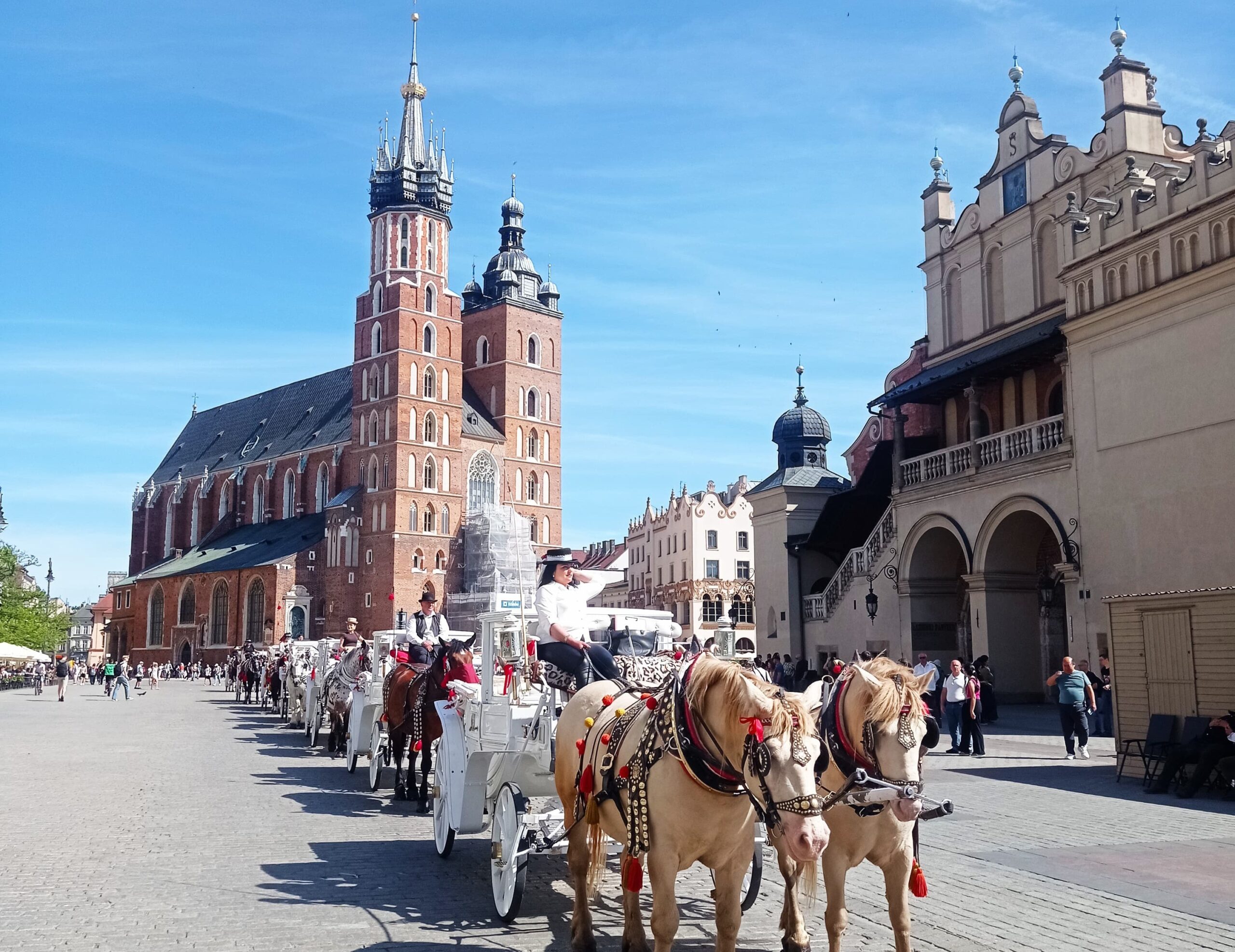
Kraków is a city that seems to have been built for stories. Beneath the towers of Wawel Castle, a dragon is said to have once lived in a cave. In the centre of the city, medieval streets and market stalls lie buried beneath the pavement. Along the Vistula, boats drift past the old royal hill, while beyond the historic centre, forests, gardens and wide-open spaces offer a welcome escape from the crowds. For adults, Kraków is a city of kings, churches, art and centuries of history. For children, it can be something even better: a place where legends appear to have escaped from books and become part of the landscape.
That is what makes Kraków such an unexpectedly good family destination. You can spend the morning wandering through the Old Town and, rather than asking children to stand quietly in front of another painting or historic plaque, give them a dragon to find. A visit to Wawel becomes an adventure beneath the castle. The Main Market Square becomes the entrance to an underground archaeological world. A walk along the river turns into a search for mythical creatures, while a trip outside the centre leads into the wooded hills of Las Wolski and one of Poland’s most atmospheric zoos. The city offers enough history to satisfy adults without asking children to spend the entire holiday behaving like miniature historians.
The secret is not to try to see Kraków exactly as an adult would. The city’s greatest family experiences are often found in the spaces between the famous sights: a shaded stretch of Planty where children can run after a morning of sightseeing, an ice cream beside the Vistula, a boat appearing around the bend in the river, or the sudden roar of a dragon breathing fire beneath Wawel Hill. Build the day around these moments and Kraków becomes much less about ticking attractions off a list and much more about discovering a city together.
Begin With a Dragon at Wawel
There are few better introductions to Kraków for a child than the Wawel Dragon. The bronze creature standing beside the Vistula has become one of the city’s most beloved symbols, but the legend behind it is much older than the statue itself. According to the traditional story, a monstrous dragon once lived beneath Wawel Hill and terrorised the people of Kraków, demanding animals and even young women as food. Knights tried and failed to defeat it until a clever shoemaker devised a more unusual plan: a sheep stuffed with sulphur was left for the dragon to eat. The creature swallowed it, became desperately thirsty and drank so much water from the Vistula that it eventually burst.
Today, the legend is made remarkably tangible. The Dragon’s Den is a real cave beneath Wawel Hill, and during the visitor season families can descend into its dark passages before emerging beside the river. Outside, the famous bronze dragon waits near the mouth of the cave, occasionally sending a burst of real fire into the air. It is an almost perfect family attraction because nobody needs to explain why it is interesting. Children understand immediately. There is a castle above them, a cave beneath them, a river beside them and a dragon in front of them. Even parents who have spent the morning immersed in Polish history are likely to find themselves waiting for the next fiery breath.
From here, the Vistula provides a natural continuation. Instead of immediately returning to the crowded centre, walk along the river and let the city open up. Wawel rises above the water behind you, while the opposite bank gives a broader view of the castle and the historic skyline. The pace becomes slower, and that matters when travelling with children. A family holiday in Kraków is not won by seeing the most sights before sunset. It is won by knowing when to stop.
Let Wawel Become a Castle, Not a History Lesson
Wawel is one of Poland’s most important historic places, but children do not need to know the names of every monarch who lived here to appreciate it. The hill itself does much of the work. Its walls, towers and courtyards have the unmistakable atmosphere of a medieval fortress, while the royal chambers and cathedral introduce a world of kings, queens, knights and ceremonies that feels far removed from modern Kraków.
The trick is to let children imagine the place before explaining it. Ask where they think the king slept. Let them search for the most impressive room. Look down from the hill towards the Vistula and imagine how the city would have looked hundreds of years ago. History becomes easier to understand when it is connected to physical spaces rather than presented as a collection of dates. Wawel was not simply a chapter in a textbook; it was a home, a centre of power and a place where generations of people actually lived.
And when attention begins to disappear, that is your signal to leave the castle rather than force another exhibition. The Dragon’s Den and river are waiting below.
Beneath the Main Square, Another Kraków Is Waiting
Few family attractions in Kraków are as effective at turning history into adventure as Rynek Underground. From the surface, the Main Market Square is a spectacular but very familiar European city space: St Mary’s Basilica dominates one side, the Cloth Hall stretches across the centre and cafés occupy the surrounding streets. Yet beneath all this modern activity lies a much older Kraków.
The underground museum takes visitors below the square, where archaeological discoveries reveal the medieval marketplace and the lives of the people who once worked and traded here. The experience is particularly effective for children because the idea is so simple: the city you can see is not the oldest city. There is another one underneath it.
Descending underground changes the atmosphere immediately. The light disappears, the modern square becomes distant and old stone, archaeological remains and objects from everyday life take its place. Children who might have little patience for a conventional history museum can become surprisingly absorbed when the story involves going underground and discovering something hidden.
It is one of those experiences that also changes the way you see Kraków after leaving. Once you know what lies beneath the Main Square, every old street feels as though it might have another story buried below it.
When the City Gets Too Much, Find the Green
Kraków’s historic centre is wonderfully walkable, but even the most enthusiastic young traveller eventually needs somewhere to run. Planty, the green belt surrounding the Old Town, is therefore one of the most useful places in the city for families. It is not an attraction in the conventional sense, and that is precisely why it works.
After the crowds of the Main Square, the trees and paths provide a natural pause. Children can move ahead without the constant pressure of navigating busy streets, while parents can sit for a few minutes and watch the city continue around them. The old medieval walls that once surrounded Kraków have largely disappeared, but Planty follows their former line, creating a green ring between the historic centre and the newer city.
It is worth resisting the urge to make every stop educational. Let children notice things for themselves. A statue, a bird, an unusual building glimpsed through the trees, a fountain or simply a patch of grass can become more memorable than another carefully explained historical fact. Family travel works best when there is room for discovery that nobody planned.
And that is perhaps Kraków’s greatest advantage with children: you can keep the history, but you do not have to make the entire trip feel like a lesson.
Leave a Reply