Author: Why Poland?

  • A Brief History of the Hejnał Trumpet Call, Kraków’s Hourly Tradition

    Every hour, a trumpet sounds from the tower of St. Mary’s Basilica in Kraków. The melody lasts only a few moments, but its story has become one of the city’s most enduring traditions.

    Stand in Kraków’s Main Market Square at almost any hour, and sooner or later you will hear it.

    A clear trumpet rises above the rooftops from the taller tower of St. Mary’s Basilica. The melody is played once, then again, and again—four times in total, facing the four directions of the city.

    And then, unexpectedly, it stops.

    There is no grand ending.

    That unfinished final phrase is the Hejnał Mariacki, or St. Mary’s Trumpet Call, one of Kraków’s most recognizable symbols. The city officially describes it as a tradition that is played every hour, day and night, from the basilica’s higher tower.

    But why does the melody stop so abruptly?

    The legend of the trumpeter

    The story most visitors hear begins in 1241, when Mongol—often called Tatar in Polish historical tradition—forces approached Kraków.

    According to the legend, a watchman standing in a tower saw the approaching army and sounded his trumpet to warn the city.

    The alarm worked.

    But before the trumpeter could finish the melody, an enemy arrow struck him in the throat.

    The trumpet fell silent.

    And that, the story says, is why the Hejnał still ends abruptly today.

    It is a wonderfully dramatic explanation.

    There is just one problem.

    There is no historical evidence proving that this is how the tradition began.

    What we actually know

    The history of the Hejnał is older and less certain than the legend suggests.

    The tradition is documented from the Middle Ages, and the call originally had a practical purpose. A watchman on the church tower helped monitor the city for danger, including fires and approaching enemies. The signal was also connected with the opening and closing of Kraków’s city gates.

    According to Kraków’s official tourism information, the call was initially played at dawn and sunset and was later performed every hour.

    Culture.pl likewise describes the Hejnał as a medieval time signal, with the tradition established by the 14th century.

    In other words, the trumpet was originally less about romance and more about keeping a medieval city organized and alert.

    The legend came later.

    Why does it face four directions?

    Listen carefully and you will notice that the trumpeter does not simply play once.

    The melody is performed in four directions, traditionally associated with the four cardinal points of the compass.

    Today, the trumpeter opens windows on the tower and plays the signal toward each direction. The tradition has become part of the soundscape of Kraków itself.

    It is a wonderfully old-fashioned idea: a melody broadcast from a tower, not through speakers or phones, but directly into the streets.

    And despite the city’s modern traffic and constant movement, the sound still carries across the Main Square.

    The tradition survives

    One reason the Hejnał feels so remarkable is that it is not a recording.

    It is played live by trumpeters stationed in the tower of St. Mary’s Basilica. Kraków’s official city information notes that firefighters serving as trumpeters take turns performing the call around the clock.

    The tradition has also reached far beyond Kraków.

    Since 1927, the Hejnał has been broadcast by Polish Radio at noon, allowing listeners throughout Poland to hear the famous melody.

    A signal that once warned a medieval city of danger eventually became one of Poland’s most recognizable radio sounds.

    More than a melody

    Perhaps the most fascinating thing about the Hejnał is the way history and legend have become inseparable.

    We may never know exactly why the original melody ends where it does.

    The medieval watchman may never have been shot by an arrow.

    But the story has become part of Kraków’s identity.

    Every hour, the same unfinished phrase reminds the city of its past.

    Tourists stop in the Main Square and look upward.

    Locals hear it as part of everyday life.

    And somewhere high above them, another trumpeter opens the window and begins to play.

    The melody travels across the rooftops.

    Then it stops.

    Just as it has done for generations.

    If you want to hear it: The Hejnał is played every hour, around the clock, from the higher tower of St. Mary’s Basilica overlooking Kraków’s Main Market Square. The noon performance is also broadcast nationwide on Polish Radio.

  • Free Things to Do in Kraków: A Budget-Friendly Travel Guide

    Kraków is one of the easiest cities in Poland to enjoy without spending much money. You can walk through a medieval square, wander beneath the walls of Wawel Castle, cross the Vistula at sunset, explore the atmospheric streets of Kazimierz and climb one of the city’s ancient mounds without buying a ticket. Some of the most memorable experiences are not behind a museum entrance at all. They are waiting outside, in the streets, parks, churches and neighbourhoods where Kraków’s history continues to unfold every day.

    This is particularly good news for travellers on a budget.

    Kraków has a reputation for being one of Poland’s most beautiful destinations, and its famous attractions can certainly come with admission fees. But you do not need to buy a long list of tickets to experience the character of the city. In fact, some of the best days in Kraków can cost almost nothing.

    The secret is to slow down.

    Instead of moving from one ticketed attraction to another, give yourself time to walk. Follow the Planty around the Old Town. Sit beside the Vistula. Wander through Kazimierz without a particular destination. Watch the trumpeter’s call from St Mary’s Basilica. Explore the streets around the Main Market Square early in the morning, before the crowds arrive.

    Kraków rewards curiosity more than money.

    Start in the Main Market Square

    The best free attraction in Kraków is also the one that almost every visitor sees first: the Main Market Square.

    Rynek Główny is enormous by European medieval standards and has been at the heart of Kraków for centuries. Today, it is one of the city’s great public spaces, surrounded by historic townhouses, cafés, churches and landmarks.

    You do not need a ticket to experience it.

    Simply walk into the square and take your time.

    Look towards St Mary’s Basilica and listen for the famous trumpet call, the Hejnał Mariacki, traditionally played from the tower every hour. Watch the crowds moving between the Cloth Hall and the surrounding streets. In the early morning, the square can feel surprisingly peaceful; later in the day, it becomes one of the busiest places in the city.

    The atmosphere changes again after sunset.

    The buildings are illuminated, horse-drawn carriages move around the edges of the square and the cafés fill with people. It can be tempting to think of the Main Market Square as merely a place to pass through on the way to another attraction, but it is worth doing the opposite.

    Stay.

    Sit on a bench.

    Watch Kraków.

    This is a public square, and experiencing it costs nothing.

    Walk the Planty

    Encircling Kraków’s Old Town is one of the city’s most pleasant free attractions: Planty Park.

    Planty occupies the area where the medieval city walls and defensive structures once stood. Instead of leaving the centre surrounded by fortifications, Kraków eventually transformed much of the former defensive zone into a green belt.

    Today, Planty is one of the best places to escape the intensity of the Old Town without actually leaving it.

    A walk around the park takes you through a changing sequence of trees, lawns, statues and pathways. At one moment you are beside a busy street; a few minutes later, you are sitting beneath trees with the sound of traffic softened around you.

    It is especially beautiful in spring and summer, when the greenery makes the historic buildings beyond the park feel even more dramatic.

    But Planty has another advantage for budget travellers.

    It can become part of the journey between attractions.

    Instead of taking public transport from one side of the Old Town to another, walk through the park. You save money, see more of Kraków and discover corners that you might otherwise miss.

    Walk up Wawel Hill

    Wawel is one of Poland’s most important historic sites, and many of its interior exhibitions require tickets. But the hill itself and the surrounding outdoor areas offer plenty to explore without paying admission.

    Zamek Królewski na Wawelu – Państwowe Zbiory Sztuki dominates the skyline above the Vistula and has been closely connected with Polish royal history for centuries.

    You can walk up Wawel Hill, admire the exterior of the castle complex and cathedral, explore the courtyards and take in the views over the river and surrounding city.

    The experience is particularly atmospheric in the early morning.

    The crowds are thinner, the light is softer and the hill feels less like a major tourist attraction and more like a historic part of the city.

    The castle interiors are where you will need to start checking ticket prices, but you can still experience the grandeur of Wawel without entering every exhibition.

    Sometimes simply standing on the hill and looking across Kraków is enough.

    See the Vistula from the riverbanks

    The Vistula is one of the best free spaces in Kraków.

    The river divides and connects different parts of the city, and its banks offer some of the easiest opportunities to slow down after a day of sightseeing.

    Walk along the boulevards near Wawel and you will see cyclists, runners, families, students and people simply sitting beside the water. On warm evenings, the riverbanks become particularly lively.

    This is also one of the best places in Kraków for sunset.

    As the light begins to disappear behind the city, Wawel takes on a different appearance. The river reflects the changing sky, boats move slowly across the water and the historic buildings become silhouettes.

    You do not need a restaurant terrace to enjoy the view.

    Bring a bottle of water or something from a supermarket, find a place beside the river and watch the evening arrive.

    Explore Kazimierz on foot

    Few neighbourhoods in Kraków reward walking as much as Kazimierz.

    Once a centre of Jewish life in Kraków, the district has a complicated history that can be felt in its synagogues, cemeteries, streets and surviving architecture. Today, it is also one of the city’s most popular areas for restaurants, cafés, bars, galleries and nightlife.

    But you do not have to spend anything to experience its atmosphere.

    Start around Szeroka Street and wander without a strict route. Look at the old buildings. Notice the small courtyards and architectural details. Walk towards Plac Nowy and then continue through the surrounding streets.

    Kazimierz is particularly enjoyable when you are not trying to reach a specific destination.

    Every turn offers another detail.

    A faded sign.

    An old doorway.

    A tiny courtyard.

    A synagogue standing quietly among modern businesses.

    A café hidden inside a historic building.

    This is one of those parts of Kraków where the best sightseeing activity is simply walking.

    Visit Plac Bohaterów Getta

    Across the Vistula, in Podgórze, another square tells a much darker story.

    Plac Bohaterów Getta is the site of the famous installation of empty chairs, created by artists Piotr Lewicki and Kazimierz Łatak. The chairs represent the belongings and furniture left behind when the Jewish population of the Kraków ghetto was forcibly removed during the Second World War.

    The installation is powerful precisely because it is so simple.

    Rows of empty chairs stand across the square.

    There is no elaborate monument demanding attention. Instead, the objects invite you to stop and think about the people who once lived here.

    Visiting the square is free, and it can be combined with a walk through Podgórze and along the Vistula.

    For travellers interested in Kraków’s wartime history, this is one of the city’s most important public spaces.

    Discover Kraków’s churches

    Kraków’s churches are among its greatest architectural treasures, and many can be entered without paying an admission fee, although rules can vary depending on services, events and particular areas.

    The city’s religious buildings are not simply beautiful interiors. They are part of the history of Kraków itself.

    St Mary’s Basilica dominates the Main Market Square. St Francis’ Basilica is known for its colourful interior and connection with the Franciscan tradition. The Church of St Peter and St Paul on Grodzka Street is another architectural landmark.

    Entering a church can also provide a welcome moment of quiet after the noise of the streets.

    Remember that these are active places of worship rather than museums. Dress respectfully, avoid disturbing services and follow any instructions displayed at the entrance.

    The reward is an opportunity to experience Kraków’s religious heritage without necessarily spending anything.

    Climb Krakus Mound

    If you want one of the best free views in Kraków, head towards Podgórze and climb Krakus Mound.

    Kopiec Krakusa is one of the city’s ancient mounds and one of its most atmospheric viewpoints. The climb is not particularly demanding for most visitors, and once you reach the top, the city opens out around you.

    The view is different from what you see from Wawel.

    From here, Kraków appears less like a collection of individual monuments and more like a sprawling city surrounded by greenery and hills.

    On a clear day, the panorama stretches across much of Kraków.

    The best part?

    There is no entrance ticket.

    Go around sunset if the weather is good. Bring something to drink, find a comfortable place and watch the city change colour as evening approaches.

    It is one of the simplest and most rewarding free experiences in Kraków.

    Take the walk to Kościuszko Mound

    Another famous Kraków mound is Kościuszko Mound.

    Kopiec Kościuszki offers spectacular panoramic views and is one of the city’s most recognisable landmarks. However, there is an important distinction for budget travellers: access to the mound itself is ticketed.

    The surrounding area and approaches can still be enjoyed as part of a walk, but if your goal is specifically to reach the summit, check the current admission arrangements before going.

    This is a useful reminder when planning a “free Kraków” itinerary: not every beautiful viewpoint is completely free, even if the surrounding landscape is.

    If you want a guaranteed no-ticket mound experience, Krakus Mound is the better choice.

    Find the hidden courtyards of the Old Town

    One of the pleasures of Kraków is that some of its most interesting details are not listed on attraction maps.

    Look beyond the main streets.

    The Old Town is filled with historic entrances, courtyards and passages that reveal another side of the city’s architecture. Some are quiet and residential, while others contain cafés, restaurants or small businesses.

    You do not need to buy anything.

    Simply walk slowly and pay attention.

    A grand building may have an ordinary entrance from the street but reveal a beautiful courtyard behind it. Decorative doorways, carved details and old signs can easily disappear when you are rushing between major attractions.

    This is the kind of sightseeing that costs nothing and rewards patience.

    Search for Kraków’s hidden street art

    Kraków is not only a city of medieval architecture.

    It also has a contemporary artistic side, particularly around Kazimierz, Podgórze and other neighbourhoods beyond the traditional tourist centre.

    Street art changes constantly, so there is no definitive list that will remain accurate forever. Murals disappear, new ones appear and buildings are renovated.

    That is part of the attraction.

    Instead of searching for a single famous work, walk through the neighbourhoods with your eyes open.

    Look at walls.

    Underpasses.

    Side streets.

    Old industrial buildings.

    You may discover something that was not there the last time you visited.

    Walk across Bernatek Footbridge

    The Father Bernatek Footbridge connects Kazimierz with Podgórze across the Vistula.

    It is more than a practical crossing.

    The bridge has become a small attraction in its own right, particularly because of the suspended acrobatic sculptures created by Polish artist Jerzy Kędziora.

    The figures appear to balance above the bridge, creating an unusual contrast with the historic buildings and river below.

    Crossing the bridge is completely free, and it makes a natural part of a walking route between Kazimierz and Podgórze.

    Go during the day for the surrounding views or after dark when the city lights begin to reflect on the river.

    Visit museums on their free days

    Kraków has an enormous number of museums, and although many charge admission, several institutions offer free-entry days or free access to selected exhibitions at particular times.

    This is one of the best tricks for budget travellers.

    The National Museum in Kraków, for example, has historically offered free admission to permanent exhibitions on Sundays, although individual branches and current rules can change.

    Do not assume that every museum is free every Sunday, however.

    Check the official museum website before you go, because free-entry days can change and some exhibitions may still require tickets.

    The same principle applies to the city’s municipal museums. Special events such as Kraków’s annual Open Museums Day can offer dramatically reduced or free access to participating institutions, but these are event-specific rather than everyday arrangements.

    If your dates are flexible, planning your Kraków trip around free museum days can save a surprising amount of money.

    Watch the city from the bridges

    Kraków’s bridges provide some of the simplest viewpoints in the city.

    The Bernatek Footbridge is one of the most atmospheric, but the other bridges crossing the Vistula can offer excellent perspectives as well.

    Look back towards Wawel.

    Watch boats moving along the river.

    Look towards Podgórze.

    Follow the skyline as the sun disappears.

    These are moments that cost nothing and often become some of the strongest memories of a trip.

    Take a long walk through Błonia

    Błonia is a huge open meadow just west of Kraków’s Old Town.

    It is an excellent place to experience a different side of the city. Instead of medieval streets and narrow alleys, you suddenly have open space, grass and a wide horizon.

    Locals use the area for walking, running, cycling and relaxing, and large public events can also take place here.

    For visitors, Błonia can be a welcome break after several days of historic sightseeing.

    There is no monument you need to tick off.

    No museum to understand.

    No queue.

    Just space.

    Sometimes that is exactly what a traveller needs.

    Search for Kraków’s dragons

    Children — and adults who have not completely lost their imagination — should keep an eye out for Kraków’s dragons.

    The city’s legendary connection with the Wawel Dragon has inspired sculptures and references throughout Kraków, and finding them can become a small treasure hunt during a walk.

    The most famous dragon sculpture stands near the Vistula below Wawel Hill.

    You can visit it without paying anything and then continue along the river.

    It is a particularly easy free activity for families because it turns ordinary sightseeing into a game.

    Walk the Royal Route

    One of the best ways to experience Kraków without spending money is to follow the historic Royal Route.

    The route connects some of the city’s most important landmarks, passing through the Old Town towards Wawel.

    You can walk it independently and stop whenever something catches your attention.

    Begin around St Florian’s Gate, continue through Floriańska Street towards the Main Market Square, then follow Grodzka Street towards Wawel.

    Along the way, you pass churches, historic houses, monuments and some of Kraków’s most famous streets.

    The route costs nothing.

    And unlike a guided tour, you can take as long as you want.

    Stop for photographs.

    Sit in a square.

    Enter a church.

    Take a detour.

    The city becomes your itinerary.

    Watch the sunset from the Vistula

    If you only have one completely free evening in Kraków, spend it beside the river.

    The Vistula is particularly beautiful around sunset, when the light catches Wawel and the surrounding buildings.

    You can walk from the Old Town towards the river, follow the boulevards and find a place to sit.

    No reservation.

    No ticket.

    No schedule.

    Just the city at the end of another day.

    This is also where Kraków begins to feel less like a tourist destination and more like a place where people actually live. Locals meet friends, cyclists pass by, couples sit together and families take evening walks.

    For a visitor, that everyday atmosphere can be more valuable than another paid attraction.

    So, can you really enjoy Kraków for free?

    Absolutely.

    You will probably want to pay for a few experiences if you are interested in Kraków’s museums, royal interiors or major historical exhibitions. But the city does not require an expensive sightseeing pass to be memorable.

    A budget traveller can easily spend a full day walking through the Old Town, exploring Planty, visiting Wawel Hill, wandering through Kazimierz and watching the sunset beside the Vistula without paying admission to a single attraction.

    Another day could include Podgórze, Plac Bohaterów Getta, the Bernatek Footbridge and Krakus Mound.

    And if you plan carefully around museum free-entry days, you can add culture to the itinerary without dramatically increasing your budget.

    The important thing is to remember that Kraków is not a city that needs to be consumed one ticket at a time.

    Its greatest attraction is the city itself.

    The medieval streets.

    The churches.

    The river.

    The parks.

    The old neighbourhoods.

    The unexpected courtyards.

    The people sitting outside cafés.

    The bells ringing across the Old Town.

    The light falling across Wawel at sunset.

    These things belong to everyone.

    And perhaps that is the best news for travellers watching their spending.

    You can come to Kraków with a small budget and still leave with a suitcase full of memories.

    Because sometimes the most expensive attraction is not the one you remember.

    Sometimes it is the view you stopped to look at for free.

  • The Truth Behind the Legend of the Wawel Dragon, Kraków’s Most Iconic Symbol

    There are few cities in Europe with a creature quite like Kraków’s Wawel Dragon.

    At the foot of Wawel Hill, beside the Vistula River, a bronze dragon stands with its head raised towards the sky. It looks as though it has stepped out of a medieval story and somehow survived into the modern city. Every few minutes, a burst of real fire shoots from its mouth, sending children into excitement and adults reaching for their phones.

    For visitors seeing it for the first time, the scene can feel almost surreal.

    Behind the dragon rises Wawel Castle, one of Poland’s most important historic landmarks. The Vistula flows past below the hill, while the entrance to the creature’s legendary lair lies nearby. Tourists gather around the statue, waiting patiently for the next flame.

    But the fire-breathing sculpture is only the latest chapter in a story that is centuries old.

    Long before the bronze dragon became one of Kraków’s most recognisable symbols, people told stories about a terrible monster living beneath Wawel Hill.

    And according to the legend, the creature was not particularly friendly.

    The monster beneath Wawel Hill

    The story begins in the distant past, when Kraków was still imagined as the city of the legendary ruler Krak.

    According to the best-known version of the tale, a monstrous dragon made its home in a cave beneath Wawel Hill. From its underground lair, the creature terrorised the inhabitants of the settlement above.

    The dragon demanded food.

    Cattle disappeared.

    People lived in fear.

    Some versions of the legend say that the creature demanded livestock as tribute, while later retellings added an even darker detail: the dragon wanted young women as victims.

    The people of Kraków were powerless to stop it.

    Warriors tried.

    Knights tried.

    None could defeat the monster.

    The creature seemed too powerful to be killed by ordinary means, and the longer it remained beneath Wawel, the more frightened the inhabitants became.

    Then someone came up with a different idea.

    Not a king.

    Not a knight.

    A shoemaker.

    His name was Skuba.

    And instead of fighting the dragon, he decided to trick it.

    The shoemaker’s clever plan

    The most famous version of the legend says that Skuba prepared a very unusual meal.

    He took a sheep’s hide and filled it with sulphur and other burning materials. The false animal was then placed near the entrance to the dragon’s cave.

    The dragon saw the sheep.

    It did what any hungry monster might be expected to do.

    It ate it.

    At first, everything seemed to have gone exactly as the creature intended.

    But then the sulphur began to burn inside the dragon.

    The monster was suddenly overcome by an unbearable thirst.

    It rushed towards the Vistula and began drinking.

    And drinking.

    And drinking.

    The more water it swallowed, the more enormous it became.

    Eventually, according to the legend, the dragon could drink no more.

    It exploded.

    The city was saved.

    The shoemaker became a hero.

    And Kraków could finally live without fear of the beast beneath Wawel Hill.

    It is a wonderfully strange story, but like many legends, it has not remained unchanged.

    There is more than one version of the dragon

    The Wawel Dragon story has evolved over centuries.

    The oldest known written version appears in the chronicle of Master Vincent, known as Kadłubek, from the turn of the 13th century. In that early account, the story differs from the version most Polish children know today. Later chroniclers changed and expanded the tale, and the character of the clever shoemaker Skuba became part of the popular version towards the end of the 16th century.

    Another version gives the honour of defeating the dragon to King Krak himself.

    This is an important detail because legends rarely arrive in the present exactly as they began.

    They change as people retell them.

    A storyteller adds a detail. A chronicler records another. A later generation reshapes the ending. Eventually, one version becomes so familiar that it feels as though it has always been that way.

    The Wawel Dragon is a perfect example.

    The monster beneath the hill remained the same essential character, but the people who defeated it changed depending on the telling.

    Today, however, Skuba is firmly established in the popular imagination.

    That makes the story particularly satisfying.

    The dragon has enormous strength.

    The shoemaker has intelligence.

    And in the end, intelligence wins.

    The cave is real

    This is where Kraków’s legend becomes particularly fascinating.

    The dragon’s lair is not entirely imaginary.

    Beneath Wawel Hill is a real limestone cave known as the Dragon’s Den, or Smocza Jama in Polish. Visitors can descend into the cave and follow the underground passage before emerging near the Vistula.

    The Wawel Royal Castle describes the cave as the legendary home of the dragon and includes it in a dedicated route exploring the history of the story.

    Standing inside the cave makes the old legend surprisingly easy to imagine.

    The passage is dark and enclosed.

    The stone surrounds you.

    The sounds of the city disappear.

    It is not difficult to understand why people once imagined that something enormous could be hiding beneath the hill.

    For centuries, caves were mysterious places. Without modern geological knowledge, a dark chamber beneath a royal hill could easily become the setting for a story about a monster.

    And perhaps that is one reason the Wawel Dragon legend has survived so well.

    The location itself helps tell the story.

    A dragon that became a symbol of Kraków

    For a long time, the dragon existed primarily as a character from legend.

    Then, in the 20th century, it became something visitors could actually see.

    The famous bronze sculpture was created by Polish sculptor Bronisław Chromy and unveiled in 1972. It stands beside the Vistula at the foot of Wawel Hill, close to the entrance to the Dragon’s Den.

    The sculpture is not an ancient medieval monument.

    It is modern.

    That is part of what makes it so interesting.

    Kraków did not simply preserve its medieval legend in old books. It turned the story into a piece of public art and placed the dragon exactly where the legend says it lived.

    And then came the fire.

    The sculpture was equipped to breathe real flames using natural gas, turning the old monster into a surprisingly convincing modern attraction. Kraków’s official tourism site describes the bronze dragon as being fed by natural gas and breathing real fire.

    For children, this is the moment when the legend suddenly becomes real.

    You can tell them about the dragon.

    You can show them the cave.

    And then the statue actually breathes fire.

    No wonder it has become one of Kraków’s favourite meeting points for families.

    The dragon’s view of the Vistula

    There is something almost poetic about the location of the statue.

    The dragon stands beside the river that, according to the legend, caused its downfall.

    The creature’s greatest enemy was not a knight’s sword.

    It was water.

    After eating the sulphur-filled sheep, the dragon rushed to the Vistula and drank until it could drink no more. The river that flows peacefully past Wawel today therefore occupies an important place in the story.

    Visitors can stand beside the dragon and look directly towards the water.

    The contrast between reality and legend is striking.

    There is the river.

    There is the cave.

    There is the castle above.

    And there is the monster itself.

    Of course, no dragon is hiding inside the hill.

    But for a few moments, it is easy to understand how the story took hold of people’s imagination.

    Did a real dragon ever live here?

    The answer is no — at least not in the legendary sense.

    But Kraków has an unexpectedly entertaining connection with prehistoric creatures.

    Palaeontologists discovered fossils of a large prehistoric reptile in southern Poland, and the animal was given the scientific name Smok wawelski — the Wawel Dragon. The creature lived roughly 210 million years ago and may have reached around six metres in length.

    It was not a medieval fire-breathing monster.

    It did not live beneath Wawel.

    And it certainly did not eat sheep stuffed with sulphur.

    But the scientific name is a wonderful nod to Kraków’s legendary creature.

    The discovery also adds another layer to the story. The dragon may be imaginary, but there really were enormous predators walking across what is now southern Poland long before Kraków existed.

    For modern visitors, the distinction between myth and science makes the story even more interesting.

    The legend tells us what people imagined.

    Palaeontology tells us what actually lived here.

    Both are part of the story now.

    Why did Kraków need a dragon?

    Legends often explain more than they first appear to.

    The Wawel Dragon is not simply a monster story designed to frighten children. It is connected to the legendary beginnings of Kraków itself and to the city’s ancient identity.

    The dragon represents danger.

    The hero represents cleverness and courage.

    The defeat of the monster represents the establishment or protection of the city.

    This pattern appears in myths across Europe and beyond. Communities create stories about heroes defeating monsters, overcoming chaos and establishing order.

    Kraków’s version simply happens to have a particularly memorable setting.

    A royal hill.

    A river.

    A cave.

    A city.

    And a dragon.

    It is almost impossible to design a better landscape for a legend.

    Wawel Hill and the story of Kraków

    To understand why the dragon became such an important symbol, it helps to understand Wawel itself.

    For centuries, Wawel was one of the most important centres of Polish political and religious life. The royal castle and cathedral dominate the hill, and generations of Polish rulers were associated with the site.

    The dragon therefore lives beneath one of the most symbolically important places in the country.

    That gives the legend unusual power.

    The monster is not hiding beneath an ordinary hill.

    It is beneath Wawel.

    The place where kings lived.

    The place connected with the origins of Kraków.

    The place overlooking the Vistula.

    The dragon becomes part of the city’s foundation story.

    Even today, children visiting Wawel may know the creature before they know the names of Poland’s medieval rulers.

    They may not remember every detail of Polish history.

    But they will remember the dragon.

    A modern ritual for visitors

    There is now a small ritual associated with visiting Kraków.

    You walk down from Wawel Hill towards the Vistula.

    You find the bronze dragon.

    You wait.

    And then you watch.

    Sometimes the flame appears almost immediately.

    Sometimes you have to wait a little longer.

    Then, suddenly, fire shoots from the creature’s mouth.

    Children cheer.

    Adults laugh.

    Phones come out.

    Photographs are taken.

    And for a moment, an ancient legend becomes a modern shared experience.

    The official Kraków tourism route connects the Dragon’s Den, the statue and other locations associated with the legend, making it possible to follow the story through the city rather than simply seeing the sculpture in isolation.

    This is perhaps what makes the dragon so successful as a city symbol.

    You do not need to know medieval Polish history to enjoy it.

    You do not need to understand folklore.

    You simply need to see a dragon breathe fire beside a castle.

    The story comes afterwards.

    The dragon and the children of Kraków

    Ask a child in Kraków about the city’s dragon, and the reaction is likely to be very different from the response of an adult.

    For children, the creature does not need historical explanation.

    It is simply there.

    A dragon.

    Under a castle.

    Beside a river.

    Breathing fire.

    That simplicity is part of the legend’s strength.

    Parents can introduce the story while walking through Wawel. They can take their children down to the cave, tell them about the monster and then bring them outside to see the statue.

    Suddenly, a walk through a historic city becomes an adventure.

    The dragon gives children a way into Kraków’s history through imagination.

    And perhaps that is why the creature has remained so popular for so long.

    A legend that refuses to disappear

    Kraków has changed enormously since the first written versions of the dragon story.

    Kings have disappeared.

    Wars have transformed the city.

    Political borders have changed.

    Modern buildings have risen around the Old Town.

    Millions of tourists now walk streets that once belonged to medieval townspeople.

    Yet the dragon remains.

    It survives in books, souvenirs, children’s stories, public art and the imagination of visitors arriving in Kraków for the first time.

    The cave remains beneath Wawel.

    The river continues to flow past it.

    And the bronze creature still waits beside the Vistula, ready to breathe another burst of fire.

    There is something fitting about that.

    Cities often preserve their history in monuments, archives and museums. Kraków also preserves part of its history in a monster.

    The Wawel Dragon is not real.

    But the story is.

    It has been told and retold for centuries, changing slightly with every generation while keeping the same essential ingredients: a city in danger, a terrifying creature, an unlikely hero and a clever solution.

    And perhaps the greatest lesson of the legend is that the dragon was never defeated by brute strength.

    It was defeated by imagination.

    That may be why the story still feels so at home in Kraków.

    Because when you stand at the foot of Wawel Hill and watch a bronze dragon breathe real fire towards the sky, you realise that legends do not necessarily disappear when the world becomes modern.

    Sometimes, they simply learn how to breathe fire.

    Beneath Wawel Hill is a real cave. At its entrance stands a fire-breathing dragon. But the creature itself belongs to a much older world of legends, chronicles and imagination.

    There are few symbols more closely associated with Kraków than the Wawel Dragon.

    You see him on souvenirs, children’s books, postcards and city decorations. His bronze likeness stands beside the Vistula River at the foot of Wawel Hill, where visitors gather to watch him breathe fire.

    But where did the story come from?

    And is there any truth behind Kraków’s most famous monster?

    The short answer is complicated.

    The dragon is a legend—but the place where he supposedly lived is very real.

    A monster beneath Wawel Hill

    According to the most popular version of the story, a terrifying dragon once lived in a cave beneath Wawel Hill.

    The creature terrorized the inhabitants of Kraków, demanding animals as food and, in some versions of the tale, even devouring young women. Knights tried to defeat it, but none succeeded.

    Then came a much less conventional hero: a clever shoemaker named Skuba.

    Instead of fighting the dragon, Skuba filled a sheep’s hide with sulfur and other combustible material and left it outside the creature’s den.

    The dragon swallowed the bait.

    Soon, its stomach was burning.

    Desperate for water, it drank enormous quantities from the Vistula River until, according to the legend, it finally exploded.

    The city was saved.

    The shoemaker became a hero.

    And the dragon became part of Kraków’s identity.

    The story is older than the statue

    The legend did not begin with the famous bronze sculpture.

    The earliest known written version appears in the Chronicle of Master Vincent, known as Kadłubek, written around the turn of the 13th century. But Kadłubek’s version was different from the story most visitors know today.

    Later writers changed the tale.

    In one version, the legendary ruler Krakus and his sons are involved in defeating the monster. Centuries later, the clever shoemaker Skuba became the hero of the story.

    That is an important part of the legend’s history.

    There is no single, definitive Wawel Dragon story.

    Like many great European legends, it evolved as generations retold it.

    So, did a dragon really live here?

    No historical evidence has been found for a fire-breathing dragon living beneath Wawel Hill.

    But there is an intriguing twist.

    In 2007, palaeontologists discovered fossils of a huge prehistoric reptile at Lisowice in Silesia. The animal lived approximately 210 million years ago and was estimated to have reached around six meters in length.

    It was given the scientific name Smok wawelski—the Wawel Dragon—in honor of Kraków’s legendary monster.

    The prehistoric animal obviously did not live beneath Wawel Castle.

    It lived millions of years before humans existed.

    But the discovery created an extraordinary coincidence: Poland really did have a large prehistoric predator whose scientific name is now the same as Kraków’s legendary dragon.

    It is perhaps the closest thing the real world has ever offered to the legend.

    The cave is real

    There is another part of the story that visitors can actually explore.

    Beneath Wawel Hill is a natural limestone cave known as Dragon’s Den.

    The cave itself is real, although there is no evidence that a dragon ever inhabited it. Today, visitors can descend into the cave and emerge near the Vistula Boulevards. The route includes 135 steep spiral steps, making the journey feel suitably dramatic.

    Walking through the cave is one of the best ways to experience the legend.

    The walls are dark.

    The passage narrows.

    And somewhere in the back of your mind is the thought that this is exactly the kind of place where medieval storytellers might have imagined a monster hiding.

    And then there is the dragon outside

    At the bottom of the hill stands Kraków’s modern dragon.

    The famous bronze sculpture was created by Polish sculptor Bronisław Chromy and installed in 1972. It stands near the entrance to Dragon’s Den, overlooking the Vistula.

    It is approximately six meters tall—and unlike most statues, it has a party trick.

    It breathes real fire.

    The flames are produced using gas, turning an ancient legend into one of Kraków’s most recognizable modern attractions.

    Children wait for the next burst.

    Adults take photographs.

    And every few minutes, the dragon seems to come alive.

    Why the dragon became Kraków’s symbol

    The Wawel Dragon is more than a children’s story.

    It represents something fundamental about Kraków: the city’s ability to blend history, folklore and imagination.

    Wawel Hill is already one of Poland’s great historical places. It was the center of royal power for centuries, home to the castle and cathedral and deeply connected with the country’s political and religious history.

    The dragon adds another layer.

    It belongs to the Kraków of legends—the city before the chronicles, before modern streets and before tourists arrived.

    That makes the creature strangely appropriate.

    Kraków is a city where the boundary between documented history and folklore can feel wonderfully thin.

    A legend that refuses to disappear

    The Wawel Dragon has survived for centuries because the story remains simple.

    A monster.

    A city in danger.

    A clever hero.

    An impossible victory.

    And a cave that is still there.

    Today, you can walk down to the river, stand beside the bronze dragon and wait for the flames.

    You can descend into the cave beneath Wawel Hill.

    And you can look back toward the castle and imagine why generations of storytellers chose this particular hill as the home of a monster.

    The dragon probably never existed.

    But the legend certainly does.

    And in Kraków, that may be almost as important.

    If you visit: Dragon’s Den is part of the Wawel Royal Castle visitor experience, and the official Wawel website currently lists the cave with a separate admission ticket. Opening arrangements can vary seasonally.

    The real Kraków experience: Visit the cave, then walk outside to the Vistula riverfront and see Bronisław Chromy’s fire-breathing dragon. Only then does the legend fully come together—the medieval story beneath your feet and the modern symbol standing beside the river.
  • Looking for a Green Escape in Kraków? Visit the Botanical Garden

    There is a quieter side of Kraków that many visitors never discover.

    Just a short walk from the crowded streets of the Old Town, where tourists gather around the Main Market Square and horse-drawn carriages move beneath the historic façades, another world begins. The sound of traffic fades behind trees. Narrow paths disappear between flower beds and shrubs. Greenhouses rise among the vegetation, filled with tropical plants, palms and orchids. In summer, flowers fill the garden with colour, while old trees provide shade over benches and winding paths.

    This is the Botanical Garden of the Jagiellonian University, one of Kraków’s most peaceful places and one of the oldest botanical gardens in Poland.

    Established in 1783, the garden has been connected with the Jagiellonian University for more than two centuries. Today, it covers almost 10 hectares and contains around 8,000 species and varieties of plants, ranging from Polish flora to tropical species that would never survive outdoors in Kraków’s climate.

    For visitors, however, the garden is more than a collection of plants.

    It is somewhere to slow down.

    After a morning spent walking through Kraków’s historic centre, climbing church towers and exploring museums, the Botanical Garden offers something that the city centre rarely provides: silence. You can wander beneath enormous trees, sit beside the pond, enter a greenhouse filled with exotic plants and, for a little while, forget that one of Poland’s busiest tourist cities is only minutes away.

    A Garden With More Than 240 Years of History

    The story of Kraków’s Botanical Garden begins in the eighteenth century, at a time when European universities were becoming increasingly interested in the scientific study of plants.

    The garden was founded in 1783 during reforms of the Cracow Academy, now known as the Jagiellonian University. Its creation was associated with Hugon Kołłątaj, one of the important figures behind the university’s reforms. It was established in a former palace garden and was initially much smaller than it is today.

    The early garden already had an international character.

    Plants were brought to Kraków from places including Vienna, Paris and St Petersburg, and by the end of the eighteenth century the collection contained around 3,000 specimens. The garden continued to expand during the nineteenth century, eventually developing into a landscape park with new sections and increasingly ambitious plant collections.

    That history gives the garden a character that is easy to miss if you think of it simply as a pleasant park.

    Every section has a connection with scientific study.

    Every greenhouse represents generations of botanical research.

    And some of the trees have been growing here for centuries.

    Walking through the garden therefore feels like moving through a living archive.

    Where Is the Botanical Garden in Kraków?

    One of its greatest advantages is its location.

    The garden is at ul. Mikołaja Kopernika 27, close to the centre of Kraków. The official Kraków tourism service describes it as roughly a ten-minute walk from both the Main Market Square and the Main Railway Station.

    That makes it surprisingly easy to include in a sightseeing itinerary.

    You do not need to devote an entire day to it.

    You could visit Wawel in the morning, walk through the Old Town for lunch and then spend an hour or two among the plants. Alternatively, make the garden your first destination of the day and continue towards the Main Market Square afterwards.

    The important thing is not to underestimate the atmosphere simply because it is close to the city centre.

    Some of Kraków’s most memorable places are found precisely where the busy city suddenly becomes quiet.

    The First Impression: Greenery Instead of Gothic Towers

    The entrance to the garden marks an immediate change.

    A few minutes earlier, you may have been walking along busy streets surrounded by trams, cars, cafés and tourists. Inside, the pace changes.

    Trees create a canopy above the paths.

    Flower beds introduce colour.

    The air feels different.

    There is room to stop without being in anyone’s way.

    The garden is beautifully suited to travellers who need a break from sightseeing. Kraków is a city that can easily fill an itinerary from morning until night, but constant sightseeing can become exhausting. The Botanical Garden gives you permission to do almost nothing for a while.

    Sit on a bench.

    Watch the bees move between flowers.

    Listen to birds.

    Take photographs.

    Or simply walk.

    There is no pressure to understand every plant or complete every section.

    The pleasure comes from being there.

    The Arboretum: A Forest Within the Garden

    One of the largest sections of the Botanical Garden is its arboretum, a collection devoted primarily to trees and shrubs.

    The collection includes more than 1,000 species and varieties, according to Kraków’s tourism information.

    For visitors, the arboretum can be one of the most peaceful parts of the garden.

    Trees create a completely different atmosphere from the more formal flower beds. Paths wind through greenery, and depending on the season, the colours change dramatically.

    Spring brings fresh leaves and blossoms.

    Summer creates dense green shade.

    Autumn transforms the garden into a landscape of gold, orange and red.

    Even winter, when the garden is accessible only during its seasonal opening period, has its own character.

    Among the garden’s notable trees are specimens connected with its long history, including trees planted in the eighteenth century and others estimated to be several hundred years old. Kraków’s municipal information identifies the Jagiellonian Oak as around 400 years old.

    Standing beside a tree that was already growing before modern Kraków existed in anything like its present form can be unexpectedly moving.

    The city has changed around it.

    The tree remained.

    Step Inside the Historic Greenhouses

    If the outdoor garden shows the richness of Poland’s temperate climate, the greenhouses take you somewhere much farther away.

    There are three main greenhouse complexes: Victoria, Jubilee and Holenderka.

    The oldest is Victoria, whose name comes from the giant water lilies cultivated in its pool. Today, the greenhouse contains collections of tropical plants as well as aquatic plants, epiphytes, succulents, ferns and citrus.

    The atmosphere inside is completely different from the garden outside.

    The air becomes warmer and more humid.

    Leaves become enormous.

    Plants climb upwards.

    Colours become stronger.

    And suddenly it is difficult to remember that you are in Kraków rather than somewhere much closer to the equator.

    This is one of the reasons the greenhouses are particularly enjoyable during cooler weather. When the streets outside are grey and cold, stepping into a tropical greenhouse can feel like entering another climate.

    Meet the Palm Trees

    The Jubilee Palm House contains a collection of approximately 50 species of palms, forming one of the garden’s most striking displays.

    Tall palms rise overhead while smaller tropical plants fill the space below.

    For photographers, it is one of the garden’s most atmospheric corners.

    For children, it can feel like an adventure.

    And for anyone escaping a rainy Kraków afternoon, it offers warmth and colour.

    The palm house also demonstrates something important about botanical gardens. Their purpose is not simply to make beautiful public parks. They allow plants from completely different parts of the world to be cultivated, studied and preserved in a controlled environment.

    A plant that would never survive a Polish winter can become part of Kraków’s scientific collection.

    That is the magic of the greenhouse.

    Look for the Carnivorous Plants

    Among the garden’s more unusual collections are carnivorous plants.

    These plants have developed extraordinary ways of surviving in environments where nutrients are scarce, capturing insects and other small organisms rather than relying solely on the soil around them.

    For visitors, they are usually an instant favourite.

    There is something fascinating about seeing a plant behave in a way that contradicts our usual understanding of vegetation.

    Plants seem passive.

    Carnivorous plants are not.

    The Botanical Garden’s tropical greenhouse collections include carnivorous species alongside palms, orchids, epiphytes and other exotic plants.

    If you are visiting with children, this is one of the sections worth seeking out.

    It may be the part of the garden they remember most.

    The Orchid Collection

    Kraków’s Botanical Garden also has an impressive collection of orchids.

    The Holenderka greenhouse houses one of the richest orchid collections in Polish botanical gardens, with around 500 species and varieties according to Kraków’s municipal information.

    Orchids are particularly rewarding because their flowers can look almost impossibly delicate.

    Some are tiny.

    Others are extravagant.

    Some have shapes and colours that seem almost artificial.

    But all of them represent the extraordinary variety that exists within one plant family.

    If you visit during a period when the orchids are flowering, allow yourself some time here.

    This is not a collection that needs to be rushed.

    Discover Plants From the Mountains

    The Botanical Garden does not concentrate only on tropical vegetation.

    Its alpine sections introduce visitors to plants from mountain environments, including the Alps, Carpathians and Caucasus.

    For anyone interested in Poland’s natural landscapes, the Carpathian collection is particularly interesting.

    The mountains of southern Poland support plant communities that are very different from those found in the lowlands around Kraków. Botanical gardens allow these plants to be studied and displayed together, giving visitors an opportunity to see the diversity of mountain flora without travelling into the mountains themselves.

    It is another example of how the garden compresses the natural world into a relatively small space.

    Within one afternoon, you can move from a Polish meadow to a tropical greenhouse and then to a miniature mountain landscape.

    A Place for Science, Not Just Beauty

    It is easy to see the Botanical Garden as a beautiful park.

    But its connection with the Jagiellonian University is central to its identity.

    The garden is a scientific institution as well as a public attraction. Its collections support research and education, while the Botanical Garden Museum presents the history of the institution and the work of botanists connected with Kraków.

    The museum also contains material connected with botanical expeditions, including research from environments ranging from equatorial rainforests to Arctic and Antarctic tundra.

    That makes the garden much more interesting than a conventional city park.

    You are walking through a place where plants have been collected, classified, studied and preserved for generations.

    Kraków’s long intellectual tradition is present here in a quieter form.

    The Garden and the Jagiellonian University

    The connection between the garden and the Jagiellonian University gives the place another historical dimension.

    The university itself dates back to the fourteenth century and is one of the oldest universities in Europe. The Botanical Garden arrived much later, but it became part of the university’s scientific development during the Enlightenment.

    The result is a fascinating combination.

    Kraków’s university tradition is often represented by historic lecture halls, medieval courtyards and libraries.

    Here, knowledge grows outdoors.

    The classroom is the landscape.

    The laboratory is the greenhouse.

    The specimens are alive.

    The Best Time to Visit

    There is no single perfect season for the Botanical Garden.

    That is part of its appeal.

    Spring is perhaps the most obvious choice for visitors who want flowers. After winter, the garden suddenly fills with new growth, and flowering plants transform the landscape.

    Summer brings a different experience.

    The trees are fully developed, the garden feels lush and green, and the greenhouse collections are particularly impressive.

    Autumn can be spectacular in the arboretum as leaves change colour.

    For photographers, this seasonal transformation means that returning to the garden at different times of year can feel like visiting a completely different place.

    One practical point is important: the garden is seasonal, and opening hours for the outdoor collections, greenhouses and museum can vary. The Jagiellonian University advises visitors to check the current opening information before visiting.

    Is the Botanical Garden Worth Visiting With Children?

    Absolutely.

    The garden is one of the easier Kraków attractions for families because children do not need to stand quietly and look at objects in display cases for hours.

    There is movement everywhere.

    Water.

    Flowers.

    Huge leaves.

    Tropical plants.

    Carnivorous species.

    Birds and insects.

    Different colours and smells.

    A child who is not interested in traditional museums may find the garden much more engaging.

    It can also be turned into a small treasure hunt.

    Who can find the strangest leaf?

    Which flower smells strongest?

    Can you spot a carnivorous plant?

    Which tree is tallest?

    The garden becomes an experience rather than a lesson.

    And perhaps children absorb more than we realise when they are simply allowed to explore.

    A Quiet Alternative to Kraków’s Crowded Attractions

    The Botanical Garden is particularly valuable because of what it is not.

    It is not the Main Market Square.

    It is not Wawel.

    It is not Kazimierz.

    It does not have crowds pressing around a famous monument.

    There is no need to hurry from one room to another.

    You can stay for an hour.

    Or two.

    Or longer.

    For travellers spending several days in Kraków, this can make it an ideal middle-of-the-day escape.

    Spend the morning exploring the historic centre.

    Have lunch.

    Walk towards Kopernika Street.

    Enter the garden.

    And suddenly the city feels far away.

    Why This Garden Belongs on Your Kraków List

    Kraków has no shortage of famous attractions.

    Its castle is spectacular.

    Its churches are extraordinary.

    Its museums contain masterpieces.

    Its historic streets can occupy an entire holiday.

    Yet some of the city’s most memorable experiences are found in quieter places.

    The Botanical Garden is one of them.

    Founded in 1783, it has survived for more than two centuries as a place of science, education and beauty. Its collections now include thousands of plants from around the world, from ancient trees and Polish mountain flora to orchids, palms and carnivorous plants growing inside its greenhouses.

    But statistics do not really explain why you should go.

    The reason is simpler.

    Sometimes, after spending hours discovering a city, you need somewhere that asks nothing from you.

    No queue.

    No timetable.

    No complicated history to memorise.

    Just a path beneath the trees.

    A flower opening in the sunlight.

    A greenhouse filled with tropical leaves.

    The sound of water.

    And the strange pleasure of finding a little piece of another world in the middle of Kraków.

    The Botanical Garden is that place.

    And once you discover it, you may find yourself returning — not because it is one of Kraków’s most famous attractions, but because it is one of the places where the city finally becomes quiet.

  • The Stained Glass Museum in Kraków Is More Than Just a Museum

    Inside one of Poland’s oldest surviving stained-glass workshops, art is not simply displayed—it is still being made.

    There are grand museums in Kraków, the kind that announce themselves with famous names and imposing façades. And then there is the Stained Glass Workshop and Museum, tucked along Aleja Zygmunta Krasińskiego, where the story of Polish art is told not in marble galleries but through panes of colored glass, lead lines, sketches, tools and the quiet concentration of craftsmen at work.

    It is a museum, but calling it only a museum misses the point.

    This is a place where the past has refused to become entirely still.

    The workshop dates to 1902, when architect Stanisław Gabriel Żeleński established what became one of Poland’s most important stained-glass studios. The present museum occupies the historic workshop itself, preserving the atmosphere of a working artistic institution rather than reconstructing one after the fact.

    Walk inside and the first impression is less like entering a conventional collection than stepping backstage at a theater.

    Here, the finished masterpieces matter, but so do the things normally hidden from the visitor: designs, fragments, working methods and the physical environment in which monumental windows were conceived and assembled. More than a century of the studio’s history survives throughout the building.

    Kraków, seen through colored glass

    To understand why this matters, it helps to look at Kraków at the turn of the 20th century.

    The city was becoming one of the great centers of the Young Poland movement, an artistic period fascinated by symbolism, nature, folklore and the possibilities of modern design. Stained glass offered artists something a painting could not: an image that changed with daylight.

    Among the artists associated with the workshop were some of the defining figures of the period, including Stanisław Wyspiański, Józef Mehoffer and Włodzimierz Jastrzębowski. The museum’s permanent exhibition, the Gallery of Young Poland’s Stained Glass Masters, brings together works by four important artists of the era: Wyspiański, Mehoffer, Jastrzębowski and Stefan Matejko. The museum describes this as the only place in Poland where their stained-glass works can be seen together in this way.

    Their windows do not behave like ordinary pictures.

    Light passes through them.

    A blue may become deeper in the afternoon. A yellow can appear almost incandescent. Black leading becomes drawing; translucent glass becomes atmosphere. The work is never completely identical from one hour to the next because the light outside is part of the composition.

    That is perhaps the secret pleasure of stained glass: it is an art form that belongs partly to the artist and partly to the sky.

    A museum that lets you see the making

    The most compelling reason to visit, however, may be what happens beyond the exhibition.

    The museum remains connected to a functioning stained-glass studio. Visitors can see craftsmen at work and learn how monumental glass works are produced. The studio continues to create new works today under the direction of artistic director Piotr Ostrowski.

    That distinction changes the experience.

    In most museums, an artwork arrives after its difficult life has already happened: the designing, cutting, painting, assembling and restoration are invisible. Here, the process remains part of the institution.

    Glass is cut. Pieces are fitted together. Lead or other framing elements define the drawing. Soldering joins the structure. What appears from a distance to be a single luminous image is revealed as an intricate construction of hundreds of decisions.

    Suddenly, the window stops looking effortless.

    It becomes architecture, drawing and craft at the same time.

    The pleasure of making something yourself

    For travelers who prefer experiences to checklists, the museum offers another possibility: making a small stained-glass object themselves.

    Its workshops begin with a guided visit to the museum and studio before participants move into the practical work. Under the supervision of an experienced artist, visitors learn basic stages of the process, including cutting glass, framing and soldering. The finished piece goes home with its maker.

    The standard workshop is designed for small groups of one to five people and is offered in Polish and English. The museum currently lists workshops for adults and teenagers aged 13 and over.

    It is a particularly fitting souvenir.

    Kraków is full of objects visitors can buy: amber, ceramics, prints, books. A small piece of stained glass is different. It carries evidence of the hand that made it—and, more importantly, of the place where it was made.

    Come for the light, stay for the story

    The Stained Glass Museum is not the sort of attraction that requires half a day.

    A standard guided visit lasts about 45 minutes, and the museum currently requires visitors to join a guided tour, with tours beginning from a minimum of two people. English tours are listed at noon and 3 p.m.

    That modest scale is part of its charm.

    You do not leave feeling that you have conquered another enormous European museum. Instead, you have spent an hour inside a specialized world—one where an early-20th-century artistic revolution can still be traced through patterns on paper, pieces of colored glass and the tools of a living workshop.

    And afterward, Kraków looks slightly different.

    Walk back toward the center and you begin noticing stained glass not as decoration but as part of the city’s visual language. The churches, historic interiors and public buildings of Kraków contain works that belong to the same artistic culture you have just encountered.

    The museum has given you a new way of looking.

    That may be its greatest achievement.

    Before you go

    The Stained Glass Workshop and Museum is at al. Zygmunta Krasińskiego 23, 31-111 Kraków. It is currently open Tuesday through Saturday, with split daytime hours; Saturdays have longer opening hours. It is closed Sundays, Mondays and holidays. Because visits are guided, checking the current tour schedule and booking ahead is sensible.

    Official Stained Glass Museum — plan your visit

    For a first visit to Kraków, it would be easy to overlook this place in favor of the city’s more famous sights. That would be a mistake.

    The Stained Glass Museum offers something rarer than another celebrated view or historic square: a glimpse into how beauty is actually made.

    And in a city famous for preserving its past, there is something wonderfully Kraków about finding a piece of that past still at work.

  • Inside the Banksy Exhibition in Kraków: Where Street Art Becomes a Message of Love

    Inside the Banksy Exhibition in Kraków: Where Street Art Becomes a Message of Love

    There is something almost poetic about discovering Banksy in Kazimierz.

    Outside, Kraków moves at its usual pace. Café tables spill onto pavements, bicycles slip between pedestrians, trams rumble through the city and visitors wander between centuries-old synagogues, restaurants and the faded façades of one of the city’s most atmospheric neighbourhoods. But behind one of Kazimierz’s streets, the mood changes. Enter the old industrial building on Berka Joselewicza Street and the polished Kraków of guidebooks gives way to something rougher, darker and much more contemporary.

    Inside the former Marcin Jarra factory, the walls become canvases.

    More than 150 full-scale reproductions of Banksy’s work fill the post-industrial interiors, which date back to 1886 and cover more than 1,000 square metres. The exhibition brings together images associated with cities including London, Paris, New York, Naples, Venice, Bethlehem and Kyiv, turning the building into a kind of journey through the places where Banksy’s visual language has appeared.

    There are rats and children, soldiers and protesters, balloons and flowers. There is humour, anger, tenderness and a great deal of political unease.

    And somewhere between the satire and the provocation, something gentler begins to emerge.

    Love.

    Not the sentimental kind found on Valentine’s Day cards, but the more difficult kind: compassion for strangers, tenderness towards children, resistance to violence and the stubborn belief that another way of seeing the world might still be possible.

    That is what makes the exhibition worth lingering over.

    The Museum Feels More Like a Street Than a Gallery

    Banksy’s art has always had an uneasy relationship with the traditional museum.

    His work was born on city walls rather than behind glass. It appeared overnight, sometimes in places where nobody expected it, confronting commuters, tourists and passers-by before disappearing beneath layers of paint, weather or redevelopment.

    The Kraków exhibition understands that.

    Rather than placing the works neatly inside conventional white rooms, the exhibition uses the old industrial architecture as part of the experience. The organisers describe the space as an immersive presentation created with the involvement of international street artists, with animated visual elements and films accompanying the reproductions.

    The effect is deliberately theatrical.

    You move from one image to another almost as though walking through a city after dark, discovering something painted on a wall that you were not expecting to see.

    The rough surfaces of the building help.

    So does the scale.

    A Banksy image that might normally appear on a computer screen or in a photograph suddenly occupies an entire wall. The relationship between the viewer and the artwork changes when you are standing in front of it rather than looking at it through a phone.

    It feels closer to the street.

    And that matters.

    First, an Important Detail About the Exhibition

    There is one thing travellers should know before visiting.

    This is not an official Banksy exhibition authorised or curated by Banksy. The Kraków museum presents reproductions of his works, rather than a collection of original murals created by the artist specifically for this exhibition. Kraków’s official city information describes the display as more than 150 reproductions, while the museum itself explains that the exhibition recreates works from Banksy’s street career and includes reproductions of some studio pieces.

    That distinction is important, particularly for anyone expecting to see original Banksy works.

    But it does not necessarily diminish the experience.

    In fact, there is an argument that reproduction is particularly appropriate to Banksy’s work. So many of his most famous pieces have vanished from the places where they originally appeared — painted over, damaged, removed, dismantled or simply lost to time. The Kraków exhibition attempts to bring some of those images together in one place.

    You are not seeing the original wall.

    You are seeing the memory of the wall.

    And that is a rather Banksy-like idea in itself.

    The Art of Saying More With Less

    Banksy’s genius lies partly in his ability to communicate enormous ideas with very little.

    A child holds a balloon.

    A protester carries flowers.

    A soldier searches a little girl.

    A rat walks across a wall.

    A couple kisses.

    The image is simple.

    The meaning is not.

    His best work does not require a long explanation beside it. You see the image and understand the joke almost immediately. Then, a few seconds later, the joke becomes uncomfortable.

    That second reaction is where the real work begins.

    Banksy has built an international reputation by making political and social commentary accessible without making it simplistic. His images can be funny enough to attract attention and serious enough to stay in your head long after you have walked away.

    The Kraków exhibition is full of those moments.

    When Flowers Become Weapons

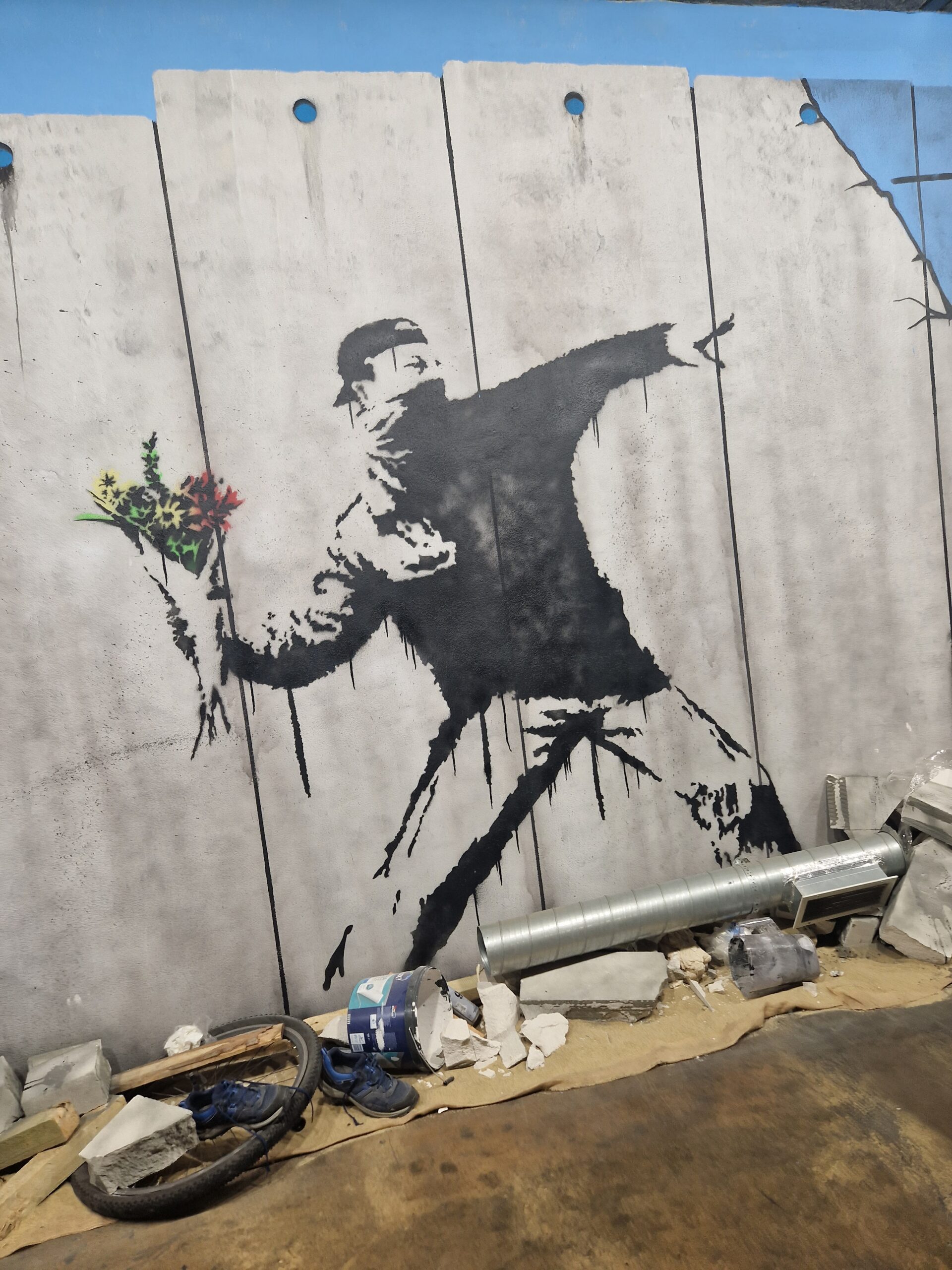
    Perhaps the clearest example is the image commonly known as Rage, the Flower Thrower.

    A masked man stands with his body twisted as if he is preparing to throw something. His clothing and posture suggest confrontation. You expect a stone, perhaps a weapon.

    Instead, he holds a bouquet of flowers.

    The contradiction is immediate.

    The body says violence.

    The flowers say peace.

    It is one of those images that requires almost no explanation, yet the longer you look at it, the more questions appear.

    Can anger be transformed?

    Can protest remain peaceful?

    Can resistance be beautiful?

    And perhaps most importantly, what would happen if the instinct to destroy were replaced by the instinct to care?

    That is where Banksy’s work becomes unexpectedly tender.

    He is not simply making fun of the world.

    He is imagining a different one.

    A Child in a World Built by Adults

    Children appear repeatedly in Banksy’s visual universe, often placed in situations where the innocence of childhood collides with the failures of adults.

    The contrast is powerful.

    A child does not understand borders in the same way an adult does. A child does not invent wars, build prison walls or write political speeches. Yet children are often among the first to suffer when adults make those decisions.

    Banksy uses that vulnerability deliberately.

    The children in his work can represent innocence, but they can also act as witnesses.

    They look at us.

    And sometimes it feels as though they are asking why the adult world has become so complicated.

    The simplicity of the images makes the question harder to avoid.

    The Girl and the Soldier

    Among the works presented by the museum is The Girl and the Soldier, associated with Bethlehem and dated to 2008.

    Bethlehem is not an incidental setting for Banksy.

    The city and the wider Palestinian territories have been central to some of his most politically charged work, particularly his interventions around the separation wall.

    Walls are a recurring subject in Banksy’s art because they are both physical and symbolic.

    They divide.

    They protect.

    They imprison.

    They separate people who might otherwise meet.

    And yet Banksy repeatedly turns walls into places where people can communicate.

    A concrete barrier becomes a canvas.

    A political boundary becomes a place for imagination.

    That transformation lies at the heart of his appeal.

    Love in a Place of Conflict

    It is tempting to describe Banksy purely as an artist of protest.

    But that misses something.

    His work is often angry, certainly. It can be cynical, funny, brutal and deliberately provocative. Yet underneath the politics there is a recurring concern with people.

    People who are displaced.

    People who are poor.

    People who are ignored.

    People caught in wars.

    People who live behind borders.

    People who simply want to be left alone.

    That is why love can become a political idea in Banksy’s work.

    To care about someone you have been encouraged to see as an enemy is itself a form of resistance.

    To place flowers in the hands of a protester is to imagine a different response to violence.

    To put a child at the centre of a political image is to remind us of the human cost hidden behind abstract words.

    The message is not always optimistic.

    But hope is there.

    Usually hiding in plain sight.

    And Then There Are the Rats

    No Banksy experience would feel complete without the rats.

    They scurry through his work with the confidence of creatures that know they will always survive the city.

    They are unwanted.

    They are persistent.

    They are everywhere.

    And perhaps that is why Banksy has used them so effectively.

    The rat can represent the outsider, the rebel, the anonymous citizen or simply anyone who exists beyond the respectable surface of society.

    There is humour in it, but there is also something uncomfortable.

    Cities are designed to make some people visible and others invisible.

    Banksy’s rats belong to the invisible side.

    They live behind walls, under streets and in places people prefer not to think about.

    Then suddenly one appears in enormous black paint on a city wall, and everyone notices.

    A Journey Across Cities

    One of the pleasures of the Kraków exhibition is the sense that you are moving through a fragmented map of Banksy’s career.

    London.

    Bristol.

    Paris.

    New York.

    Venice.

    Naples.

    Bethlehem.

    Ukraine.

    The exhibition brings works associated with these different places together, allowing visitors to see how Banksy’s ideas have travelled across borders while remaining surprisingly recognisable.

    His style is immediately identifiable.

    A few lines.

    A small number of colours.

    A familiar figure.

    A visual joke.

    Yet the meaning changes depending on where the image appears.

    Street art is never completely separate from its surroundings.

    A stencil on a wall in London is part of London.

    A piece created in a place marked by conflict carries another emotional weight.

    A work appearing in a wealthy European city may make a completely different point from the same image in a refugee camp or war-torn neighbourhood.

    The exhibition cannot reproduce those original streets.

    But it can make you think about them.

    Why the Old Factory Matters

    The building itself adds another layer.

    The former factory dates to 1886, a period when Kraków was undergoing its own industrial transformation. Today, the raw brick and industrial interiors contrast beautifully with the polished Renaissance architecture elsewhere in the city.

    That contrast is part of the attraction.

    Kraków is usually presented through its most beautiful face: Wawel Castle, the Main Market Square, Gothic towers and elegant historic streets.

    But the city has another personality.

    There are courtyards, workshops, old factories and fragments of industrial architecture hidden among the more famous sights.

    The Banksy exhibition belongs to that side of Kraków.

    It is rough around the edges.

    It is contemporary.

    And it refuses to behave like a traditional museum.

    An Exhibition for People Who Don’t Normally Visit Art Museums

    You do not have to know much about contemporary art to enjoy this exhibition.

    That may be one of its greatest strengths.

    Banksy’s images are deliberately democratic.

    You do not need an art-history degree to understand why a flower is more hopeful than a weapon.

    You do not need to know the entire political history of a country to understand that a wall can separate people.

    You do not need to know who Banksy is to recognise the humour of a rat wearing a mask.

    The exhibition works at the level of instinct.

    You see.

    You react.

    Then you think.

    For families, teenagers and travellers who normally skip galleries, that can make it an especially accessible cultural stop.

    Kazimierz Outside the Museum

    And then there is the neighbourhood.

    Once you leave the exhibition, you are immediately back in Kazimierz, one of Kraków’s most atmospheric districts.

    The contrast is worth embracing.

    Spend an hour surrounded by Banksy’s political images, then step outside and wander through the streets.

    Look at the old synagogues.

    Stop for coffee.

    Find a small restaurant.

    Explore a courtyard.

    Walk towards the Vistula.

    The exhibition works particularly well as part of a wider afternoon in Kazimierz because the neighbourhood itself is full of layers — Jewish heritage, post-war history, contemporary culture, nightlife and a constantly changing creative scene.

    You do not have to rush away after the last room.

    In fact, you probably shouldn’t.

    What Makes the Exhibition Memorable

    It is not the number of artworks.

    It is not even the famous name on the door.

    It is the feeling that the exhibition keeps changing the emotional temperature.

    You laugh.

    Then you become uncomfortable.

    You admire the visual simplicity.

    Then you realise what the image is saying.

    You photograph something.

    Then you stop taking photographs and simply look.

    That shift is important.

    Good travel experiences often work in the same way.

    They begin as something you want to see.

    Then they become something you want to understand.

    Leave Room for the Message

    There are plenty of places in Kraków where you can spend an afternoon admiring beautiful things.

    The Banksy exhibition asks for something different.

    It asks you to look at the world you live in.

    To think about who gets heard and who disappears.

    To question violence.

    To notice inequality.

    To laugh at absurdity.

    And, perhaps most importantly, to remember that compassion is not weakness.

    The flowers matter.

    The children matter.

    The walls matter.

    The people on the other side of them matter.

    The Last Image You Carry With You

    Eventually, you step back into the daylight.

    Kazimierz is still there.

    People are eating lunch.

    Someone is riding past on a bicycle.

    A couple is talking outside a café.

    The city carries on.

    But after an hour inside Banksy’s world, the streets can look slightly different.

    A wall is no longer just a wall.

    A flower can be a protest.

    A child can be a political statement.

    A joke can be an act of resistance.

    And art can be a way of saying something difficult without shouting.

    The Kraków exhibition may not give you the experience of discovering an original Banksy mural unexpectedly on a London street. Nor does it claim to. It is an immersive presentation built from reproductions, films and street-art-inspired installations inside an old industrial building.

    But perhaps that is enough.

    Because Banksy’s most enduring ideas do not belong to one wall.

    They belong to everyone who sees them.

    And among all the anger, irony and political commentary, there is a quieter message waiting underneath.

    That people matter.

    That kindness can be radical.

    That beauty can survive in ugly places.

    And that sometimes the most powerful thing you can put into the hands of someone ready to throw a stone is not another weapon at all.

    It is a flower.

  • Add Tyniec Abbey to Your Kraków Trip List

    If you are planning a trip to Kraków, there is one place worth adding to your itinerary before you leave the city behind: Tyniec Abbey.

    Perched dramatically above the Vistula River, around 12 kilometres southwest of Kraków’s historic centre, the Benedictine abbey feels wonderfully removed from the bustle of the Old Town. You can reach it relatively easily, but once you arrive, the pace changes. The river moves slowly below the limestone cliffs, the monastery rises above the landscape, and the noise of Kraków feels very far away.

    It is the kind of place that makes you wonder why more visitors don’t put it higher on their Kraków lists.

    A monastery above the Vistula

    Tyniec is one of Poland’s oldest Benedictine monasteries. Its origins reach back to the 11th century, when the Benedictines established a monastery on the hill overlooking the Vistula. Over the centuries, the complex was repeatedly rebuilt, damaged and restored, leaving behind the remarkable mixture of Romanesque, Gothic, Baroque and later architectural elements visible today.

    The setting is extraordinary.

    From the monastery grounds, the Vistula curves through the landscape below, while wooded hills stretch toward the horizon. On a clear day, the view is as much a reason to come as the abbey itself.

    This is not a monument you simply photograph and leave.

    It is a place to slow down.

    A different side of Kraków

    Most visitors experience Kraków through its historic centre.

    They walk around the Main Market Square, enter St Mary’s Basilica, explore Wawel Castle and wander through Kazimierz. These are essential experiences, but they also mean spending much of your trip among crowds.

    Tyniec offers something different.

    Here, history is surrounded by nature.

    The abbey stands above the river in a landscape of forests, fields and limestone outcrops, making the journey feel like a small escape from the city rather than another stop on a sightseeing circuit.

    That is precisely why it deserves a place on your list.

    Follow the river

    One of the most enjoyable ways to experience Tyniec is by approaching it along the Vistula.

    Cyclists regularly make the journey from Kraków, following paths beside the river before climbing toward the monastery. In warmer months, boats also connect the city with Tyniec, turning a simple day trip into something closer to a slow journey through the countryside.

    There is something particularly satisfying about arriving at the abbey this way.

    The city gradually disappears behind you.

    The river becomes the main feature of the landscape.

    Then, ahead, the monastery appears above the trees.

    For a traveller looking for a memorable half-day away from Kraków, it is hard to imagine a more atmospheric arrival.

    Inside the abbey

    The heart of the complex is the church of Saints Peter and Paul and the monastery buildings surrounding it.

    The interior reflects centuries of change, with the Baroque character of the church contrasting with the much older foundations and medieval history beneath it.

    But perhaps the most interesting thing about Tyniec is that it is not merely a historic shell.

    The Benedictine community continues to live and work here.

    That gives the site a different atmosphere from many European monasteries that survive purely as museums. Bells still mark the rhythm of the day, religious services continue and the monastery remains a place of spiritual life.

    You are visiting history that is still being lived.

    Don’t rush the visit

    Tyniec is best experienced without a checklist.

    Walk around the monastery.

    Visit the church.

    Look across the Vistula.

    Explore the surrounding paths.

    If time allows, stop for something to eat or drink and simply enjoy the view.

    The point is not to see everything in an hour.

    The point is to notice how different Kraków feels from here.

    The abbey’s position makes it particularly beautiful in the late afternoon, when the light falls across the river and the surrounding hills begin to soften.

    Bring a camera, but don’t spend the entire visit looking through it.

    Some places are better remembered from the edge of a terrace, looking across the river.

    Why put Tyniec on your Kraków list?

    Because Kraków is more than its Old Town.

    The city is surrounded by a landscape of rivers, forests, limestone valleys and historic villages, and Tyniec is one of the easiest places to discover that wider world.

    It is close enough to Kraków for a half-day trip but far enough away to feel like an escape.

    It offers architecture without the crowds, history without the museum atmosphere and spectacular scenery without requiring a long journey.

    Most importantly, it gives you a different perspective on the region.

    From the centre of Kraków, the Vistula can feel like part of the city.

    At Tyniec, you realise just how much landscape lies beyond it.

    And that may be the best reason to add Tyniec Abbey to your Kraków itinerary.

    Come for the monastery. Stay for the river. Leave with the feeling that you’ve discovered a side of Kraków that many visitors never see.

  • Zakrzówek Park in Kraków Is a Sunny Summer Escape for Locals and Tourists

    Once an industrial quarry, Zakrzówek has become one of Kraków’s most striking places to spend a summer day—where turquoise water, limestone cliffs and green walking trails create an unexpected landscape just minutes from the city center.

    There are few places in Kraków that look quite like Zakrzówek.

    On a sunny summer afternoon, the water can appear an almost impossible shade of blue. Limestone cliffs rise above the reservoir, while people walk along the surrounding paths, sit in the grass, take photographs or head toward the water.

    It is easy to forget that this dramatic landscape is only a short distance from the historic heart of the city.

    Zakrzówek is a former limestone quarry that has been transformed into a large recreational area. Today, it is one of Kraków’s most popular places for outdoor activities and summer relaxation.

    For locals, it is a familiar escape.

    For visitors, it can feel like discovering a secret corner of the city.

    From quarry to urban oasis

    Zakrzówek’s unusual appearance is a result of its industrial past.

    Limestone was extracted here for decades, leaving behind deep quarry workings. After the quarry ceased operating, groundwater gradually filled the excavated areas, creating the distinctive blue pools that became one of the area’s defining features.

    Nature began to reclaim the industrial landscape.

    Today, the former quarry is surrounded by greenery and walking routes, creating an unusual combination of wild-looking scenery and urban accessibility.

    The contrast is part of the attraction.

    You can spend the morning exploring Kraków’s Old Town and, later the same day, find yourself standing above a turquoise body of water surrounded by cliffs.

    A summer place to swim

    During the warmer months, swimming is one of Zakrzówek’s biggest attractions.

    The park has a designated bathing area with floating platforms and recreational facilities. The swimming area is supervised during the official bathing season, making it a popular destination on hot summer days.

    But visitors should pay attention to the rules.

    The old quarry landscape includes steep cliffs and deep water, and swimming is not permitted everywhere. The safest experience is to use the designated bathing zone and follow current instructions from the park and lifeguards.

    That is particularly important because photographs of Zakrzówek can make the water look like a tropical lagoon.

    It is beautiful—but it is still a former quarry.

    More than a swimming spot

    Even if you don’t want to get into the water, Zakrzówek is worth visiting.

    Walking paths run through the surrounding green space, with viewpoints overlooking the quarry and its dramatic cliffs. The area is also popular with runners, cyclists and people simply looking for somewhere to sit outdoors.

    For photographers, the combination of blue water, pale limestone and green vegetation is particularly appealing.

    The landscape changes throughout the day.

    In the morning, the light can be soft and atmospheric. Around midday, the water becomes intensely blue. Toward evening, the cliffs and surrounding vegetation take on warmer tones.

    You don’t need a complicated itinerary.

    A walk, a viewpoint and somewhere to sit in the sun can be enough.

    A different side of Kraków

    Zakrzówek also reveals something interesting about Kraków itself.

    The city is often presented through its historic architecture: Wawel Castle, St. Mary’s Basilica, the Main Market Square and the streets of Kazimierz.

    But Kraków is also a city with an increasingly strong outdoor culture.

    Parks, riverside paths, cycling routes and former industrial landscapes have become important places for residents to spend time outside.

    Zakrzówek fits perfectly into that picture.

    It is not a traditional tourist monument.

    There is no royal history to study and no museum ticket to buy.

    Instead, the attraction is the landscape itself.

    The best time to go

    Summer is naturally the busiest season.

    On hot weekends, Zakrzówek can become extremely popular, with locals arriving early to secure a place near the water. If you prefer a quieter atmosphere, visiting on a weekday or earlier in the day is a better option.

    Late afternoon can also be beautiful, particularly if your priority is photography or a relaxed walk rather than swimming.

    And don’t assume that Zakrzówek disappears when summer ends.

    The surrounding landscape remains attractive throughout the year. Autumn brings color to the vegetation, while colder months create a much quieter atmosphere around the quarry.

    The water may no longer be the main attraction, but the dramatic landscape remains.

    A place to slow down

    Perhaps the greatest appeal of Zakrzówek is how little you have to do.

    There is no pressure to see everything.

    You can walk.

    Swim.

    Read a book.

    Have a picnic.

    Take photographs.

    Or simply sit above the water and watch Kraków’s summer unfold around you.

    For tourists, it can be a welcome break from sightseeing.

    After several hours of churches, museums and crowded historic streets, the open landscape feels refreshingly uncomplicated.

    For locals, it is something more familiar: a place to meet friends, exercise, cool down and enjoy one of the city’s longest summer days.

    Kraków’s blue oasis

    Zakrzówek is not the kind of place you might expect to find in the middle of a European city.

    That is exactly why it is memorable.

    The former quarry has become a landscape where industry and nature meet—where old limestone cliffs surround clear blue water and city residents come to enjoy the outdoors.

    On a warm summer afternoon, it is easy to understand the attraction.

    The city is close.

    But standing beside the water, with the sun reflecting off the reservoir and green hills rising around you, Kraków can suddenly feel very far away.

    Travel tip: Zakrzówek is a public recreational area, but swimming should only take place in the designated bathing area during the official season and according to current safety rules. Conditions, opening arrangements and access can change, so check Kraków’s official information before visiting. (krakow.pl)

    Best for: swimming, walking, photography, picnics, outdoor recreation and escaping the summer crowds of central Kraków.

  • Wojtek the Soldier Bear: The Incredible WWII Story Behind Kraków’s Statue

    In a quiet corner of Kraków’s Jordan Park stands a soldier unlike any other.

    He wears no uniform. He carries no rifle. He has no medals pinned to his chest. Instead, he stands on four enormous paws, his head raised and his front legs lifted as though he has just been caught in the middle of a greeting.

    He is a bear.

    His name was Wojtek.

    And his story is one of the strangest, most unexpectedly moving chapters of the Second World War.

    The bronze statue in Kraków commemorates a Syrian brown bear who travelled thousands of kilometres with Polish soldiers, became part of their military unit and eventually found himself associated with one of the most important battles of the Italian campaign. The monument, created by Kraków sculptor Wojciech Batko, was unveiled in Jordan Park on 18 May 2014, the 70th anniversary of the Polish capture of Monte Cassino. It stands 2.3 metres high, among the park’s avenues of monuments and greenery.

    For most visitors, it takes only a moment to realise that the statue is unusual.

    The story behind it takes considerably longer.

    A Bear Arrives in the Middle of a War

    Wojtek’s story began far from Kraków.

    In the spring of 1942, Polish soldiers serving with the army being formed under General Władysław Anders were travelling through Iran after leaving the Soviet Union. Among the civilians and soldiers moving through the region was a tiny orphaned brown bear cub.

    The details of his first encounter with the Polish troops have been told in several versions over the years, but the essential story remains remarkably consistent: Polish soldiers acquired the young bear near Hamadan and brought him into their camp. The frightened little animal, separated from his mother, suddenly found himself surrounded by men in military uniforms who had little experience raising bears but plenty of affection to give him.

    He was named Wojtek, a diminutive form of Wojciech.

    The name has often been interpreted as meaning something close to a “joyful warrior”, an almost perfect name for an animal who would eventually become one of the most famous mascots in the history of the Polish armed forces. The Museum of General Anders at the University of the National Education Commission in Kraków records that Wojtek eventually became part of the 22nd Artillery Supply Company of the 2nd Polish Corps.

    At first, he was simply a cub.

    Then he became a companion.

    And eventually, he became one of the men.

    The Soldier’s Camp Became His Home

    Imagine a wartime military camp with a bear wandering through it.

    For the soldiers of the 22nd Artillery Supply Company, Wojtek gradually became part of everyday life. He grew from a small cub into an enormous animal, and the men around him became his family.

    He played with them.

    He followed them.

    He learned by watching them.

    The relationship was unusual, but it was also deeply human. The Polish soldiers had endured imprisonment, displacement and the trauma of war. Many had lost homes, families and friends. In the middle of that brutal existence, Wojtek offered something completely uncomplicated: companionship.

    He did not understand politics.

    He did not understand borders.

    He did not understand why the men were fighting.

    He simply knew the people who cared for him.

    And they cared for him in return.

    That relationship would follow them across the Middle East and eventually into Europe.

    From Iran to the Italian Front

    Wojtek travelled with the Polish forces along a remarkable wartime route.

    From Iran, the unit moved through Iraq and the Middle East before eventually reaching Italy. Kraków’s official city history notes that Wojtek travelled with the soldiers through Iran, Iraq, Syria, Palestine and Egypt before arriving on the Italian front. After the war, his journey would continue to Britain.

    It is difficult to imagine the logistics involved.

    A growing bear was not exactly standard military equipment.

    Yet Wojtek was no longer regarded simply as an animal the soldiers happened to keep.

    He was part of the company.

    And when the Polish troops prepared to move towards Italy, the problem became more complicated.

    The British military had rules concerning animals aboard military transports.

    Wojtek’s companions found a remarkably practical solution.

    He would become a soldier.

    Wojtek Becomes a Soldier

    The idea sounds almost absurd.

    A bear was officially enlisted.

    Wojtek received a military identity and became associated formally with the 22nd Artillery Supply Company. The arrangement allowed him to travel with the unit rather than being separated from the soldiers who had raised him.

    And so Wojtek went to war.

    Not as a symbolic mascot in the modern sense, but as an animal living alongside soldiers during an extraordinary period of military history.

    By then he was enormous.

    And he had developed habits that made him even more beloved.

    He copied the men around him.

    He played.

    He wrestled.

    He learned to respond to gestures.

    He became famous for his extraordinary strength and his curiosity about the strange routines of army life.

    The bear who had once been a helpless cub in Iran was now travelling with a Polish military unit towards one of the most difficult campaigns of the war.

    Then Came Monte Cassino

    Few names in Polish military history carry the emotional weight of Monte Cassino.

    The battle for the monastery and surrounding heights in Italy in 1944 was one of the fiercest campaigns of the Italian front. Polish soldiers of the 2nd Corps played a crucial role in the final assault, and the capture of the ruins of Monte Cassino became one of the defining moments in the history of Anders’ army.

    It was here that Wojtek’s legend became inseparable from the Polish military story.

    According to the long-established account, Wojtek helped soldiers move heavy ammunition crates during the battle, carrying boxes of artillery shells alongside the men.

    The image is extraordinary.

    A huge brown bear moving through a military supply area while artillery thundered around him.

    A creature that had begun life as an orphaned cub was now helping the men who had become his family.

    Kraków’s official city account records the story of Wojtek carrying artillery ammunition during the Monte Cassino fighting, and notes that the bear carrying a shell subsequently became the symbol of the 22nd Company, appearing on military vehicles, pennants and uniforms.

    There is, however, an important nuance.

    The ammunition-carrying story has become legendary, and historians have discussed the extent to which later retellings may have embellished particular details. It is safer to say that Wojtek was an extraordinary and much-loved member of the unit who was associated with carrying supplies, rather than treating every dramatic version of the Monte Cassino story as independently proven.

    But perhaps the more important truth is simpler.

    The soldiers believed he was one of them.

    And that mattered.

    The Bear Became a Military Emblem

    After Monte Cassino, the connection between Wojtek and the unit became permanent in another way.

    The 22nd Artillery Supply Company adopted an emblem showing a bear carrying an artillery shell.

    It appeared on vehicles and uniforms and became an unmistakable symbol of the company.

    It is difficult to think of a more unusual military insignia.

    Most armies use eagles, lions, swords or other traditional symbols of strength.

    The Polish soldiers had a bear.

    And not an imaginary bear.

    Their bear.

    The animal who had travelled with them across continents.

    The animal who had grown up among them.

    The animal whose presence had become part of their shared identity.

    For soldiers living through the devastation of war, that kind of symbolism could mean more than an emblem on a uniform.

    It represented home.

    Friendship.

    Memory.

    A piece of ordinary life surviving in an extraordinary time.

    After the War, Wojtek Had Nowhere to Go

    The end of the war did not mean that Wojtek could simply return to Poland with his soldiers.

    The political situation had changed.

    Poland was now behind the Iron Curtain, and many soldiers of Anders’ army faced an uncertain future. They had fought for a free Poland, but returning home was not necessarily safe or straightforward.

    Wojtek, meanwhile, was a large Syrian brown bear.

    Eventually, he was taken to Britain.

    The soldiers who had travelled with him were being demobilised, and the unusual military family that had formed during the war was breaking apart.

    Wojtek was eventually transferred to Edinburgh Zoo.

    It must have been an extraordinary change.

    For years, he had lived among Polish soldiers.

    Suddenly he was surrounded by visitors.

    People came to see the famous bear who had supposedly served in the Polish Army.

    Some former soldiers visited him.

    They would call his name.

    And, according to accounts preserved about his life, he recognised the sound of Polish voices.

    A Bear Remembered His Soldiers

    This may be the most poignant part of the story.

    Wojtek had spent his formative years surrounded by Polish soldiers.

    They were his world.

    After the war, that world disappeared.

    The camps were gone.

    The military vehicles were gone.

    The uniforms were gone.

    The men who had fed him, played with him and travelled with him were scattered across Britain and elsewhere.

    Yet the memory of Wojtek remained with them.

    And their memory remained with him.

    Wojtek lived at Edinburgh Zoo until his death in December 1963.

    By then, his story had already travelled far beyond the Polish military unit that had adopted him.

    The soldier bear had become a symbol.

    Why Kraków Chose to Remember Him

    Kraków is a city full of monuments.

    Kings.

    Poets.

    Generals.

    Scientists.

    Writers.

    Political figures.

    Walk through Jordan Park and you will find an entire gallery of Polish historical figures commemorated in sculpture.

    And among them stands Wojtek.

    That is what makes the monument so charming.

    The bear looks almost as though he has wandered into a gathering of distinguished Polish historical figures by mistake.

    But he belongs there.

    His story is not only about an animal.

    It is about the soldiers who carried him through a war.

    It is about exile.

    It is about friendship.

    And it is about the strange ways in which people preserve pieces of home when everything familiar has been taken away.

    The statue was unveiled in 2014, with the date deliberately connected to the anniversary of the Battle of Monte Cassino. The monument was funded through the Henryk Jordan Park Association, with money collected from Kraków residents.

    That detail feels particularly fitting.

    Wojtek belonged to the soldiers.

    But his memory now belongs to Kraków.

    A Bear With His Commander

    Look closely at the Kraków statue and you will notice something easy to miss.

    Wojtek is positioned so that one of his paws points towards the bust of General Władysław Anders, commander of the 2nd Polish Corps.

    It is a small detail, but a beautiful one.

    Anders was the man under whose command Wojtek travelled from the Middle East to Italy.

    The bear and the general are now permanently connected in the park.

    One was a celebrated Polish commander.

    The other was a Syrian brown bear who became a corporal in his army.

    History rarely produces pairings quite like this.

    Why Wojtek’s Story Still Feels So Modern

    More than eight decades after the events that made him famous, Wojtek continues to attract attention.

    Part of the reason is obvious.

    The story sounds almost impossible.

    A bear in the Polish Army?

    A bear travelling through a world war?

    A bear carrying ammunition at Monte Cassino?

    It sounds like something invented for a children’s book.

    But Wojtek really did exist.

    There are photographs.

    There are soldiers’ memories.

    There are military records and surviving accounts.

    There are monuments in Poland and Britain.

    And there is the bronze bear in Kraków, standing among the trees of Jordan Park as a physical reminder that the twentieth century was sometimes stranger than fiction.

    More Than a Cute Story

    It would be easy to tell Wojtek’s story as a charming tale about a friendly bear.

    But doing so would miss the darker history surrounding him.

    The men who adopted Wojtek were themselves products of a devastating wartime journey.

    Many had experienced Soviet imprisonment or deportation before joining Anders’ army. They had left the Soviet Union, travelled through Iran and the Middle East and eventually fought in Italy. The bear became part of their lives during a period of enormous uncertainty.

    Wojtek therefore represents something more profound than an amusing military anecdote.

    He represents companionship in exile.

    The soldiers had lost their normal lives.

    So they created a new kind of family.

    And somehow, at the centre of that family was a bear.

    The Meaning Behind the Statue

    Stand beside the monument today and the contrast with Wojtek’s wartime life is almost surreal.

    There are no explosions.

    No artillery.

    No military convoys.

    Instead, there are trees, paths, families and children.

    The bronze bear stands peacefully in the middle of the park.

    Children can walk around him.

    Visitors photograph him.

    Locals pass by.

    The monument has become part of everyday Kraków.

    And perhaps that is exactly how it should be.

    A creature who spent his early life surrounded by war has been given a final home surrounded by peace.

    Finding Wojtek in Kraków

    The statue stands in Henryk Jordan Park, in Kraków’s Krowodrza district. It is positioned at the junction of paths, close to the park’s collection of monuments dedicated to important Polish figures.

    The park itself makes the visit particularly pleasant.

    You do not need to plan an entire afternoon around the statue.

    Instead, treat Wojtek as part of a slower walk through one of Kraków’s green spaces.

    Come for the bear.

    Stay for the park.

    Look at the other monuments.

    Sit beneath the trees.

    And take a moment to imagine the journey that brought that bronze figure here.

    Iran.

    Iraq.

    Palestine.

    Egypt.

    Italy.

    Britain.

    Then Kraków.

    It is an extraordinary itinerary for any soldier.

    For a bear, it is almost unbelievable.

    A Story That Crossed Borders

    There is another reason Wojtek’s story has endured.

    It does not belong to one country alone.

    He began life in the Middle East.

    He travelled with Polish soldiers.

    He fought — or, at the very least, lived alongside them — in Italy.

    He spent his final years in Scotland.

    Today, statues and memorials dedicated to him can be found in several places connected with his story, including Kraków and Edinburgh. Kraków’s own city information has highlighted the connection between the Polish soldiers, Wojtek and Scotland, where he spent his post-war years.

    His story therefore became a strange thread connecting countries that had been brought together by the Second World War.

    And perhaps that is why people continue to find it so moving.

    Wojtek belonged everywhere and nowhere.

    He was Polish by adoption.

    Scottish by final residence.

    Middle Eastern by birth.

    And remembered today wherever people encounter his story.

    The Lasting Image of Wojtek

    There is one image that has survived above all others.

    A bear standing upright, carrying an artillery shell.

    It became the emblem of the 22nd Company.

    It appears in photographs.

    It appears on memorials.

    And now it is transformed into bronze in Kraków.

    But perhaps the more important image is not the soldier bear at all.

    It is the little orphaned cub who found a family.

    The soldiers who had endured captivity and exile gave him food, shelter and affection.

    In return, he gave them something that war could not easily destroy.

    A reason to laugh.

    A companion to care for.

    A piece of normality.

    And a creature who did not care where anyone came from.

    Why You Should Look for Wojtek

    If you are exploring Kraków, Wojtek is easy to overlook.

    He does not stand in the Old Town.

    He is not surrounded by souvenir shops.

    His statue is not one of the city’s grandest monuments.

    There is no enormous queue waiting to photograph him.

    But that is precisely why he is worth seeking out.

    Some of the best stories in Poland are hidden in places that do not announce themselves.

    Wojtek’s monument is one of them.

    It takes only a few minutes to see.

    But once you know the story, the bronze figure becomes difficult to forget.

    You see the bear.

    Then you picture the cub in Iran.

    You imagine the soldiers crossing the Middle East.

    You imagine the journey to Italy.

    You think of Monte Cassino.

    You think of the men who eventually had to leave him behind.

    And suddenly a statue in a Kraków park is no longer simply a statue.

    It is a monument to a friendship that survived a war.

    The Soldier Who Was Never Really a Soldier

    Wojtek was, of course, a bear.

    He did not understand military strategy.

    He did not choose to enlist.

    He did not understand the politics of the Second World War.

    But he became a soldier because the men around him could not imagine leaving him behind.

    And perhaps that is why his story has endured when so many other wartime stories have faded.

    It contains something universal.

    In the middle of history’s darkest years, people still formed friendships.

    They still cared for vulnerable creatures.

    They still laughed.

    They still found reasons to hope.

    And sometimes, those reasons came with four paws and a very large appetite.

    Today, Wojtek stands quietly in Kraków’s Jordan Park, frozen forever in bronze.

    He is looking towards the monument of the commander whose army carried him across continents.

    The war is long gone.

    The soldiers are gone.

    The camps are gone.

    But the bear remains.

    And perhaps that is the most fitting ending to his extraordinary journey.

    After travelling thousands of kilometres with an army, Wojtek finally found a place where he no longer needed to march.

    He could simply stand.

    And be remembered.

  • 10 Exhibitions Worth Seeing in Kraków

    Kraków is usually introduced through its medieval streets, royal castle and magnificent churches, but there is another city hiding behind that familiar postcard image. It is a city of painters, collectors, photographers, experimental artists and small exhibition spaces, where centuries of artistic tradition meet a younger, more restless contemporary scene. Walk far enough beyond the Main Market Square and the grand historic monuments begin to give way to former industrial buildings, converted warehouses, independent galleries and cultural institutions that tell a rather different story about Poland’s former capital.

    For centuries, Kraków has been one of the country’s most important centres of art. The city’s universities and academies have attracted generations of artists, while its museums hold some of Poland’s most important collections. But what makes Kraków particularly interesting today is the conversation between its past and present. You can spend an afternoon looking at masterpieces of Polish nineteenth-century painting and, before dinner, find yourself standing in front of an installation that challenges almost everything you thought you knew about art.

    The best galleries in Kraków do not all look alike, and they certainly do not offer the same experience. Some are grand institutions with international exhibitions and permanent collections. Others are intimate spaces where the distance between the artist and visitor feels remarkably small. Some concentrate on contemporary art, while others preserve the work of individual Polish artists or introduce visitors to traditions that have shaped the country’s visual culture.

    If you want to see Kraków beyond its famous sights, these ten galleries and art spaces are an excellent place to begin.

    MOCAK: Where Kraków Looks Towards the Future

    Muzeum Sztuki Współczesnej w Krakowie MOCAK is perhaps the most obvious starting point for anyone interested in contemporary art in Kraków.

    Located in the post-industrial area of Zabłocie, on Lipowa Street, MOCAK occupies a site that itself tells an important part of Kraków’s twentieth-century story. The museum opened in 2011 in the former Schindler factory complex, transforming an industrial landscape into one of the city’s most important cultural destinations.

    Inside, the atmosphere is very different from the historic museums around the Old Town. The emphasis is on contemporary artistic practice, with painting, sculpture, photography, video, installation and conceptual work appearing alongside exhibitions that explore social and political questions.

    The museum’s permanent collection includes works by Polish and international artists, while temporary exhibitions regularly introduce visitors to new artists and ideas. In 2026, the programme includes exhibitions such as Stan posiadania. Topografia Kolekcji MOCAK-u and Katarzyna Krakowiak-Bałka’s Ekologie współtworzenia, alongside permanent presentations from the museum collection.

    MOCAK is particularly worthwhile if you have already spent several days immersed in Kraków’s past. After castles, Gothic churches and medieval squares, contemporary art offers another way of understanding Poland — not as a country frozen in history, but as a place still questioning, experimenting and changing.

    Bunkier Sztuki: Contemporary Art in the Heart of the Old Town

    Galeria Sztuki Współczesnej Bunkier Sztuki occupies one of the most interesting positions of any contemporary art institution in Kraków. It sits on Plac Szczepański, only a short walk from the Main Market Square, meaning that visitors can move from the medieval heart of the city into the world of contemporary art in a matter of minutes.

    That contrast is part of the attraction.

    Outside, Kraków looks almost impossibly historic. Horse-drawn carriages cross the square, tourists photograph the churches and the architecture seems determined to remind you how old the city is. Inside Bunkier Sztuki, the conversation is about the present.

    The gallery has long played an important role in Kraków’s contemporary art scene, presenting exhibitions by Polish and international artists and creating a space for experimental approaches to art. It is the kind of place where you should not necessarily expect to understand everything immediately.

    Some works will attract you.

    Others may confuse you.

    A few may irritate you.

    That is part of contemporary art’s purpose.

    Bunkier Sztuki is worth visiting precisely because it interrupts the comfortable rhythm of traditional sightseeing. Instead of looking backwards, it asks what art can say about the world you are living in now.

    Galeria Starmach: One of Kraków’s Most Respected Private Galleries

    In Kraków’s Podgórze district, Galeria Starmach has developed a reputation far beyond the city itself. Founded by Teresa and Andrzej Starmach, the gallery became an important part of Poland’s contemporary art landscape and has represented and exhibited numerous significant Polish artists.

    Its setting adds to the experience. Rather than being housed in an anonymous modern shopping district, the gallery occupies a historic building in an area where Kraków’s industrial and residential past still feels visible.

    The gallery is particularly interesting for visitors who want to understand the development of modern and contemporary Polish art beyond the major museums. Its exhibitions have included artists from different generations and artistic movements, allowing visitors to see how Polish art changed during the twentieth century and into the present.

    There is also an important connection between the Starmach name and MOCAK. Works from the Starmach collection form part of the contemporary museum’s holdings, including the permanent presentation Wielcy współcześni. Dar Teresy i Andrzeja Starmachów.

    That connection makes a visit to both places particularly rewarding.

    One introduces you to the gallery’s history and artistic programme; the other shows how an important private collection has become part of Kraków’s public cultural landscape.

    Zofia Weiss Gallery: A Smaller, More Intimate Art Experience

    Zofia Weiss Gallery – Galeria Sztuki Współczesnej offers a different experience from Kraków’s major museums.

    Situated on Podwale, close to the Old Town, it is the kind of gallery that can easily be overlooked by visitors concentrating on the city’s major attractions. Yet this is exactly why smaller galleries are worth seeking out.

    There is something different about entering a relatively intimate exhibition space. The atmosphere is quieter. You are not surrounded by dozens of tour groups, and the artwork has more room to hold your attention.

    For travellers interested in contemporary Polish art, independent galleries such as this provide an opportunity to encounter artists outside the large institutional circuit.

    You may not spend two hours here.

    You may not need to.

    A good gallery does not have to occupy an entire afternoon. Sometimes twenty or thirty minutes with a handful of carefully chosen works can stay with you longer than an enormous museum collection.

    That is one of the pleasures of exploring Kraków’s smaller art spaces: you never quite know what you will discover.

    Sukiennice: The Gallery That Connects Kraków With Its Artistic Past

    MNK Sukiennice Galeria Malarstwa Polskiego is not a contemporary gallery, but no serious exploration of Kraków’s art scene would be complete without it.

    The gallery occupies the upper floor of the Cloth Hall in the centre of the Main Market Square, one of the most recognisable buildings in Poland. Downstairs, merchants and souvenir stalls continue the building’s centuries-old commercial tradition; upstairs, some of the country’s most important paintings reveal another side of Poland’s history.

    This is where Kraków’s artistic heritage becomes impossible to ignore.

    The collection focuses on Polish nineteenth-century painting and sculpture, a period when art became deeply connected with questions of national identity. Poland had disappeared from the political map of Europe for more than a century, divided between neighbouring empires, and artists often carried historical memory and national feeling into their work.

    Standing before these paintings, therefore, is not simply an exercise in appreciating technique.

    It is a way of seeing how art helped a nation remember itself.

    The gallery is especially valuable for visitors who want context before exploring Kraków’s contemporary art scene. Once you have seen the grand historical tradition, the experimentation of MOCAK and other contemporary spaces begins to look like part of a much longer artistic conversation.

    Czartoryski Museum: A Collection Built Around a Masterpiece

    Muzeum Książąt Czartoryskich is another essential stop for art lovers, particularly because of the extraordinary history of its collection.

    The museum’s greatest treasure is Leonardo da Vinci’s Lady with an Ermine, one of the most famous paintings in Poland. Yet the attraction goes well beyond a single masterpiece. The collection reflects centuries of collecting and includes European paintings, works of art and historical objects.

    The museum’s story is closely connected with the Czartoryski family, whose collecting ambitions helped preserve works of enormous cultural importance.

    For visitors, the experience is wonderfully different from walking through a modern gallery.

    There is a sense of layers.

    You are looking at artworks that survived wars, political upheaval and the changing fortunes of Poland. The objects have travelled through different hands and different periods of European history before arriving here.

    And then there is Leonardo.

    Even visitors who are not normally interested in Renaissance painting tend to stop when they reach the portrait. The young woman looks calmly towards the viewer, the small white animal held against her body, while centuries of history seem to gather around the painting.

    It is one of those moments when the reputation of a masterpiece becomes understandable.

    The Bishop Erazm Ciołek Palace: Medieval and Early Polish Art

    Muzeum Narodowe Pałac Biskupa Erazma Ciołka occupies a beautiful historic building on Kanonicza Street, one of the most atmospheric streets leading towards Wawel.

    This is a place for travellers who want to go further back into Poland’s artistic history.

    The collections focus on older Polish and European art, including medieval sculpture and painting. The atmosphere is considerably quieter than that of Kraków’s most famous museums, and the building itself deserves attention.

    Kanonicza is one of the streets where the city’s medieval and Renaissance character is particularly easy to imagine. Historic façades rise on either side, and Wawel is only a short walk away.

    That makes the museum easy to combine with a visit to the castle.

    But do not hurry through it.

    Medieval Polish art can look unfamiliar to visitors accustomed to Renaissance masterpieces or modern painting. The figures, colours and religious imagery belong to a different visual language, one shaped by faith and symbolism rather than the realism that would dominate later European painting.

    For anyone interested in understanding where Polish art began, this is an important stop.

    Manggha: Kraków’s Fascinating Window Into Japanese Art

    Muzeum Sztuki i Techniki Japońskiej Manggha is one of the most unusual cultural institutions in Kraków.

    Across the Vistula from Wawel, its modern building immediately stands apart from the historic architecture that dominates most of the city. Inside is a remarkable collection devoted to Japanese art and culture.

    The connection between Kraków and Japan is older than many visitors realise. Polish fascination with Japanese art grew particularly strongly in the late nineteenth and early twentieth centuries, when Japanese prints, crafts and aesthetics influenced European artists and collectors.

    Manggha tells part of that story while also presenting Japanese art on its own terms.

    The museum is a refreshing change of visual language.

    After days of Gothic churches, Polish portraits and European paintings, Japanese prints, ceramics, textiles and design can make the familiar city feel suddenly distant.

    The building’s location beside the Vistula adds another layer. From here, you can look back towards Wawel across the river, creating one of the most interesting cultural contrasts in Kraków: a Japanese cultural centre facing one of Poland’s great symbols of national history.

    Cricoteka: The Extraordinary World of Tadeusz Kantor

    Ośrodek Dokumentacji Sztuki Tadeusza Kantora Cricoteka w Krakowie is dedicated to Tadeusz Kantor, one of Poland’s most internationally recognised twentieth-century artists and theatre makers.

    Even before entering, Cricoteka is difficult to forget. The building in Podgórze combines an old industrial structure with a dramatic modern addition that seems to hover above it.

    Inside, the museum explores Kantor’s work, particularly his theatre, performances, objects and artistic ideas.

    Kantor’s world can be strange.

    Sometimes disturbing.

    Sometimes playful.

    Often deeply personal.

    He was fascinated by memory, death, objects and the boundary between theatre and visual art. His work does not necessarily offer the comfortable beauty associated with a conventional museum visit, but it offers something arguably more valuable: a glimpse into one of the most distinctive artistic minds Poland produced in the twentieth century.

    Cricoteka is particularly worth visiting if you are interested in theatre as well as visual art.

    It demonstrates that a gallery does not have to be a room filled with paintings.

    Art can occupy a stage.

    A costume.

    An object.

    A memory.

    A building.

    The Stained Glass Workshop and Museum: Where Art Is Still Being Made

    Pracownia i Muzeum Witrażu offers perhaps the most hands-on artistic experience on this list.

    Located on Aleja Zygmunta Krasińskiego, the workshop combines a historic stained-glass studio with a museum devoted to the craft.

    That distinction matters.

    You are not simply looking at finished works behind glass.

    You are seeing the place where the work is made.

    Stained glass has a particularly important place in Kraków’s artistic heritage, and the city is home to numerous churches and historic buildings containing remarkable examples of the craft. The workshop allows visitors to understand the painstaking process behind them.

    Glass must be selected.

    Pieces must be cut.

    Colours have to be considered.

    Lead lines become part of the composition.

    Light does the rest.

    The result can look effortless when sunlight passes through a finished window, but seeing the process makes you appreciate how much skill and patience sits behind that apparent simplicity.

    For visitors travelling with children, it can also be one of the more engaging art experiences because it feels like a working studio rather than a silent collection.

    And for adults, it is a reminder that some of Kraków’s artistic traditions are not simply being preserved in museums.

    They are still alive.

    Kraków’s Art Scene Is Bigger Than Its Museums

    The temptation when visiting Kraków is to remain within the familiar triangle of the Main Market Square, Wawel and Kazimierz.

    There is nothing wrong with that. These are some of Europe’s most beautiful historic spaces.

    But the city’s art scene becomes more interesting when you begin to move beyond them.

    Go to Zabłocie and you encounter contemporary art in former industrial surroundings. Cross the river into Podgórze and you find galleries, studios and institutions connected with artists who challenged conventional ideas about what art could be. Return to the Old Town and you can move from medieval sculpture to nineteenth-century Polish painting within a few streets.

    This is what makes Kraków rewarding for art lovers.

    Its artistic identity is not confined to one museum or one period.

    It is spread across the city.

    The old and the new exist side by side, sometimes comfortably and sometimes in deliberate opposition. A medieval Madonna can be followed by a conceptual installation. A Japanese woodblock print can be viewed across the river from Wawel Castle. A contemporary gallery can occupy a neighbourhood shaped by industrial history.

    You do not have to understand every work.

    You do not even have to like everything you see.

    The pleasure is in looking.

    And Kraków gives you plenty to look at.