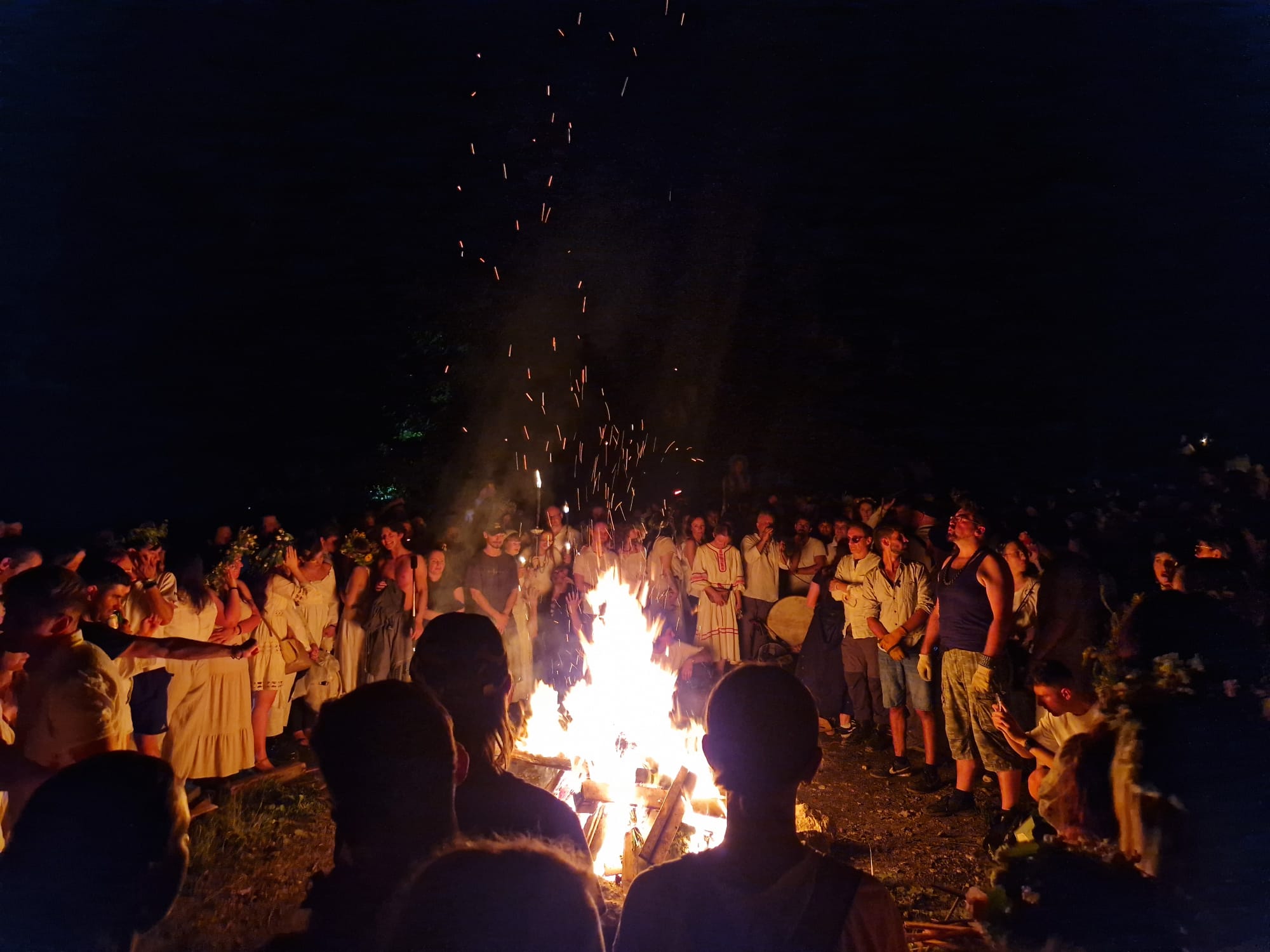
Every year, locals in Kraków gather at the Zakrzówek cliffs to celebrate Noc Kupały (Kupala Night), the ancient Slavic festival of the summer solstice.
This celebration is a chance to revive ancient pagan traditions, with people jumping and dancing around bonfires and throwing flower wreaths into the water (Wianki). These rituals continue throughout the whole night making a Slavic atmosphere you won’t find anywhere else.
This year, I had the chance to celebrate it for the first time at Zakrzówek Park with hundreds of other people, and it completely blew my mind.
On a warm June evening, as the last light fades over the Vistula, Kraków can feel as though it has stepped briefly outside the modern calendar. Along the riverbanks, people gather beneath the summer sky, flowers are woven into wreaths, candles and small fires begin to glow, music fills the air and the ancient rhythms of midsummer return in a modern form. This is the atmosphere of Noc Kupały, one of the most intriguing celebrations connected with the old Slavic traditions of summer.
For visitors arriving in Kraków, the celebration offers something different from the city’s usual attractions. There is no royal procession through Wawel and no grand medieval ceremony in the Main Market Square. Instead, the focus moves towards nature, fire, water, music and community. The celebration is rooted in traditions that predate Christianity in this part of Europe, yet today they exist alongside contemporary Polish culture, festivals and urban life.
Noc Kupały is often described as the Slavic midsummer celebration, and its timing is connected with the summer solstice, when the days are at their longest and the nights are at their shortest. Across Central and Eastern Europe, midsummer traditions developed in different forms, carrying themes of fertility, love, purification, protection and the power of nature. In Poland, some of these customs survived for centuries by changing, adapting and blending with later Christian traditions.
That is part of what makes Noc Kupały so fascinating.
It is not simply a reconstruction of an ancient festival.
It is a tradition that has been remembered, reinvented and brought into the present.
What Is Noc Kupały?
Noc Kupały is traditionally associated with the shortest night of the year and the celebration of midsummer. The Polish name is generally connected with Kupała, a figure or ritual concept associated in later tradition with the festival, although the exact origins and historical development of the name are more complicated than modern descriptions sometimes suggest.
What is clearer is the importance of the natural world.
Fire and water occupy a central place in many midsummer customs. So do flowers, herbs, wreaths and the search for love.
For communities living in pre-modern agricultural societies, the summer solstice was not simply another date on the calendar. The changing seasons determined when crops were planted, when animals were moved, when harvests approached and when people prepared for the difficult months ahead.
The longest days of the year therefore carried enormous symbolic importance.
Nature was at its most powerful.
And people celebrated that power.
The Night of Fire and Water
Few images are more closely associated with Noc Kupały than fire.
Bonfires have traditionally been connected with purification, protection and the symbolic destruction of misfortune. People gathered around them, sang, danced and celebrated late into the night.
Water represented another important element.
Fire and water may seem like opposites, but together they created one of the central symbolic contrasts of midsummer traditions. Fire illuminated the darkness, while water represented cleansing, renewal and the natural world.
In modern Kraków, these ancient associations can take on a more festive character. The Vistula provides a natural setting for celebrations, giving the river a role that feels almost inevitable in a city where the waterway has shaped Kraków’s landscape for centuries.
As evening arrives, the river reflects the lights of the city.
The towers of Wawel rise above the water.
And the atmosphere becomes something between a summer festival and a journey into the past.
The Famous Flower Wreaths
One of the most beautiful traditions associated with Noc Kupały is the making of flower wreaths.
Young women traditionally prepared wreaths from flowers and herbs, sometimes decorating them with candles before placing them on the water.
The wreaths were not merely decorations.
They were part of a ritual connected with fortune, love and the future.
In some traditions, a young woman would place her wreath on the river and watch where it travelled. A wreath that floated freely could carry positive meaning, while the behaviour of the wreath was sometimes interpreted as a sign concerning marriage or romantic fortune.
Young men, meanwhile, might try to catch the wreaths.
The ritual became a playful way of imagining who might meet whom, who might fall in love and what the future might bring.
Today, the symbolism may be approached more playfully, but the image remains remarkably poetic.
A small circle of flowers floating down a dark river, illuminated by candlelight, is difficult to forget.
Why Flowers Matter
The wreath tradition also reflects the importance of plants in traditional Slavic culture.
Flowers and herbs were not only beautiful. People attributed protective, healing and symbolic qualities to many plants, and midsummer was an important moment for gathering and celebrating the natural world.
The use of herbs also connects Noc Kupały with wider European midsummer traditions.
The exact customs varied from one region to another, but the idea was remarkably consistent: at the height of summer, nature was celebrated as something powerful and alive.
For modern visitors, this aspect of the festival can be especially appealing.
It offers a reminder of a relationship with nature that was much more direct than the one most city dwellers experience today.
Before modern calendars, weather forecasts and supermarkets, the changing seasons were impossible to ignore.
People lived according to them.
Kraków Gives an Ancient Tradition a Modern Setting
Kraków is a particularly atmospheric place to experience a midsummer celebration because the city combines centuries of history with a large, youthful population.
The Vistula becomes a natural stage.
People gather along the river.
Music and cultural performances can bring the celebration to life.
Traditional symbols appear alongside contemporary entertainment.
And the result is not a museum reconstruction, but a living public event.
This is important.
Traditions survive when people use them.
They do not survive simply because historians write about them or museums preserve old objects behind glass.
A tradition remains alive when a new generation learns it, changes it and finds a reason to celebrate it.
That is exactly what happens with Noc Kupały.
Noc Kupały and the Summer Solstice
The summer solstice gives the celebration its natural rhythm.
Around this time of year, daylight dominates the landscape. In Kraków, the evening seems to last forever, with the sky remaining light long after dinner and the darkness arriving slowly.
This makes a midsummer festival particularly atmospheric.
People can gather outdoors for hours.
The riverbanks remain active late into the evening.
And the transition from daylight to darkness becomes part of the celebration itself.
The solstice is also a moment of transition.
The longest day has arrived.
From that point onwards, the days very gradually begin to shorten.
For ancient communities, this turning point would have been deeply significant.
Today, most of us barely notice it.
Noc Kupały gives people a reason to stop and notice.
Love Is at the Centre of the Celebration
If fire represents energy and water represents renewal, love is perhaps the most romantic element of Noc Kupały.
The festival has long been associated with young people, courtship and the search for partners. Traditional stories describe young women and men meeting during the celebrations, with the wreath ritual adding a playful element of fate and romance.
There is something wonderfully human about this part of the tradition.
Long before dating apps and social media, communities created their own ways for young people to meet.
A summer night beside a river.
Music.
Dancing.
Flowers.
Firelight.
A little superstition.
It is easy to understand why such a celebration could become associated with love.
Even today, couples walking along the Vistula during midsummer are participating in an atmosphere that has echoes of that much older tradition.
The Legend of the Fern Flower
One of the most famous stories connected with Polish midsummer traditions is the legend of the fern flower.
According to folklore, a magical flower was said to bloom only for a short time on the night of the summer solstice. Whoever managed to find it would gain extraordinary knowledge, happiness or wealth, depending on the version of the story.
The fern flower was almost impossible to find.
And that was the point.
The search represented the possibility of discovering something hidden and extraordinary.
It is a beautiful piece of folklore because it captures the imagination of the night itself. Midsummer was traditionally imagined as a time when the boundaries between the ordinary and extraordinary became thinner, when nature possessed unusual power and when things that were normally hidden might briefly reveal themselves.
There is no need to believe the legend literally to understand its appeal.
Every culture has stories about one magical night when anything might happen.
In Slavic folklore, the fern flower became one of them.
From Pagan Ritual to Modern Tradition
The history of Noc Kupały is not completely straightforward.
As Christianity spread through Poland, older seasonal customs did not simply disappear. Many traditions were transformed, renamed or incorporated into Christian celebrations.
The midsummer period became associated in Christian tradition with St John’s Eve, known in Polish as Noc Świętojańska.
This created an interesting overlap.
Older customs involving fire, water, herbs, flowers and midsummer celebrations continued in various forms, while Christian symbolism was introduced into the calendar.
As a result, the traditions that exist today cannot always be separated neatly into “pagan” and “Christian” categories.
Culture rarely works that way.
Customs change.
People reinterpret them.
Names evolve.
Old rituals acquire new meanings.
And sometimes traditions survive precisely because they are flexible enough to change.
What You Might See During a Modern Celebration
A contemporary Noc Kupały celebration in Kraków can vary depending on the organiser and year, but visitors may encounter many of the symbols associated with the tradition.
There may be concerts, folk performances, dancing and cultural workshops. Some events involve wreath-making, allowing visitors to participate rather than simply watch.
Traditional costumes may appear alongside modern clothing.
Folk music can be performed beside contemporary interpretations of Polish music.
And, of course, the Vistula provides the perfect setting for the evening.
The atmosphere is generally more relaxed than a formal historical reenactment.
You are not being asked to imagine that you have travelled back a thousand years.
Instead, you are seeing how an old cultural idea has been adapted for modern life.
That is arguably more interesting.
A Tradition for the Whole Family
Although the romantic side of Noc Kupały is often emphasised, midsummer celebrations can be enjoyed by families as well.
Children are naturally fascinated by the combination of flowers, candles, music, dancing and stories about magical plants.
A wreath-making workshop can become a memorable activity, particularly for younger visitors who might otherwise find historical attractions difficult to connect with.
This is one of the strengths of traditional festivals.
They allow history to become something you can touch and participate in.
You do not simply read that people once made flower wreaths.
You make one.
You do not just learn that fire was important.
You sit near it.
You hear the music.
You watch the river.
Suddenly, a historical tradition becomes an experience.
Where to Experience Noc Kupały in Kraków
The Vistula and its surrounding public spaces are among the most natural places to look for midsummer events in Kraków.
The exact programme and location can change from year to year, so visitors should check the current city’s cultural calendar and event announcements before planning their evening.
This is particularly important because Noc Kupały is not necessarily one single event with one permanent location.
Different cultural organisations and communities may organise their own celebrations.
The atmosphere can therefore vary considerably.
Some events are strongly focused on folk culture.
Others are more like summer concerts.
Some emphasise workshops and traditional crafts.
Others create a broader festival atmosphere.
If your goal is to experience the cultural traditions rather than simply attend a party, look for events that include folk performances, storytelling, wreath-making or explanations of the customs themselves.
Respect the Meaning Behind the Celebration
For visitors, Noc Kupały can be a beautiful and entertaining experience, but it is worth remembering that traditional celebrations are more than colourful photo opportunities.
The customs carry cultural meaning.
They are connected with Polish folklore, regional identity and the long history of Slavic traditions in Central Europe.
It is therefore better to approach the celebration with curiosity than to treat it as a novelty.
Ask questions.
Learn the stories.
Speak to people involved in organising the event.
Try making a wreath.
Listen to the music.
Understanding the tradition makes the experience much richer.
Why Noc Kupały Still Matters
In a modern city filled with smartphones, traffic, shopping centres and high-rise buildings, it might seem surprising that an ancient midsummer tradition can still attract attention.
But perhaps the reason is obvious.
People still need rituals.
We still celebrate the changing seasons.
We still gather around fire.
We still fall in love.
We still make wishes.
We still look at rivers and flowers and feel that summer should be remembered.
The modern world has changed almost everything about daily life, but these basic human experiences remain.
Noc Kupały gives them a cultural language.
It reminds people that the calendar is not only a sequence of appointments and deadlines.
There are moments worth stopping for.
The longest day of the year is one of them.
See Kraków in a Different Light
Kraków is famous for its royal history, medieval architecture and extraordinary museums, but some of the city’s most memorable experiences take place outside the traditional sightseeing circuit.
Noc Kupały is one of them.
For one summer night, the Vistula becomes part of an old story about fire, water, flowers, love and the mysterious power of nature. Modern Kraków continues to move around it, but the celebration creates a brief pause — a chance to reconnect with traditions that have travelled through centuries of Polish history.
You may arrive expecting a festival.
You may leave thinking about something much older.
As the evening darkens and the lights of Kraków begin to shimmer on the Vistula, a wreath drifts away on the water, music carries across the river and the last traces of daylight disappear from the sky.
For a moment, the distance between modern Kraków and the world of old Slavic folklore feels remarkably small.
And perhaps that is the real magic of Noc Kupały: not that it takes you back into the past, but that it shows how the past can still find a place in the present.